
Locating the Jubilees
According to Leviticus 25, the Sabbath and Jubilee year system of counting toward years of rest and restoration began upon entering the land after the exodus from Egypt and the wilderness wandering for forty years. Simply stated, Israel was to engage in cultivating the land for six years and allow it to rest in the seventh. After a cycle of seven of these Sabbath years they were instructed to keep a Jubilee on the fiftieth year, after the forty-ninth. This fiftieth year included an extension of rest for the land and expanded human liberties and restoration of land rights as originally allocated to the tribes.
Though it is not within the scope of this article to establish the precedent for the month which began these cycles, we believe it was Tishri. The Jewish system embraced two calendar beginnings. We believe Nisan in the Spring pertained to Priests, Levites and the religious festivals. Tishri in the fall pertained to civil and land issues. Even though Israel crossed Jordan in the Spring, this marked the year 1575 BC as a banner year upon which Israel entered the promised land. We understand this year 1575 was the first of the Sabbath cycle of seven. It would have counted from the previous Fall to the next Fall as with all subsequent Sabbath cycles and Jubilee years. It is likely that the events of Deut. 2:5, 24-25 took place in the Fall prior to crossing Jordan. However, this understanding is not essential to our subject, except to identify the correct year that began the Sabbath/Jubilee system.
Precious little is written about any attempts to keep the Jubilee year rights. In fact it is likely that it was mitigated or neglected almost entirely. Nevertheless this was God’s program given to Israel through Moses. Only God has the right to end or replace ordinances He has given. The fact that man imperfectly keeps these ordinances has nothing to do with the fact that God counts time under His own rules.
We know of one time for sure that Israel was not given the opportunity to keep the Jubilee. This was during the captivity in Babylon after the fall of Zedekiah and the destruction of Jerusalem. Certainly a Jubilee would have been scheduled during 70 years of captivity. But it was God’s own providence that imposed this chastisement. Therefore Pastor Russell makes the point in Scripture Studies, Volume Two, that after the last Jubilee for which God allowed Israel to be in the land, He must have begun a larger and grander cycle to replace the type. This grander cycle leads to the grand Jubilee under the administration of Messiah. This grander cycle as projected from the Law and Prophets is detailed in Volume Two, The Time is at Hand, so we will not further elaborate here.
An interesting paragraph appears on page 183, where Pastor Russell says “In every captivity previous to that one, God evidently delivered them from their enemies in time to get back into their own land to celebrate the Jubilee Year.” This says that we assume Israel always had the opportunity to keep the Jubilees even if they set aside the practice. If God allowed them to be in bondage or captivity during any Jubilee, it would indicate His setting aside of the program.
During the period of the Judges there are six known periods of bondage. These likely included major portions of the twelve tribes dwelling in the land. In the period of the Kings, the northern ten tribe kingdom split away and maintained a separate capitol in Samaria. In the reign of Hoshea they went into captivity, while Judah and Benjamin remained independent and Jerusalem was free. When Jerusalem was destroyed and Judah went into captivity, the cycles were broken. In this way God terminated His own program.
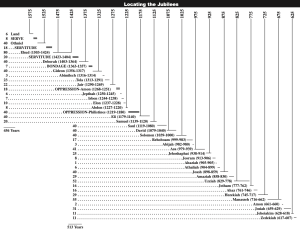
But was there any earlier period when Israel was in bondage during a scheduled Jubilee year? We used the time periods listed for the judges by Brother Edgar in the Volume 4, Number 3 issue of Beauties of the Truth. This produced the accompanying chart, with periods of bondage shown in thick lines. No Jubilee year occurred during these periods. We know of no way to precisely place each judgeship to an exact year. We also acknowledge there may have been some farming or harvest during bondage periods under the administration of the oppressor, or even some covert threshing in confined places as in the case of Gideon in Judges 6:1, 7, 11. However, note this case of Gideon did not occur during a Jubilee according to the projection. We know the periods during the Judges may not be entirely consecutive and some events may have overlapped and unaccounted periods may occur. However, no great periods of time could be shifted without intruding on the Jubilee years. In some cases the Jubilee occurred just before a period of captivity as in the case of Ehud, and in other cases it came just after a captivity as during Eli’s judgeship. It is interesting to note in this projection that in the period of the Judges bondage or oppression always followed shortly after a term designated a Jubilee. Oppression never followed a non-occurring jubilee term. This would seem to speak for this being a discipline for Israel’s lax attention to the spirit of the Jubilee ordinance.
My conclusion is that Pastor Russell’s deduction was correct, that the first time God interrupted the Jubilee system was with the captivity in Babylon. This could still allow for some small compensating overlaps and gaps in the period of the Judges, yet still yield the 450 year figure given in Acts 13:20.
Isaiah 37:30 may refer to a Jubilee in the reign of Hezekiah. This is not peculiar as a Jubilee year was due during his reign. However, there is a curious account in Jeremiah 34:8-9. Though a Jubilee is not mentioned, it is apparent that the Sabbath system and Jubilee year is the focus of attention in the next several verses. The proclamation went beyond the provision of Dent. 15:1-2, 9, 12. This was in the reign of Zedekiah, but a Jubilee was not scheduled during his reign. However, he seems keenly aware of Israel’s neglect of this plan by God. He appears to declare a pseudo Jubilee in an effort to appease God and forestall the inevitable siege. But while God acknowledged the endeavor, He condemned the spirit in which it had been compromised and did not accept this appeasement. This is apparent from the NIV translation of Jeremiah 34:15-17, 21- 22.
“Recently you repented and did what is right in my sight: Each of you proclaimed freedom to his countrymen. You even made a covenant before me in the house that bears my Name. But now you have turned around and profaned my name; each of you has taken back the male and female slaves you had set free to go where they wished. You have forced them to become your slaves again. Therefore, this is what the LORD says: You have not obeyed me; you have not proclaimed freedom for your fellow countrymen. So I now proclaim ‘freedom’ for you, declared the LORD – ‘freedom’ to fall by the sword, plague and famine. I will make you abhorrent to all the kingdoms of the earth… I will hand Zedekiah king of Judah and his officials over to their enemies who seek their lives, to the army of the king of Babylon, which has withdrawn from you. I am going to give the order, declares the LORD, and I will bring them back to this city. They will fight against it, take it and burn it down. And I will lay waste the towns of Judah so no one can live there.”
This emphasizes that the predicted captivity was in respect to the historical neglect of the Jubilees. Ezekiel’s prophecy in 7:12 also seems to relate the captivity to Israel’s misuse of the Sabbath/jubilee system. This adds to the evidence that in setting aside this type, God was about to replace it with the greater cycle which He would keep Himself. Yet this new keeping would entail burdens for His people.
The beauty of this truth is that when God gives an injunction He also gives the opportunity to obey. For whatever God asks of us, He will also provide the means. Israel did not keep the jubilees properly because of selfishness, not because God made it too hard for them. Israel did not reap the rewards because they did not keep the program. Ezekiel 18:29, “Yet saith the house of Israel, The way of the Lord is not equal. 0 house of Israel, are not my ways equal? are not your ways unequal?”
We also exult in the vantage point of now standing at the beginning of the antitypical jubilee. Soon Israel and all humanity will realize freedom from the bondage of the past 6000 years of laboring under sin and death.
– Jerry Leslie