
Solomon’s True Gold, Ecclesiastes
“Who is as the wise man? and who knoweth the inter pretation of a thing? a man’s wisdom maketh his face to shine, and the boldness of his face shall be changed” (Ecclesiastes 8:1).
“Have you found anything?” the bookstore owner inquired of the earnest rabbinical student with a wisp of a beard. The student was sitting cross‑legged on the floor searching through the Hebrew titles in a large box of used books. Looking up through his glasses and refocusing on the owner, the earnest student smiled broadly, his face shining as he replied, “True gold.” The “true gold,” in the commentaries he was inspecting, taught critical thinking in their expositions of the sacred text. More frequently than not, the sages expounding the text disagreed with one another on the sense of the word, definitions and scripture. It demanded judgment by the reader.
Such critical thinking was first modeled in Ecclesiastes when Solomon set forth his observations on life. He never claimed the prophetic inspiration of a, “thus saith the Lord.” If, “the fear of the Lord is the beginning of wisdom,” following on from this beginning, what then is the road? How are we to move with reverence in obeying the commandments and understanding the mind of the Lord? Solomon seeks to mark out this road for us.
Leaving our friend with his find of “true gold,” how does the Laodicean church obtain the “true gold” that Christ counsels us to buy? “I counsel thee to buy of me gold tried in the fire, that thou mayest be rich; and white raiment, that thou mayest be clothed, and that the shame of thy nakedness do not appear; and anoint thine eyes with eyesalve, that thou mayest see” (Revelation 3:18).
We need to set aside, or “sell” earthly ambitions and earthly methods inherited through Father Adam so that we might develop the new mind of Christ (Romans 12:2). How rich is this bargain! This gold is complimented by the linen “white raiment” of Christ’s righteousness, and the Laodicean “eyesalve” for guidance in these troublous times. The gold, the garment, and the eyesalve are given to us as our present inheritance if we are willing and faithful.
A TURNED AWAY HEART
In the fourth year of his reign, Solomon saw the laying of the foundation of the temple in Jerusalem. The temple was completed in the 11th year of his reign, and he saw the installation of its priesthood, its sacrifices, its twenty‑four courses of singers and its massive support staff (1 Kings 6:1, 37, 38). While in the full vigor of life, every human desire Solomon could imagine was fulfilled.
The defenses of Jerusalem were not neglected, for Solomon expanded the citadel of Mount Zion. The Tower of David, named after his beloved father, was an imposing stately round fortification visible throughout the city, over which it kept watch. One thousand gold shields fastened to its outer walls blazed in the sunlight. Endued with a gift for passionate poetry, Solomon celebrated his most memorable love. He writes in the Song of Songs 4:4, “Thy neck is like the Tower of David.”
With the practical duties, religious duties, and administration of the twelve tribes in orderly operation, Solomon turned his attention to planting gardens. These gardens had pools of water, certainly featuring lotus and water lilies, and garden beds where we could expect gardenias with their intoxicating evening fragrance, lilies, and roses. These were nestled among hibiscus and exotic flowers, shrubs and trees from both native and far distant zones.
Throughout his life that tradition sets forth as sixty years, Solomon exhibits a restless personality with high intelligence and keen powers of observation, but with a disposition to compromise rather than confront. Sadly, “It came to pass, when Solomon was old, that his wives turned away his heart after other gods: and his heart was not perfect with the Lord his God, as was the heart of David his father” (1 Kings 11:4). Seemingly, the rebuke from the Lord for Solomon’s covenant‑breaking, and the Lord’s judgement against Solomon, refocused him and brought him back onto the right path (1 Kings 11:11, 12).
As tradition relates, around the age of fifty‑five Solomon forsook living as king.[1] He forsook his seven hundred wives and three hundred concubines. Solomon forsook the long distance sea trade programs in partnership with Canaanite Sidon and Tyre (1 Kings 10:22). In the west, these routes stretched beyond the Mediterranean Sea down the West African coast starting from the now excavated Phoenician settlement of Tarshish near present day Cadiz, Spain[2] Possibly, the fleet even pressed around the fearsome and frigid waters sweeping Africa’s southern Cape of Good Hope during the southern summer in three years of voyaging. Certainly, the sea trade networks skirted Africa’s eastern coast stretching as far south as Zimbabwe. From these trade connections, exotic trade in apes and peacocks and immense wealth — recorded in one year as 666 talents of gold — flowed back to Jerusalem (1 Kings 9:28, 10:14).

Precious gold represents developed Christian character.
THE ECCLESIASTES PROJECT
Now, at age fifty‑five, Solomon became reflective about the brevity of life’s short “breath.” He committed his energy to his most important and singular life work. Possibly his health was in decline as a consequence of his excesses and the weight of the Lord’s judgement. In his last five years of life he would be an instructor in the “true gold” of critical thinking skills, examining popular proverbs for living, some set forth as “wisdom.” Solomon recorded his brutally honest reflections on life keenly observed through a character molded by experience. His daunting task was reshaping the minds of thoughtful believers, who would “assemble” to seek wisdom based on the promises of Jehovah. This effort would trickle down both to us as well as to our earnest rabbinical student.
Solomon’s resulting book, Ecclesiastes, or in Hebrew Kohelet, like his Songs, stand apart in the Biblical canon. Modern scholars such as Robert Alter describe it as “the most peculiar book in the Hebrew Bible.” The book’s Hebrew name Kohelet (or Qohelet) is derived from the verb q‑h‑l “to assemble” (H6953). Alter further writes, “q‑h‑l means to assemble … this Hebrew verb always takes people, not words or things as its object…so, it may reflect the assembling of audiences of people or disciples” (Robert Alter, The Wisdom Books, Norton & Co., New York, 2010, page 337). While Luther’s translation of the book as “The Preacher” has taken hold of the translation community, obviously it is not accurate. The title is rendered as Ecclesiastes (“One concerned with the assembly”) in the Greek Septuagint.
We may presume his teaching post was on the outer eastern porch of the temple which was rebuilt in our Lord’s day and designated as “Solomon’s porch.” Solomon presents us with a full account of his spiritual Odessey.
NEITHER SCIENCE, PSYCHOLOGY, MIRTH, PUBLIC PROJECTS, NOR MUSIC ARE MORE THAN “BREATH”
Ecclesiastes opens with the interpretive poetic rendering “vanity of vanities,” or “futility of futilities” this comes from the allusion to the literal word “merest breath” that comprises life (H1892, following scholar Robert Alter on translation.) Emphasis throughout Ecclesiastes is placed on the brevity of “breath.” The recognition that all is “merest breath” opens and closes the book, and this word “merest breath” is employed some forty times. In Solomon’s confession of his searches during his thirty years of excess, he does not tell us that he sought the Lord’s guidance. The consequences clearly brought no rest to his soul.
First, he sets forth a clear statement about the permission of evil, as “this sore travail that God has given to the sons of man to be exercised therewith” (Ecclesiastes 1:13). While our life, indeed, the life of the beasts, are “merest breath,” the physical earth abides forever (Ecclesiastes 1:4). “God created it to be inhabited” (Isaiah 45:18), and the earth will continue to sustain “breath” for both man and beast despite the great tribulations, earthquakes, and storms predicted in the Scriptures. The elements needful for both man and beast will never be exhausted; these will be renewed through eternal cycles.
Seeking out the wisdom behind these cycles is what we today call natural science (Ecclesiastes 1:13). Solomon’s thinking was a marked departure from the learning and science of the surrounding nations. Solomon saw the cycles of earth as natural processes operating by fixed laws, laws not requiring continued direct divine action. To explain this, Solomon does not assert that angels under divine direction were pushing the sun, planets, and heavenly bodies about in their courses, as did pious believers of the Jewish Qumran community. However, in the end, science could not provide soul‑satisfying answers to meaning of life. It was “merest breath.”
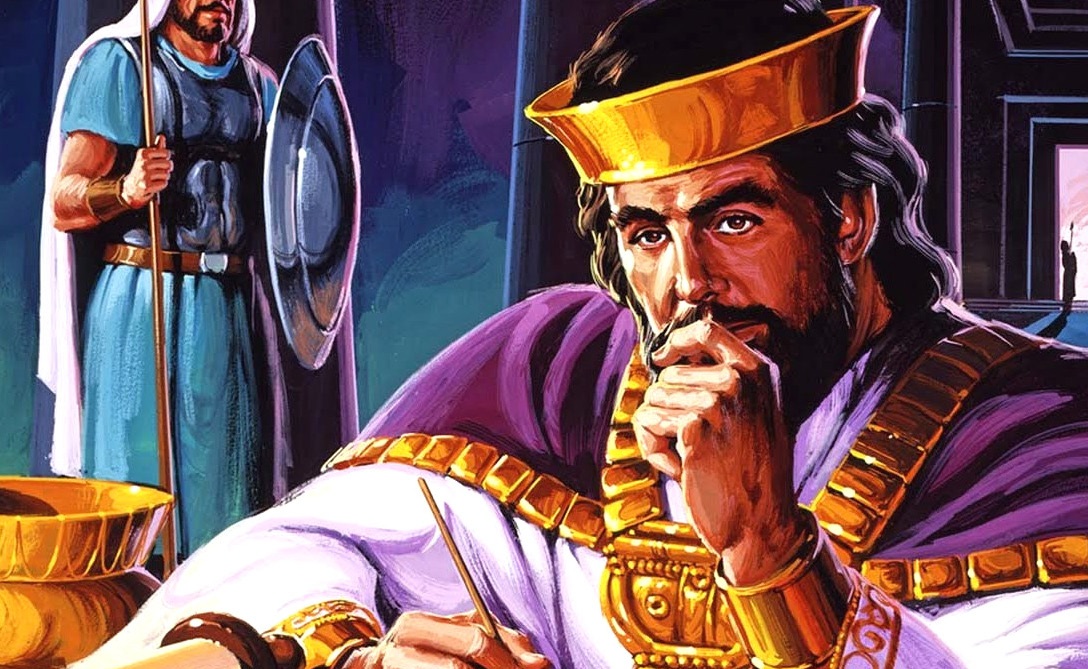
King Solomon, who asked for wisdom
Restless, Solomon moved on in his quest. He sought to know more about human wisdom, madness, and folly (Ecclesiastes 1:17, 18). Today we call this psychology. Yet, the more he learned, the more his knowledge of the grief carried in the human heart gave him grief also. Empathy is commendable. Today’s psychology practitioners recognize the very real danger of bringing grief on themselves from their efforts to counsel. They mitigate the grief by establishing “boundaries,” reflecting on the counseling session by writing notes of analysis, and sharing the especially heavy burdens of heart with their peers. In the end, Solomon’s early visit to psychology also proved not only to be “merest breath,” but “vexation of spirit.”
Abandoning the search for soul‑satisfying rest in either the natural realm of science, or the deeper realm of understanding the workings of the human psyche, Solomon abandoned rationality. He embraced mirth, laughter, wine, and folly (Ecclesiastes 2:1‑3). This excursion also was “merest breath.”
Observing, “moreover the profit of the earth is for all: the king himself is served by the field” (Ecclesiastes 5:9). Solomon sets out his fourth and apparently final attempt. He directed his efforts towards public works and improved housing. He worked to provide Jerusalem’s populace with abundant food and clothing. Building upon the legacy of David, his musically gifted father, he saw the benefits of musical enrichment for the populace (Ecclesiastes 2:4‑11). Yet, in the end, all these commendable works also proved to be “merest breath.”
SO I RETURNED AND CONSIDERED
Solomon’s restless spirit never gave up. After having a heart turned to a life of distraction and little focus on God (1 Kings 11:3), he now “returned and considered” (Ecclesiastes 4:1).
This was an extended process. Healing of the soul cannot begin for anyone who does not want to change and be healed. Solomon wanted answers. Eventually, he saw that he needed to change, he needed to grow, he needed his “vexation” healed. Step by step he shares his slow recovery. Sometimes there were setbacks. This is a real life. It is life experience in which Solomon gives us a fearless account of his journey. Ecclesiastes may even be read as what some branches of the psychology community today call Journaling, or writing a record of your history and your path towards healing.
While Solomon did conclude that wisdom exceeded folly (Ecclesiastes 2:13), he was confronted by a dilemma. At the conclusion of life, both the wise and fool perish. For Solomon it was now late in life. He was conscious of his own mortality. The wisdom of the wise, and all their laudable works perish. Unable to reconcile this with some higher purpose, Solomon was in “despair” with all his labors (Ecclesiastes 2:20). This also was “merest breath” and “vexation of spirit” (Ecclesiastes 2:26).
Through the seasons and “times” of life, there was much miscarriage of justice; the sons of men were not acting as moral men should. “I said in mine heart concerning the estate of the sons of men, that God might manifest them, and that they might see that they themselves are beasts” (Ecclesiastes 3:18). Abandoning hope at this stage of his life, he concluded, “there is nothing better than that a man should rejoice in his own works” (Ecclesiastes 3:22).
Solomon persisted, and the final core of his book of Proverbs appears to be the result. “Moreover, because the preacher was wise, he still taught the people knowledge; yea, he gave good heed, and sought out, and set in order many proverbs. The preacher sought to find out acceptable words: and that which was written was upright, even words of truth” (Ecclesiastes 12:9, 10).
A book of thoughtul observations
The unwary attendees may have affirmed some of these popular proverbs as set forth for consideration, only then to learn better as Solomon amplifies their more correct sense. One specific example is, “money answereth all things” (Ecclesiastes 10:19). Many to our very day hold this proverb near to their hearts. But this popular proverb is closely followed with an amplification for the godly use of money, “Cast thy bread upon the waters: for thou shalt find it after many days. Give a portion to seven, and also to eight; for thou knowest not what evil shall be upon the earth” (Ecclesiastes 11:1, 2).
BE NOT OVERWISE OR FOOLISH — NOT OUR COUNSEL
Pastor Russell, commenting on Ecclesiastes, observes that whatever appears to be cautious and careful counsel for those concerned with getting along in this world, the New Creation has a different and higher standard. (See comments on Ecclesiastes 7:1, 7:16.) Hence we take exception with, “Be not righteous over much; neither make thyself over wise: why shouldest thou destroy thyself? Be not over much wicked, neither be thou foolish: why … die before thy time?” (Ecclesiastes 7:16, 17).
Like those who collected around Solomon, we, with the holy spirit’s guidance through study of the Bible, must weigh Solomon’s words against the testimony of the Lord’s faithful ones elsewhere in scripture. This requires understanding and critical thinking. Let Solomon’s own words serve as our guide as he confesses his limits, “All this have I proved by wisdom: I said, I will be wise; but it was far from me. That which is far off, and exceeding deep, who can find it out?” (Ecclesiastes 7:23,24).
In his “vexation of spirit,” Solomon at first praised the dead and the unborn more than the living (Ecclesiastes 4:1‑3). Among the living was envy, those who shunned work, there were those who worked beyond the demands of their own needs for life. This was “merest breath.”
With the wisdom of unfulfilling life experience, after over thirty years with one thousand women, he endorses the true wisdom of the divine arrangement for monogamous marriage and family (Ecclesiastes 4:9‑12). He further offers much in the way of practical counsel on the pitfalls of our relationships.
PROPER CONDUCT IN THE LORD’S HOUSE, AND KEEPING GOD’S COMMANDMENTS
Sanctified proper and reverent conduct, fewness of words, and the fear of the Lord, both in the Lord’s house and when praying in private, must direct our lives (Ecclesiastes 5:1‑7, R5187). Though a man may have the wealth to grant himself anything his heart desires, one hundred sons, and live two thousand years, yet he will perish (Ecclesiastes 6:1‑6).
Knowing this, what is sufficient for Life? “Better is the sight of the eyes than the wandering of the desire: this is also vanity (“mere breath”) and vexation of spirit” (Ecclesiastes 6:9). “A good name is better than precious ointment” (Ecclesiastes 7:1). While only our reputation will outlive us, our good name will not always be on the lips of our fellow men.
With whom do we want this good name? The consecrated want a “good name” with God. The consecrated will prefer to suffer for righteousness’ sake rather than win a good name among men by compromising (R1532, Matthew 5:11). At the same time, we should have “a good report of them that are without” (1 Timothy 3:7).
SOLOMON’S LEGACY
As Solomon closes this amazing book of Ecclesiastes, he affirms once again the “merest breath” of human life (Ecclesiastes 12:8). He then gives a confession of full dependence upon God and building a relationship with God. This best begins in youth. “Remember now thy Creator in the days of thy youth” (Ecclesiastes 12:1).
Solomon shares his final conclusion, “Let us hear the conclusion of the whole matter: Fear God, and keep his commandments: for this is the whole duty of man. For God shall bring every work into judgment, with every secret thing, whether it be good, or whether it be evil” (Ecclesiastes 12:13, 14). He asserts this conviction while recognizing that, “because sentence against an evil work is not executed speedily, therefore the heart of the sons of men is fully set in them to do evil” (Ecclesiastes 8:11). Solomon knew that few would be holding fast to these straightforward precepts.
Following Solomon’s death, Jeroboam, the “man of valor” (1 Kings 11:28) who had been advanced by Solomon, would lead a civil war of rebellion against Solomon’s inept son and successor. The twelve tribes would be torn apart. Jeroboam would lead the people into false worship, even bringing back the worship of the golden calf (1 Kings 14:7‑9). Within five years of Solomon’s death the “mere breath” of his worldly‑wise policy and practice would be manifest. Pharoah Shishak of Egypt launched a punitive expedition against Israel, and the thousand gold shields hanging on David’s Tower would be carried off as Egyptian spoil (1 Kings 14:24‑26). But if the gold and the kingdom was departed, for those in the “assembly” reflecting on Solomon’s wisdom and puzzling over Ecclesiastes, the “true gold” was securely locked away in their reflective worship and critical thinking. And so it must be for us.
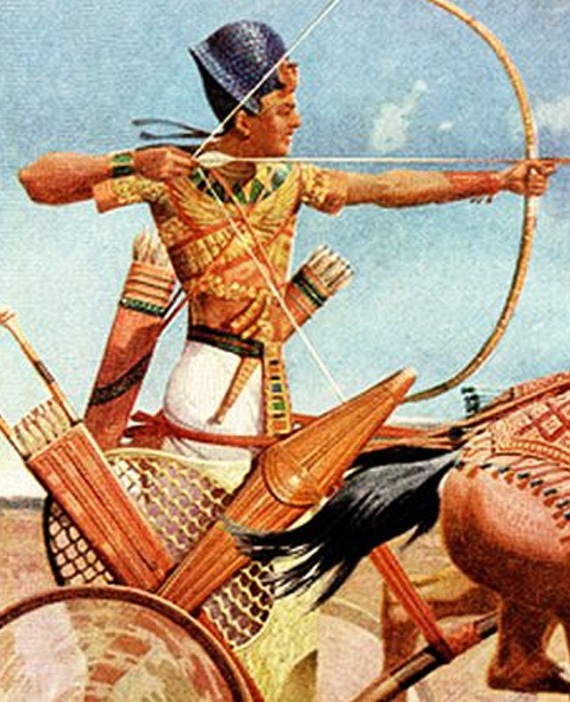
Pharaoh Shishak
Employing the proverb in Ecclesiastes 6:1,2, Jesus may have constructed the parable of the rich man who tore down his barn to erect a bigger barn (Luke 12:16‑ 21). However, no direct quote from Ecclesiastes appears in the Gospels. The Apostle Paul seems to echo Solomon when he writes, “O the depth of the riches both of the wisdom and knowledge of God! how unsearchable are his judgments, and his ways past finding out!” (Romans 11:33).
In Jesus’ day Solomon’s porch on the eastern perimeter wall of the temple was rebuilt by Herod. This new construction, with its stately columns and roof, was dazzling. It featured the finest craftsmanship of intricately worked, inset, multi‑colored stone flooring. And it was from Solomon’s porch that both our Lord, and later the apostles, taught those who had “ears to hear” (John 10:23, Acts 3, 11). They were following the tradition that Solomon had pioneered one thousand years earlier. When Jesus spoke in parables, when he asked his disciples questions, especially those that challenged them to think deeply, he built upon Solomon’s final efforts towards instruction. Solomon now acknowledged the Lord and found meaning in life.
To this day, the parables and sayings of Jesus, our good shepherd, teach us how to think, how to extract wisdom, and how to understand; “The words of the wise are as goads, and as nails fastened by the masters of assemblies, which are given from one shepherd” (Ecclesiastes 12:11).
— Br. Richard Doctor
[1] Apparently, while not relinquishing the crown, Solomon seemingly entrusted day‑to‑day government operations to the capable administration of his senior advisors called “old men” (1 Kings 12:6). Both the book of Kings and Chronicles record the Lord’s rebuke of Solomon, but then become silent about the close of his reign until his death after forty years. We are directed to sources such as The Acts of Solomon, Nathan the Prophet, Ahijah the Shilonite, and Iddo the Seer (1 Kings 11:42, 2 Chronicles 9:29). We may presume that excerpts from these sources are preserved in 1 Kings and 2 Chronicles.
[2] 1 Kings 10:22 identifies the joint trading flotilla sent forth by Hiram and Solomon as being based in Tarshish. This identification of Tarshish with a prosperous Phoenician settlement on the Atlantic coast of Spain near Cadiz, now is well‑established (C. Lopez‑Ruiz, et al., “From Tyre to Tarshish, The Phoenicians in Spain,” Biblical Archeology Review, Summer 2025). The Spanish name for this site is “Cerro del Villar.”