
The Philosophy of Atonement
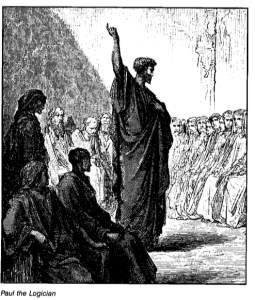
The Apostle Paul is noted as a great logician. In few places is this more exhibited than in the fifth chapter of Romans, specially in verses 16-21.
To get the background we will begin this study in verse 12. “Wherefore, as by one man sin entered into the world, and death by sin; and so death passed upon all men, for that all have sinned.” This is a simple statement of the hereditary nature of sin. In verses 13 and 14 Paul distinguishes between subjective and objective sin. “For until the law sin was in the world: but sin is not imputed when there is no law. Nevertheless death reigned from Adam to Moses, even over them that had not sinned after the similitude of Adam’s transgression, who is the figure of him that was to come”
Though the law identified sin, the fact of sin was a reality from the time of Adam’s original transgression in the Garden of Eden. The NIV gives an interesting interpretive rendering for the phrase “after the similitude of Adam’s transgression”. It reads “even over those who did not sin by breaking a command.” In other words, death was the equal consequence for both willful sins and those attributed to ignorance or Adamic weakness. Verse 15: “But not as the offence, so also is the free gift. For if through the offence of one many be dead, much more the grace of God, and the gift by grace, which is by one man, Jesus Christ, hath abounded unto many.” Here Paul begins to zero in on his main subject, a contrast between original sin and the act which brings redemption. Although the ransom, anti-lutron, is a corresponding price, a perfect life for a perfect life, Paul is emphasizing the differences between the redemption and the sin it atones for. The original was of one man, the atoning act covered the sins of many. The original sentence was for one act of disobedience, the atonement covers a multitude of transgressions.
A FINE DISTINCTION
The next three verses are the heart of Paul’s analysis of sin atonement. However the fine logic is diluted by the various English translations of these verses. The word translated “justification” in verse 16 is not the same word translated “justification” in verse 18 but is the same as the word translated “righteousness” in verse 18.
A still different Greek word is translated “righteousness” in verse 17. To illustrate this confusion we will quote these verses below, inserting a transliteration of the Greek words in question.
“And not as it was by one that sinned, so is the gift: for the judgment was by one to condemnation, but the free gift is of many offenses unto justification [dikaioma]. For if by one man’s offence death reigned by one; much more they which receive abundance of grace and of the gift of righteousness [dikaiosune] shall reign in life by one, Jesus Christ.) Therefore as by the offence of one judgment came upon all men to condemnation; even so by the righteousness [dikaioma] of one the free gift came upon all men unto justification [dikaiosis] of life.”
Of the three words, dikaiosune is easiest to identify. In the words of W. E. Vine, it means “the character or quality of being right or just; it was formerly spelled “rightwiseness” which clearly expresses the meaning.” The distinction between dikaioma and dikaiosis is not as easy to determine. Lexicographers disagree among themselves. Vine says dikaioma represents the “expression and effect of dikaiosis.”Writing in 1858, J. A. Bengel says just the opposite. “Dikaioma is, so to speak, the material substratum, the foundation for dikaiosis, justification; obe dience, righteousness fulfilled. It may be called justificament Yustificamentum), the ground and material of justification.” Both agree that the two are related as cause to effect. They just disagree on which is cause and which is effect. Paul’s statement in verse 18 of justification (dikaiosis) being the result of the righteousness (dikaioma) of one seems to strongly support the contention of Bengel.
THE FIRST ADVENT
With this background let us now look at verse 16. “And not as it was by one that sinned, so is the gift: for the judgment was by one to condemnation, but the free gift is of many offences unto justification The contrast is drawn between the original sin which was one act and the free gift of the ransom which covered a multitude of transgressions. This free gift was not justification, but the merit (dikaioma, justificament, basis) which would result in making all men righteous when applied. The work of Calvary was to provide the ransom basis for justifying the human race.
THE SECOND ADVENT
The application of this free gift is referred to in verse 18. “Therefore as by the offence of one judgment came upon all men to condemnation; even so by the righteousness of one the free gift came upon all men unto justification of life.” The work of the second advent-effecting actual justification (dikaiosis)-will result from the free gift of righteousness (dikaioma) coming upon all men.
The application of Christ’s merit will result in universal resuscitation of the dead. “All that are in their graves shall hear the voice of the Son of man and come forth.” (John 5:29). But this is only the beginning of the atonement work. Resuscitated mankind will need instruction in righteousness in order to maintain their salvation.
This work is referred to in verse 19. “For as by one man’s disobedience many were made sinners, so by the obedience of one shall many be made righteous [dikaios, the root word for the ones treated above]’ “ This describes the educational process of the kingdom, “being made righteous.”
THE GOSPEL AGE
The two advents of Christ are separated by a long period of time -the Gospel Age. The work of this age is referred to in verse 17. As verse 17 falls between 16 and 18, so the Gospel Age comes between the first and second advents.
Verse 17 reads “For if by one man’s offense death reigned by one; much more they which receive abundance of grace and of the gift of righteousness [dikaiosune] shall reign in life by one, Jesus Christ ‘ “ Here we find the correct word for righteousness, for it is Christ’s perfections that are being emphasized. The highlighted words in the text are the author’s for emphasis. These terms are peculiar to the church. The bride of Christ receives not only grace, but an abundance of grace. They shall not only live, they shall reign in life.
This work with the church during the present time requires not only the ransom for their justification but also the sin offering for their daily shortcomings.
THE JEWISH AGE
Verse 20 is a flashback to the Jewish Age. “Moreover the law entered, that the offence might abound. But where sin abounded, grace did much more abound” The particle de here translated “moreover” is usually rendered “but;’ introducing an antithesis or contrast (see Vine’s Dictionary). Having outlined the workings of the grace of salvation through Christ, Paul reverts to his main subject, the contrast of the law and the gospel. The law identified wrongdoing as sin, thus making sin “abound” But grace was more than equal to the task. It not only redeemed the gentiles under Adamic condemnation, it also removed the additional “curse of the law” which condemned Israel.
Paul wraps up his discussion in verse 21. “That as sin hath reigned unto death, even so might grace reign through righteousness [dikaiosune] unto eternal life by Jesus Christ our Lord” Now the completeness of the atonement is shown. The reign of sin and death will be replaced by the reign of life and righteousness. This life will be obtained through the use of both the ransom and the sin offering, the application of Jesus’ perfections (dikaiosune) producing in all men their own righteousness (dikaiosune), which will enable them to maintain that life.
DISPENSATIONAL TRUTH
In summary, verses 16-21 outline the philosophy of redemption age by age.
Verse 16 shows the work of the first advent, providing the basis for justification, the ransom.
Verse 17 outlines the use of that free gift in abundance so that the church may reign in life.
Verse 18 refers to the second advent when the merit will be applied to all, justifying all men.
Verse 19 speaks of the educational work of the kingdom, by which men can maintain life.
Verse 20 comments on the object of the law, identifying sin. The “curse of the law” is removed by Christ.
Verse 21 completes the picture by showing how men maintain salvation by developing their own personal righteousness.
VOLUME FIVE FOREWORD
Paul’s message to the Roman brethren is a basis for the conclusions expressed in the foreword to Volume 5 (page ii -Eii) of Studies in the Scriptures. “Now we see that our Lord Jesus left the Heavenly glory that He might accomplish a ransoming work for Adam and his race. We see that his change of nature from a spirit to a human being was with a view to enabling him to be the Ransom price -a perfect man for a perfect man -Anti-lutron –a corresponding price. We now see that Jesus gave himself a Ransom-price for all at the time of his consecration at thirty years of age at Jordan. He continued in giving the Ransom-price, that is, in laying down His life, which in due time would constitute a Ransom-price for Father Adam and his race. He finished his work of laying down His life, surrendering it, sacrificing it, permitting it to be taken from Him, when He on the cross cried: ‘It is finished!’Nothing more could be laid down than was there laid down – a Ransom, a corresponding price, for Father Adam. But it was not paid over as a price in settlement of Adam’s account, else Adam and the entire sinner race would then and there have been turned over to Jesus. The price was merely laid in the hands of Divine Justice as a deposit, to the credit of the One who had died, that He might apply it later in harmony with the Divine Plan. Our Lord Jesus was raised from the dead a spirit being of the Divine nature, as a reward for His faithfulness and loyalty to God in surrendering His earthly life sacrificially. ‘Him hath God highly exalted … above every name’
– Carl Hagensick