Matriarch Prophecies
In view of the fact that the Hebrew nation has been known as “the children of Israel,” a closer look should be given to the children of Jacob from which the nation took its name. Since Chapters 29 and 30 of Genesis record the early history of these twelve sons of Jacob, it follows that their history, in some way, corresponds with the history of the nation descended from them.
Let it be noted that in addition to the naming of the twelve sons, Genesis 29 and 30 record the circumstances which gave rise to each of their names. In each birth there is a reason given for the names they received, and their mother’s comments at the time have been preserved as a record for us.
Jacob’s first son was Reuben, born to him of Leah. Upon this son, Leah said these words, “Surely the Lord has looked upon my afflictiorf’ (Genesis 29:32). The second son was also born of Leah and his name was Simeon. The reason she named him so was “the Lord hath heard that I was hated” (Genesis 29:33).
The resemblance between these two comments by Leah and what was recorded in Exodus about the sufferings of Israel in Egypt is at once brought to our minds. First, we read that “God looked upon the children of Israel” (Exodus 2:5). Then to Moses he said “I have surely seen the affliction of my people which are in Egypt” (Exodus 3:7). Corresponding with the words of Leah when Simeon was born, God adds “I have heard their cry” (Exodus 3:7).
It is surely more than coincidence that at the births of Israel’s first two sons their mother should have spoken of “affliction,” which she plainly said the .Lord had “looked upon~’ and “heard,” and that these same words are used in the Scriptures that describe the first stage in the natural history of the children of Israel who were described as “hated” and “afflicted” by the Egyptians. When the Lord told Moses he had seen the affliction of his people and heard their cry, did he not have in mind these very words that were spoken by Leah so many years before?
Jacob’s third son by Leah was Levi. When he was born Leah said “This time will my husband be joined to m&’ (Genesis 29:34). These words point forward to the beginning of Israel’s national history. One might ask when God was “joined” to Israel and became her husband. It was on the eve of their leaving Egypt, in the night of the Passover, when the Lamb was slain and its blood shed and sprinkled on the doorposts and lintels of the homes of Israel. It was then that God entered into covenant relationship with Israel and became her “husband” It was at the antitypical Passover that God “joined” to us, his children, and has become one with us in Christ.
Jacob’s fourth son was Judah, also born of Leah. When he was born Leah said “Now will I praise the Lord” (Genesis 29:35). As her words at Levi’s birth carried us back to the Passover, her words at Judah’s birth bring us forward to Israel’s crossing of the Red Sea, where they celebrated God’s victory over their foes with much singing and praise to God.
Next came Dan, born of Bilhah, Rachel’s handmaid. At his birth Rachel said “God hath judged me” (Genesis 30:6). If we have been correct in our interpretation so far, then these words of Rachel carry us prophetically to the early experiences of Israel in the wilderness. “God hath judged me7′ points to the displeasure and wrath of God against Israel for their murmurings during this time.
At the birth of Naphtali, the sixth son, also of Bilhah, Rachel exclaims “With great wrestlings have I wrestled with my sister, and I have prevailed” (Genesis 30:8). This, too, corresponds with Israel’s natural history. The very thing we read after God “judged” Israel for their sin at Merribah was their conflict or wrestling with Amalek. It is interesting that the same word used at Naphtali’s birth by Rachel is used to describe the wrestling between Israel and Amalek. “And it came to pass, when Moses held up his hand, that Israel prevailed, and when he let down his hand Amalek prevailed” (Exodus 17: 11).
What the mother had to say at the births of the seventh and eighth sons of Jacob may be connected with the births of the ninth and tenth sons. At the birth of Gad, whose mother was Zilpah, Leah’s handmaid, it was said “A troop cometh” (Genesis 30:11). This agrees with Israel’s history also, for after their wilderness experiences and the crossing of Jordan a “troop” had indeed met them – the seven nations of Canaanites who opposed them. At the birth of Asher these words were uttered by his mother Zilpah: “Happy am I” (Genesis 30:13), and foretells Israel’s joy at overcoming their enemies.
When Jacob’s ninth and tenth sons, Issachar and Zebulun, were born, Leah explained “God hath given me my hire” and “God hath endued me with a good dowery” (Genesis 30:18, 20). These two statements fortell Israel’s occupation of the land, their goodly inheritance which God endowed to them.
There was an interval before the last two sons were born. They were both born to Jacob by his be loved wife Rachel. Her words at the birth of Joseph were “God hath taken away my reproach * “ How fitting that this new development of Jacobs lineage, this new beginning of his seed by his beloved wife, corresponds so beautifully with the new beginning of the nation when they had crossed Jordan into the new land, after every male was circumcised. The Lord then said “This day have I rolled away the reproach of Egypt from you”
Rachel spoke prophetically at Joseph’s birth, “The Lord shall add to me another son” This happened some years later, when Rachel gave birth to a second son at the time of her death. “And it came to pass that as her soul was departing that she called him “Benoni, the son of my sorrow.” But his father called him “Benjamin, the son of my right hand” Israel, as a nation, endured much sorrow until the kingship of David and Solomon, when typically it became “the son of my right hand * “ In the grander picture Israel as the restored and blesser nation will become in truth “the son of my right hand”
GROUPED BY THEIR MOTHERS
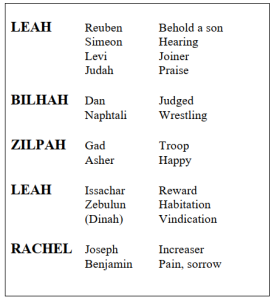
Thus the words spoken by the mothers of Jacob’s twelve sons were prophetic intimations of the history of Israel from its beginning in Egypt to its glory with Solomon and the ultimate glory of the kingdom. To complete our study, we call attention to the grouping of Jacobs sons under their different mothers. These correspond with the groupings of the outstanding events in the history of Israel.
The first four sons were born of Leah, Jacob’s first wife, and her description of each son points to Israel’s deliverance from Egypt. Rachel’s description of the fifth and six sons, born of Bilhah, point to Israel’s experience in the wilderness. Leahs words at the birth of the seventh and eighth, born of Zilpah, the handmaid of Leah, and the ninth and tenth, born of Leah, prophesied of the enjoyment of the promised land. The eleventh and twelfth were separated from all the others, being born of Rachel. Her words at their births point forward to the establishment of the Kingdom.
The words of these mothers were surely guided by God, through the influence of the holy Spirit. These words carry their prophetic utterance to our very day. Truly, we can see the divine inspiration of the Scriptures!
– George Eldridge