
Jeremiah
“The word of the LORD came in the days of Josiah the son of Amon king of Judah, in the thirteenth year of his reign … unto the end of the eleventh year of Zedekiah the son of Josiah king of Judah, unto the carrying away of Jerusalem captive in the fifth month” (Jeremiah 1:2, 3).
Jeremiah was Jehovah’s prophet to Israel, and to the nations surrounding. “I ordained thee a prophet unto the nations” (Jeremiah 1:5). As a humble servant of God, he was reticent. He considered himself too young for such an honor, “for I am a child [metaphorically].” But God replied, “Say not, I am a child: for thou shalt go to all that I shall send thee, and whatsoever I command thee thou shalt speak” (Jeremiah 1:6, 7).
Jeremiah’s ministry from the 13th year of Josiah, to the end of the reign of Zedekiah, covered 40 years (18 in the reign of Josiah, and 11 each during the reigns of Jehoiakim and Zedekiah). At the end of that 40 years the kingdom of Judah was laid waste, because the Israelites would not cease from their sins, and would not accept their servitude to Babylon.
This period of 40 years reminds us that at both the first advent, and the second advent, there were also 40 years of warning before severe judgments. At the first advent this ran from 29 AD when Jesus commenced his ministry, until 69 AD, the last year Israel observed their Day of Atonement offerings, for the temple was destroyed the following spring. At the second advent, a like period of 40 years ran from our Lord’s second presence in 1874, to 1914 when World War One engulfed Christendom. Thus the judgments prophesied by Jeremiah against Judah in his day, appear to be a foregleam of the judgments against Israel at the first advent, and against Christendom at the second advent.
CHOSEN BEFORE BIRTH
Of Jeremiah, God said “Before I formed thee in the belly I knew thee; and before thou camest forth out of the womb I sanctified thee” (Jeremiah 1:5). This description certainly fits our Lord Jesus also, who was destined from even before the womb to be God’s spokesman to Israel and to all. Thus here also appears a connection between Jeremiah and Jesus.
A further connection between the two is supplied in Matthew 16:14, where Elijah and Jeremiah are named in connection with our Lord. “Some say that thou art John the Baptist: some Elias; and others Jeremiah, or one of the prophets” (Matthew 16:14). Jesus was a fulfillment of both Elijah and Jeremiah, in many respects.
Jeremiah’s words were received by the humble of heart, but were unheeded by the nation at large, and also by the surrounding nations. But as a messenger from God, he had a message for all three of these segments. So did our Lord Jesus during his first advent, and during his second advent.
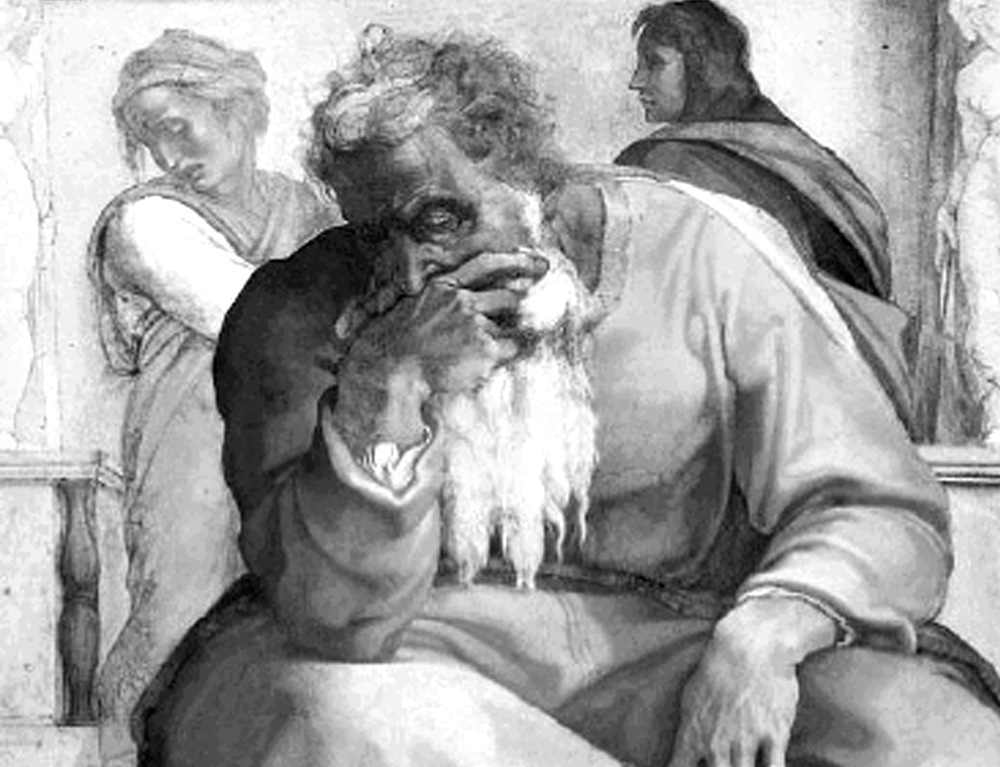
Jeremiah the Prophet (by Michaelangelo, Sistine Chapel)
A RELIGIOUS REFORMATION
A great religious reformation in the 18th year of Josiah is recorded in 2 Chronicles 34:8 and following. It was not the beginning of turning to God, for verse seven shows that Josiah had done considerable work in removing false worship from Israel already. But in the 18th year, as a consequence of work at the Temple, a discovery was made of the “book of the law of Jehovah given by Moses” (verse 14). It led to a great change in the religious direction of the nation, at least for as long as the influence of Josiah was respected. As Jeremiah’s ministry began in the 13th year of Josiah, this religious reformation commenced five years into his forty year ministry. Was there a religious reformation marked at the fifth year of the forty years beginning at each of the two advents of Jesus?
Apparently there was. Five years after 29 AD brings us to 34 AD, which was the year of the conversion of Paul to be an Apostle of Jesus Christ. He was not one of the founding apostles, in the sense of being established with the others at the time of the Pentecostal blessing. But he was an added apostle, and the words at his conversion tell us he was a chosen agent on behalf of Jesus both toward the Jews and Gentiles. “He is a chosen vessel unto me, to bear my name before the Gentiles, and kings, and the children of Israel” (Acts 9:15). The Book of Acts, from chapter 13 forward, records how effectively Paul was to minister to the same three segments as Jeremiah. The 14 epistles of Paul which appear in the New Testament constitute the bulk of the apostolic epistles we still use today.
Paul was a student. He was trained under Gamaliel, who even today is recognized as one of the leading rabbis of Israel’s history. And he lived a sanctified life, even before coming into Christ. It was this diligence – even though misdirected by his blindness to Christ until his conversion – which the Lord saw could be used on behalf of Christianity, if he was corrected. His conversion was a humbling experience. It is likely that if such a strong confrontation against former persuasions had come to many people, they may not be able to receive the correction with the humility that Paul did. In this is a lesson to all of us, to be pliable under the hands of the Almighty, and receptive to correction – even if it is humbling.

Paul’s studious set of mind, coupled with sanctified devotion, and humility before God – specially his repentance from the persecution of the saints – all enabled him to be a useful agent in God’s hand.
THE YEAR 34 AD
We say that Paul was converted in the year 34 AD. It may surprise some of our readers to know that Paul was converted so soon as the year after our Lord’s crucifixion.1 Some time after seeing this, we were glad to learn later from Bro. Frank Shallieu, before his passing, that his studies more than 20 years earlier led him to the same opinion.
The evidence for Paul’s conversion in the year 34 AD is as follows. Galatians 1:18 says that three years after Paul’s conversion, he went to Jerusalem, where he met Peter and James, and other local brethren, but did not visit generally in the churches of Judea. Galatians 2:1 says that fourteen years later he went again to Jerusalem for a council about the Gentiles. In the meantime his first missionary journey with Barnabas had occurred, and following the council he joined with Silas for a second missionary journey.
At the end of the first three years from Paul’s conversion he escaped Damascus while Aretas was king (2 Corinthians 11:32). At the end of his second missionary journey he appeared before Gallio, deputy of Achaia, at the end of his visit in Corinth (Acts 18:12). The context through verse 22 shows that this was about the spring time of whatever year, as he soon returned to Jerusalem for the feast of Pentecost.
Paul had been a year and a half at Corinth. Before that he had traveled overland through Asia Minor, by boat to Greece, overland through Macedonia, down to Athens, then to Corinth. If his travels before Corinth together matched the length of his settled stay in Corinth, then his second missionary journey would have taken three years.
This information allows us to assign some dates. The earliest date for Aretas as king of Damascus2 was 37 AD, the year Emperor Tiberius died. Aretas died three years later in 40 AD, but there is good reason to use the earliest date, 37 AD, for the year of Paul’s escape (which means his con- version, three years earlier, was in 34 AD).
Here is the reason. When Paul escaped from Damascus, he went to Jerusalem. Fifteen years later he went to Jerusalem again for the council of elders. If his escape from Damascus was in 37 AD, then the council at Jerusalem was in 51 AD. Thereafter Paul returned to Antioch, and then began his second missionary journey. If that consumed three years, then he returned to Jerusalem for the feast of Pentecost in 54 AD – it is hardly feasible to date it earlier.
That means he appeared before Gallio, near the end of that second missionary tour, late in 53 AD or early in 54 AD. Most sources cite 53 AD as the latest year feasible for Gallio as proconsul. Thus if Paul escaped Damascus later than 37 AD, the end of his stay in Corinth would be too late to appear before Gallio.
In summary – Paul’s escape from Damascus could not be earlier than 37, for Aretas did not rule Damascus until then. It could not be later than 37, for then the end of Paul’s stay in Corinth would be too late to appear before Gallio.
Thus Paul escaped Damascus in the year 37. Which means his conversion three years earlier was in 34 AD. Thus the ministry of Paul, and the testimony he bore, commenced five years into the 40 years which began with the Baptism of Christ in 29 AD.
SECOND ADVENT PARALLEL
Paul was not the bearer of Christian doctrine from the beginning. That was Christ, originally, and the other Apostles subsequently.
Similarly, Bro. Russell was not the bearer of the message of the second advent from the beginning of the harvest. Nelson Barbour and other Adventists had anticipated the date 1873 (subsequently modified to 1874). It was the recognition by Barbour and other early Adventist students of the scriptures, after the date, that perhaps Jesus had returned and was invisibly present, that so engaged the attention of Bro. Russell. As a consequence, he arranged a meeting in Philadelphia in the summer of 1876, where each shared with the other their studies – Bro. Barbour on the Lord’s Second Presence, and Bro. Russell on the great hope for the world which the second advent was to introduce. Each contributed something meaningful to the other.
For a time there was a joint effort to publish their findings, but after some disruptions it seemed expedient to commence a separate journal. Thus the first issue of “Zion’s Watch Tower” commenced publication in the summer of 1879 – five years after the Lord’s return in 1874. Thus the religious reformation which followed may be said to have a beginning five years after the Lord’s Second Advent – in parallel with the reformation in the days of Jeremiah, and also at the first advent.
Paul is thought by many brethren to have been the first messenger to the Church, and Bro. Russell the seventh. In this respect they represented the work of Christ in a special way during each harvest period. If Jeremiah is a picture of our Lord Jesus, and his work during the two advents, it is fitting that the parallel to Jeremiah’s work would be exemplified in these two messengers.
ANOTHER STEP IN THE PARALLEL
The burden of Jeremiah was to urge Israel to repentance before God, and acceptance of the chastisement that was due. That chastisement came in three stages, namely three captivities of Israelites to Babylon. The last of these was at the end of Zedekiah’s kingdom. These three times are referred to in Ezekiel. In a prophecy about the coming fall of Zedekiah, the prophet said “Let the sword be doubled the third time” (Ezekiel 21:14).
The first captivity was a relatively small one — some of the choice young men such as Daniel and his three Hebrew friends – and some other booty as well. Daniel 1:1 says this was in the third year of Jehoiakim. This would have been 22 years into the 40 years of Jeremiah’s ministry,3 and it was the first fulfillment of Jeremiah’s warnings to Israel about God’s coming punishment. Thus this was a significant marker in the years of Jeremiah’s ministry. Is there a similar marker in the years following the first advent, and the second advent?
If we add 22 years to 29 AD, the result is 51 AD. If we add 22 years to 1874, the result is 1896. Is there a meaning to these dates? It appears there is. As referred to earlier, 51 AD is the date of the council at Jerusalem to resolve questions about the Jewish customs, relative to the Gentiles. One might say it was the time for the resolution of the “Jewish” issue for the Gentile converts.
What of 1896? That was the date commencing the Zionist movement with the publication of Theodore Herzl’s The Jewish State, followed the next year with the first Zionist Congress. So at both advents, the Jewish Question came into focus in years which stand in parallel to the first fulfillment of Jeremiah’s prophecies of impending punishment.
YET ANOTHER STEP
The second captivity of Israel was much larger. In this King Jehoiachin went captive, and Nebuchadnezzar replaced him with Zedekiah. Ezekiel went to Babylon in this captivity also, and it is from this captivity that Ezekiel numbers the years as he dates his prophecies. Thus this year marked a significant milestone, namely the first major captivity of “good figs” for their preservation in Babylon. This captivity was eight years later than the previous one, and thus 30 years into the 40 of Jeremiah’s ministry.

The Apostle Paul
At the first advent period, this brings us to 59 AD, and at the second, to 1904 AD. Is there a parallel here? Possibly there is. Paul, the first messenger to the Church, by this year had completed the three missionary journeys which constituted the bulk of his ministry, and was imprisoned at Caesarea. There would be more to his ministry, but a milestone had been reached.
At the Second Advent, the year 1904 also was a milestone regarding the work of the seventh messenger. In that year the series Studies in the Scriptures was completed by the release of Volume Six, The New Creation.
Thus the year of the first major captivity in Jeremiah’s days, parallels milestone years in the work of the first and seventh messengers to the Church.
THE CLOSE
The close of Jeremiah’s 40 years point to the year 69 AD, and 1914 AD, respectively. In Jeremiah’s ministry this marked the end of Zedekiah’s kingdom. In 69 AD it marked the close of 40 years of probation for Israel – the Romans invaded and took Jerusalem the following spring. In 1914 it marked the close of 40 years of probation for Christendom, and World War I shook the kingdoms.
– Bro. David Rice
(1) Editor’s note: Some writers have concluded for later dates, even as late as after Pentecost of 37 AD. See for example F. W. Farrar, The Li/e and Work o/ St. Paul, Vol.1, p.178, Dutton & Company (1902); as reprinted by Klock & Klock Christian Publishers).
(2) Aretas evidently ruled Damascus through a governor.
(3) Josiah reigned 31 years, and Jeremiah’s ministry began in year 13. Thus his ministry lasted 18 years to the end of Jeremiah. Then came Jehoahaz, whose reign of three months crossed over the Tishri new year day of Judah. Which means the accession year of Jehoiakim commenced the year following Josiah’s year 31. Thus to the 18 years ending the reign of Josiah, we add the accession year of Jehoiakim, and three years thereafter, for a total of 22 years from the 13th of Josiah to the 3rd of Jehoiakim.