
Explaining Scripture in Light of Gnostic Heresies
“Laden with sins, led away with divers lusts, Ever learning, and never able to come to the knowledge of the truth” (2 Timothy 3:7).
During the latter stages of their ministries the Apostles constantly battled counterfeit Christian heresies. This is well documented in Scripture. Less understood is the specific nature of these heresies. The early stages of heretical thought recorded especially in Paul’s and John’s letters are often thought to be describing the incipient presence of what would later become the Papacy. However, a broader dynamic was taking place. Yes, there were the Nicolaitans, the “victorious over the people” (Strong 3532), or the “the masters of the people,”1 who as Diotrephes (3 John 9), loved to have preeminence. But this represented more of a political struggle within the traditional church. Meanwhile considerable doctrinal deceptions were taking place outside of traditional Christianity by numerous pseudo-Christian sects labeled Gnostics.
It is not within the scope of this article to closely define Gnosticism.2 That would take a while because it represents a broad range of beliefs and practices. However, there are overarching characteristics among its sects. In general Gnostics appeared to be nominal Christians who heavily borrowed their beliefs and practices from the pagan culture of the day. The degree to which these sects accomplished pagan infusion into Christian thinking dwarfed similar efforts made later by the Catholic Church. At their height, Gnostics represented fully half of the Christian world. Their pressure upon orthodox Christianity was immense, but Gnosticism was eventually overthrown within Christendom by the fourth century when Papacy gained temporal power and threw them out of the spiritual heavens, as it were.
The purpose of this article is to offer a clearer understanding of certain scriptures of Paul and John by laying a Gnostic template over them. The method used will be to list a pertinent scripture and then explain how the Apostle addressed Gnostic misconceptions. John is of special interest since he lived a long time and was thus able to see the more advanced stages of Gnostic growth first hand.
1 Timothy 6:20 – “O Timothy, keep that which is committed to thy trust, avoiding profane and vain babblings, and oppositions of science falsely so called.”
The significance of the Gnostic name common to this class of heresy is found in the Greek word gnosis. Gnosis means “knowledge” (Strong 1108) and is rendered “science” in the King James version. The acquisition of knowledge as the process for obtaining greater spirituality was accepted by all Gnostic sects. This was not knowledge from the Scripture, but from one’s self – a process of self-awareness through which the divine was supposedly discovered. The concept is illustrated in this quote from the gnostic Gospel of Philip 61:29-35. “You saw the spirit, you became spirit. You saw Christ, you became Christ. You saw [the Father, you] shall become the Father … you see yourself, and what you see you shall [become].”
Such ethereal belief has little basis in fact, whether evidenced by Scripture, nature, or reason. This quote illustrates the vain babblings aspect of Paul’s comments (Gnostic writings are full of them). Paul also renounces vain and profane babblings that would lead to ungodliness even if just engaged in discussion. His advice is to stay far away from such sophistries and adhere strictly to the Word of God (2 Timothy 3:14-16).
Acts 8:9-24 – “But there was a certain man called Simon, which beforetime … used sorcery and bewitched the people… giving out that himself was some great one.”
This is the one time this Simon is mentioned in Scripture. But given the extensive account, one would think it has an important purpose (especially considering Simon was more interested in his own safety than repentance). This Simon was identified as Simon Magus, the well known founder of the first Gnostic sect, both by Justin Martyr 3 and by Irenaeus,4 both second century luminaries close to the events described in Acts. Josephus also mentions a Simon, a close friend of governor Felix (Acts 23), who used magic. This may be a non-Christian reference to Simon Magus. 5,6
If these authors are correct, then the Bible gives us specific insight into the beginning and nature of Gnosticism. Simon came among the Christians with the desire for power and fame. Rejected by the Apostles and without the holy Spirit, he built a pseudo-Christian theology using faked miracles to reinforce his false spiritual authority.
2 Timothy 3:1-8 – “This know also, that in the last days perilous times shall come. For men shall be … Having a form of godliness, but denying the power thereof … For of this sort are they which creep into houses, and lead captive silly women … Ever learning, and never able to come to the knowledge of the truth. Now as Jannes and Jambres withstood Moses, so do these also resist the truth.”
Paul warned the recipients of his letter to turn away from such. He warned of a very present danger from those having the form of godliness. Pagans had little deceptive form of godliness to the Christian. Paul described counterfeit Christians, which the Gnostics certainly were. A common belief among Gnostics sects was a rejection of the holy Spirit as God’s power and influence. The holy Spirit was defined as wisdom, often in the form of a female deity. Thus they rejected the power of the holy Spirit.7 Also, Paul implied that these people in fact had no gnosis at all, despite their best efforts.
The “captive silly women” mentioned, if taken within a Gnostic context, could be Paul’s description of a dynamic he saw in the church. Gnosticism became particularly attractive to women by giving them added ecclesiastical influence and authority. They were often equal to men in office and practice. Elaine Pagel in her book The Gnostic Gospels says this. “[Bishop Irenaeus] notes with dismay that women especially are attracted to heretical groups. ‘Even in our own district of the Rhone valley,’ [Irenaeus] admits, the Gnostic teacher Marcus had attracted ‘many foolish women’ from his own congregation.” 8
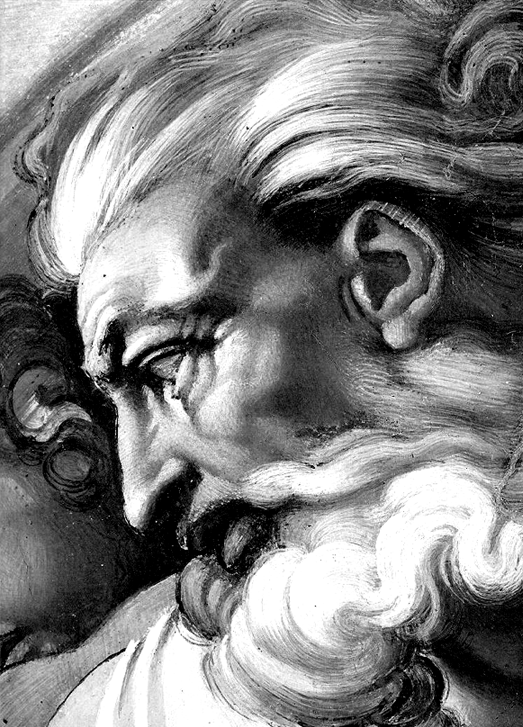
Benevolent Creator (Michelangelo)
The relevance of Jannes and Jambres is difficult to understand given their absence elsewhere in Scripture. Again, we can turn to reliable history to propose a Gnostic context. Tradition holds that Jannes and Jambres were noted magicians in Pharaoh’s court, and this is self-evident from their activity in Exodus. Magic was also a method employed by Simon and other Gnostic leaders to promote themselves and their heresies. But some ancient authors also indicate that these figures were Jewish. Pliny the Elder included Jannes and Moses among notable Jewish magicians, 9 as did Apuleious (155 AD).10
If these sources are accurate, then an interesting analogy is drawn by Paul: Those from among Christian society who withstood Christians with their magic are compared to those from among Israelite society who withstood the Israelites with magic. The parallel between two sets of false brethren using their magic is compelling. As Paul predicted in 2 Timothy 3:9, Gnostic Christianity fell permanently silent early in Christian history and does indeed appear foolish to almost all Christians now.
1 John 5:6 – “This is he that came by water and blood, even Jesus Christ; not by water only, but by water and blood. And it is the Spirit that beareth witness, because the Spirit is truth.”
A significant error common to Gnostics beliefs was the idea that Jesus was a normal man who became possessed by a higher spiritual being at his baptism, which left him prior to his death, leaving only the man Jesus to die on the cross. Here John emphases that Jesus’ full experience included also his death on the cross.
1 John 2:27 – “But the anointing which ye have received of him abideth in you, and ye need not that any man teach you: but as the same anointing teacheth you of all things, and is truth, and is no lie, and even as it hath taught you, ye shall abide in him.”
Here John could be referring to Gnostic teachers who taught from their own personally derived gnosis to disavow the teaching of John 14:26 that the holy Spirit would instruct Christians. Gnosticism deemphasizes the influence of God’s Spirit upon the faithful in favor of self-derived knowledge.
1 John 2:18-20 – “Little children, it is the last time: and as ye have heard that antichrist shall come, even now are there many antichrists; whereby we know that it is the last time. They went out from us, but they were not of us … But ye have an unction from the Holy One, and ye know all things” (“you all know it,” Wilson Diaglott).
The prefix anti usually conveys just opposition. But though the sense of opposition does apply, it also carries the though of being opposite as would be a mirror image. That is, something to correspond. This sense is used in the following Greek words. Antithesis (Strong 477) – a premise that is opposite to or balances another premise. Antitupon (Strong 499) – a counterpart type, equal in meaning yet opposite in time. Antilutron (Strong 487) – a counterpart price, equal in value, a positive to offset a negative, a ransom.
Therefore antichrist defines an element that is both like and opposing Christ. Thus, John is saying that many false Christian sects were then developing, prior to the ascent of the one great antichrist, the Papal system. At John’s time that system had not developed to the point of separation. However, Gnostics were separating into various sects. John was addressing Gnostic heretics as many antichrists. Further evidence of a Gnostic context comes from the emphasis placed upon the anointing of the holy Spirit – a concept denied by Gnostic teachers.
2 John 1:7 – “For many deceivers are entered into the world, who confess not that Jesus Christ is come in the flesh. This is a deceiver and an antichrist.”
Docetism, an early form of Gnostic Christianity (around 70 AD), taught that anything in the physical world was evil, therefore Jesus could not have come in the flesh. Instead he came in the spirit as more or less an apparition. This apparently is the error John was addressing.
1 John 2:22-23 – “Who is a liar but he that denieth that Oesus is the Christ? He is antichrist that denieth the Father and the Son. Whosoever denieth the Son, the same hath not the Father.”
Many forms of Gnosticism view Jesus as starting life like any other man. They deny the special begettal of the baby Jesus by the holy Spirit of God. Of course this denies both the fathership of God and the sonship of Jesus. John here addressed a virulent Gnostic heresy, giving it the very mark of antichrist. The seed-thought of a dual nature of Christ planted by Gnosticism developed over time into the Trinity, a distinguishing mark of the great Antichrist system.
Blame for doctrinal corruption of the early church has fallen heavily upon Greek Philosophers. But that influence of thought brought both misleading and truthful perspectives. It could be argued that enlightened Greek thinking prepared men’s minds for the Gospel principles to come. Many of the misleading aspects of Greek thought were used by Gnostic thinkers, and it was by this path, we suggest, that Greek thought most negatively impacted the early church.
Today secularists opposed to the Scriptures use newly discovered Gnostic manuscripts, almost as old as the earliest Bible fragments, to challenge the canonical authenticity of the Bible itself. With evidence of the Apostles’ struggles against this evil, we can better understand the situation, and are better prepared to answer any challenge to the holy canon made by modern skeptics.
– Bro. Robert Davis
(1) McClintock & Strong, Volume 7, Page 74, Column 2.
(2) Gnosticism is defined in the article following this.
(3) The First Apology 1:26, 56; 2:15; Dialogue with Trypho (a Jew), 20.
(4) Against Heresies 1:22.
(5) Antiquities of the Jews 20:7.
(6) See Catholic Encyclopedia, “Simon Magus,” also Dictionary of Christian Biography, “Justin Martyr,” Volume 4, page 682, also Hastings Dictionary of the Apostolic Church, Volume 2, page 496.
(7) Deny, Strong 720, means to reject, disavow, contradict.
(8) The Gnostic Gospels, page 59.
(9) Natural History 30.2.11. As a secular writer, Pliney would have not recognized Moses’ miraculous powers.(10) Apologia, or DeMagica, 90.