
Balaam’s Talking Donkey
“And Jehovah opened the mouth of the ass, and she said unto Balaam, What have I done unto thee, that thou hast smitten me these three times?” (Numbers 22:28).
Balaam’s ass is famous for refusing to carry Balaam forward as he wished, and then speaking to Balaam to defend himself against the beating that Balaam gave her.
The verbal interchange between Balaam and his donkey1 has captivated the attention and imagination of many readers through the years. One immediately wonders why Balaam did not come to marvelled attention as his beast of burden began to converse in human language. But so intent was Balaam on pursuing his ill-advised course, that rather than stop in stunned amazement, he continued to argue his case and chastise his burro for her reticence.
Donkeys can be characteristically difficult to coax forward when they perceive danger — and Balaam’s ass rightly perceived danger. “It is considerably more difficult to force or frighten a donkey into doing something it perceives to be dangerous for whatever reason. Once a person has earned their confidence, they can be willing and companionable partners and very dependable in work” (Wikipedia, “Donkey,” subsection Behavior).
In the extraordinary exchange between Balaam and his donkey, there may be some extraordinary lessons. This is supported by the fact that Revelation 2:14 refers to Balaam and his wayward interest in preaching for hire. “I have a few things against thee, because thou hast there them that hold the doctrine of Balaam, who taught Balac to cast a stumblingblock before the children of Israel, to eat things sacrificed unto idols, and to commit fornication.”
(1) The terms ass or donkey are evidently interchangeable. Wikipedia, under “Donkey,” says this: “Traditionally, the scientific name for the donkey is Equus asinus asinus … At one time the synonym ‘ass’ was the more common term for the donkey … The first recorded use of ‘donkey’ was in 1784 or 1785. The word ‘ass’ has cognates in most other Indo-Europeans languages From the 18th century, ‘donkey’ gradually replaced ‘ass.’ The change may have come about through a tendency to avoid pejorative terms in speech.” Sometimes in the southwest of America and in Mexico they are referred to as burros.
BACKGROUND
Israel had crossed the Arnon River, into the land east of Jordan that would become part of their possession. “They… pitched on the other [northern] side of Arnon, which is in the wilderness that cometh out of the coasts of the Amorites: for Arnon is the border of Moab, between Moab and the Amorites” (Numbers 21:13).
This had formerly been part of the territory of Moab, whose northern border with Ammon had been the river Jabbok. However, an Amorite king named Sihon had overrun the land between the Arnon River on the south, and the Jabbok River on the north. “Heshbon was the city of Sihon the king of the Amorites, who had fought against the former king of Moab, and taken all his land out of his hand, even unto Arnon” (Numbers 21:26).
God instructed Moses that Israel would not receive the lands of Moab or Ammon (Deuteronomy 2:9, 19). Perhaps because Sihon ruled in land that he had taken from Moab, Moses send messengers to “Sihon king of the Amorites, saying, Let me pass through thy land,” agreeing not to take from their fields, or vineyards, or even drink their well water. But in response, Sihon mounted an attack, so “Israel smote him with the edge of the sword, and possessed his land from Arnon until Jabbok, even unto the children of Ammon … Israel took all these cities” (Numbers 21:21-25).
Thereafter the Israelites went northward, apparently north of Ammon, and took the kingdom of Og, king of Bashan, that evidently included an area something like the Golan Heights of today.
These two notable conquests east of the Jordan River were later referred to in Joshua 2:10, “We have heard … what ye did unto the two kings of the Amorites, that were on the other side Jordan, Sihon and Og, whom ye utterly destroyed” (See also Joshua 9:10, 12:2,4, Nehemiah 9:22).
Thereafter, the Israelites pitched in the plains east of the Jordan River, north of the Dead Sea, across from Jericho. This location is referred to as “the plains of Moab, on this [eastern] side Jordan by Jericho” (Numbers 22:1). Perhaps it was called “the plains of Moab” because this was part of the territory Sihon had previously taken from Moab.
It was here — after two major victories of the Israelites over Amorites (Sihon and Og) — that Balak, king of Moab, began to fear. He did not need to. Moses had not threatened Moab and had no intention of doing so. But Balak feared. He consulted “the elders of Midian,” who evidently bordered Moab and felt some concern as well. Midian was the fourth son of Keturah (Genesis 25:2), and Moab was a son of Lot, so both of them had some kinship with the Israelites, but fear took the upper hand.
Moab and Midian decided to enlist the services of a non-Israelite prophet of God in order to curse Israel. Balaam was their choice. He lived in Pethor, “by the river,” evidently the Euphrates River (Numbers 22:5). That would be somewhat east, but mostly north, perhaps 300 miles or more distant from the Israelite camp, some miles south of the more famous Carchemish on the Euphrates.
Balak sent his emissaries and pleaded for Balaam’s assistance, but to no avail. That night Balaam asked God, and received the reply, “Thou shalt not go with them; thou shalt not curse the people; for they are blessed” (Numbers 22:12). Balaam therefore announced to his guests the next morning that he would not go, and they returned to Balak unsuccessful.
Whereupon Balak sent other emissaries, more honorable, with greater gifts, insistent in their urging. Balaam should have said no. God’s instructions had been clear. But instead, Balaam inquired again. Though he told the representatives, “If Balak would give me his house full of silver and gold, I cannot go beyond the word of Jehovah my God,” he nevertheless asked again — so God replied differently. “God came unto Balaam at night, and said … If the men come to call thee, rise up, and go with them; but yet the word which I shall say unto thee, that shalt thou do” (Numbers 22:18-20).
Balaam went. However, God was not pleased. This is evident from verse 22, “And God’s anger was kindled because he went: and the angel of Jehovah stood in the way for an adversary against him” (Numbers 22:22). It was here that the incident with Balaam’s ass unfolded.
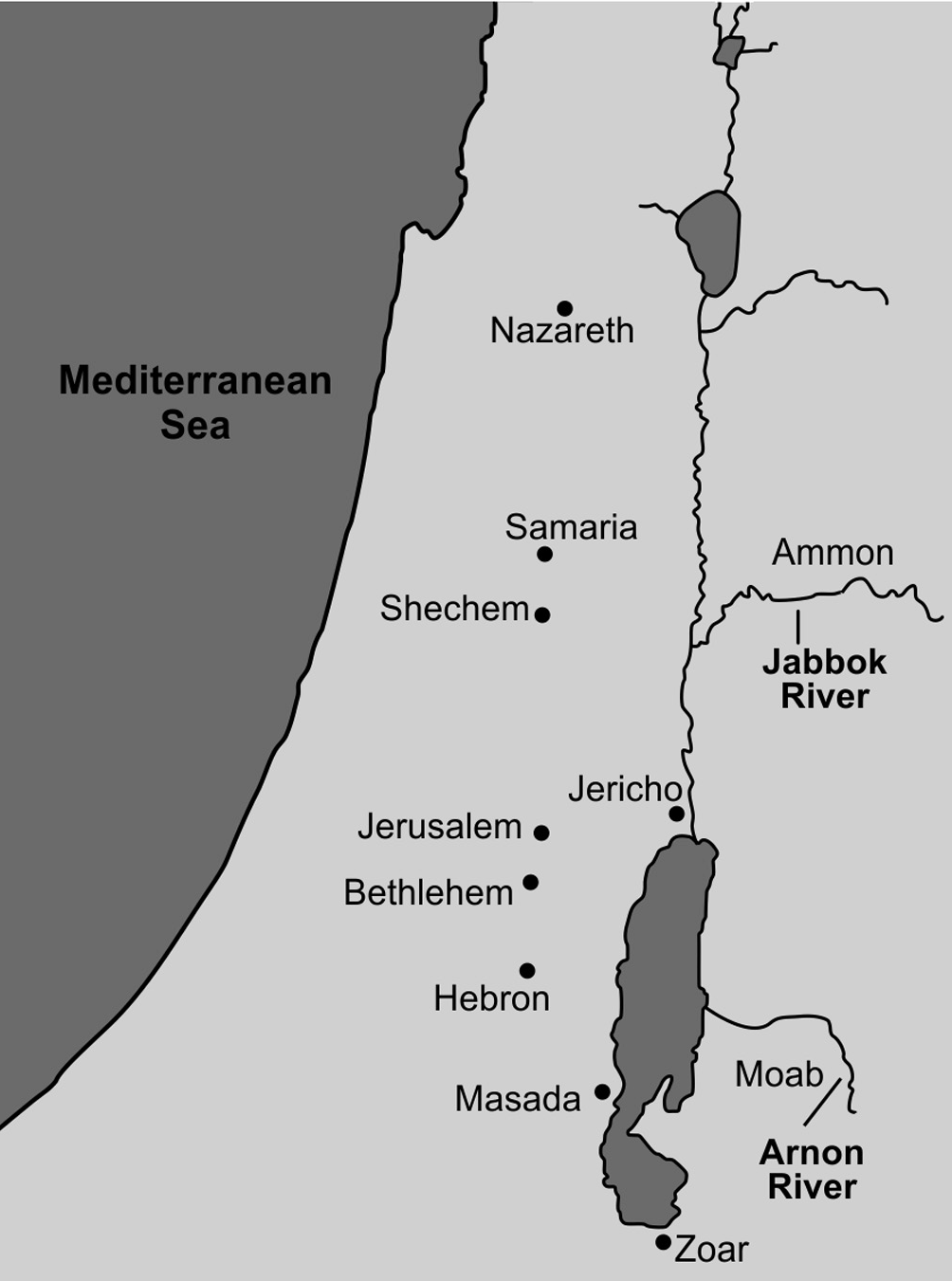
Map of Israel including the Arnon and Jabbok Rivers
His donkey saw what Balaam did not, the angel of God with sword drawn to take the life of Balaam. Three times the donkey refused to go forward. At first he diverted in a field, then in a narrow area turned against a wall injuring Balaam’s foot, at last dropping to the ground refusing to carry Balaam forward any further. Each time Balaam responded by beating the donkey, whereupon the beast of burden replied verbally.
THE LESSON
There are prophetic lessons in the story of Balaam that pertain to the Church of Pergamos, but of course all the lessons for each stage of the Church have something of value for each Christian. We should not be turned aside by wealth, worldly honors, or esteem of others, from seeking chiefly the will and mind of God. “He that has learned to see nothing but the will of God shall always find what he seeks” (R966). But he that is allured by worldly things risks loss of the spiritual treasures of far greater value.
During the third phase of the Church, this did happen. After the pains of persecution in the Smyrna period eased, Constantine, whose mother was Christian, tendered earthly honors to the leaders of the Church. In return he wished their cooperation in his goal of a unified political domain. To accept relief from persecution was wonderful. But to engage in the politics of this world was a dangerous diversion from the spiritual interests regarding the coming kingdom.
The donkey that Balaam rode represents the teachings that carried the Church forward. The sweet instruction of the scriptures had served the saints well for a long time. But during the Pergamos period those teachings would not take the Church where some of her leaders wished to go — just as Balaam’s donkey would not take him where he wished to go.
“The angel of Jehovah stood in a path of the vineyards” (Numbers 22:24). This was an appropriate place to remind us of Jesus’ followers, for he is the vine, and we are the branches (John 15:5). When the donkey saw the angel, he refused to go further. But Balaam, blinded as it were by his desire to push on, was oblivious. In his anger, he smote the animal, leading it to speak in remonstrance, “What have I done unto thee, that thou hast smitten me these three times?” (Numbers 22:28). Possibly the mention of three times has some connection to the fact that the episode relates to the third period of the Church.
Balaam replied, “Because thou hast mocked me: I would there were a sword in mine hand, for now would I kill thee” (Numbers 22:29). This may suggest that the Church by this point had lost the “sword of the Spirit” (Ephesians 6:17). The Truth had measurably corrupted already by this time, and Christians had now become embroiled in disputations over continuing corruptions that resulted in the false teaching of the trinity.
As the story unfolds, Balaam is allowed to go forward on the pledge that he would only speak what God would give him. Time after time when Balaam opened his mouth to curse Israel, he could only bless them, aggravating his benefactor, Balak. At last Balaam found a means of satisfying Balak’s wishes to bring a curse on Israel, by seducing the Israelites with pagan women. This seduction led many of the Israelite men to join in pagan festivals, and these sins are referred to in Revelation 2:14, “Balaam, who taught Balac to cast a stumbling block before the children of Israel, to eat things sacrificed unto idols, and to commit fornication.”
Spiritually, this refers to the idolatry of earthly things and the illicit union with this world’s political affairs. Many Christians succumbed. As the developing Church of God began growing in earthly prosperity, honor, and authority, they became proportionately corrupted and this ultimately led to the establishment of Papacy as an apostate but powerful system that acted against the true saints of God.
In Balaam’s day, 24,000 Israelites perished because of their infidelity, and ultimately Balaam himself lost his life when Israel pressed forward (Numbers 25:9, Jude 1:11). This large loss of life probably represents the loss of spiritual life by those who left their spiritual aspirations for earthly attractions.
BALAAM’S PROPHECY
While Balak was seeking to induce Balaam to curse Israel, one of Balaam’s utterances, through the Spirit of God, predicted things to come that indicated the success Israel would achieve in later times. “He … saw the vision of the Almighty, falling into a trance, but having his eyes open: I shall see him, but not nigh: there shall come a Star out of Jacob, and a Sceptre shall rise out of Israel, and shall smite the corners of Moab … And Edom shall be a possession, Seir also shall be a possession for his enemies; and Israel shall do valiantly. Out of Jacob shall come he that shall have dominion, and shall destroy him that remaineth of the city” (Numbers 24:16-19).
Evidently this is a prophecy about Jesus and his ultimate victory centuries after the days of Balaam, thus his expression, “Alas, who shall live when God doeth this!” (verse 23). The star Balaam mentions reminds us of the Star of Bethlehem that signaled the birth of Jesus. The victory over Moab and Edom perhaps represents the ultimate victory of Jesus over the political and religious segments of apostate Christendom, which rose during the Pergamos phase and ruled mightily during the Thyatira phase of the Church. Moab’s king was Balak, the king who hired Balaam, and Edom is thought by many brethren to represent Christians who have sought out earthly things, a bowl of pottage as it were, while giving up their spiritual heritage. These two branches of Christendom — political and religious — persecuted the true Church during the age, and this prophecy points to their eventual demise under King Jesus.
King David was a lesser and more ancient fulfillment of these texts. David is notable for the “star of David” that is an emblem of united Israel. In 2 Samuel 8:2 David is said to have subdued Moab, and 2 Samuel 8:14 speaks of his having subdued Edom. In this David was an example and picture of Jesus, the “son of David,” who would fulfill the passage in a fuller way.
— Br. David Rice