
Queen Esther
“And [Mordecai] brought up Hadassah, that is, Esther, his uncle’s daughter: for she had neither father nor mother, and the maid was fair and beautiful; whom Mordecai, when her father and mother were dead, took for his own daughter” (Esther 2:7).
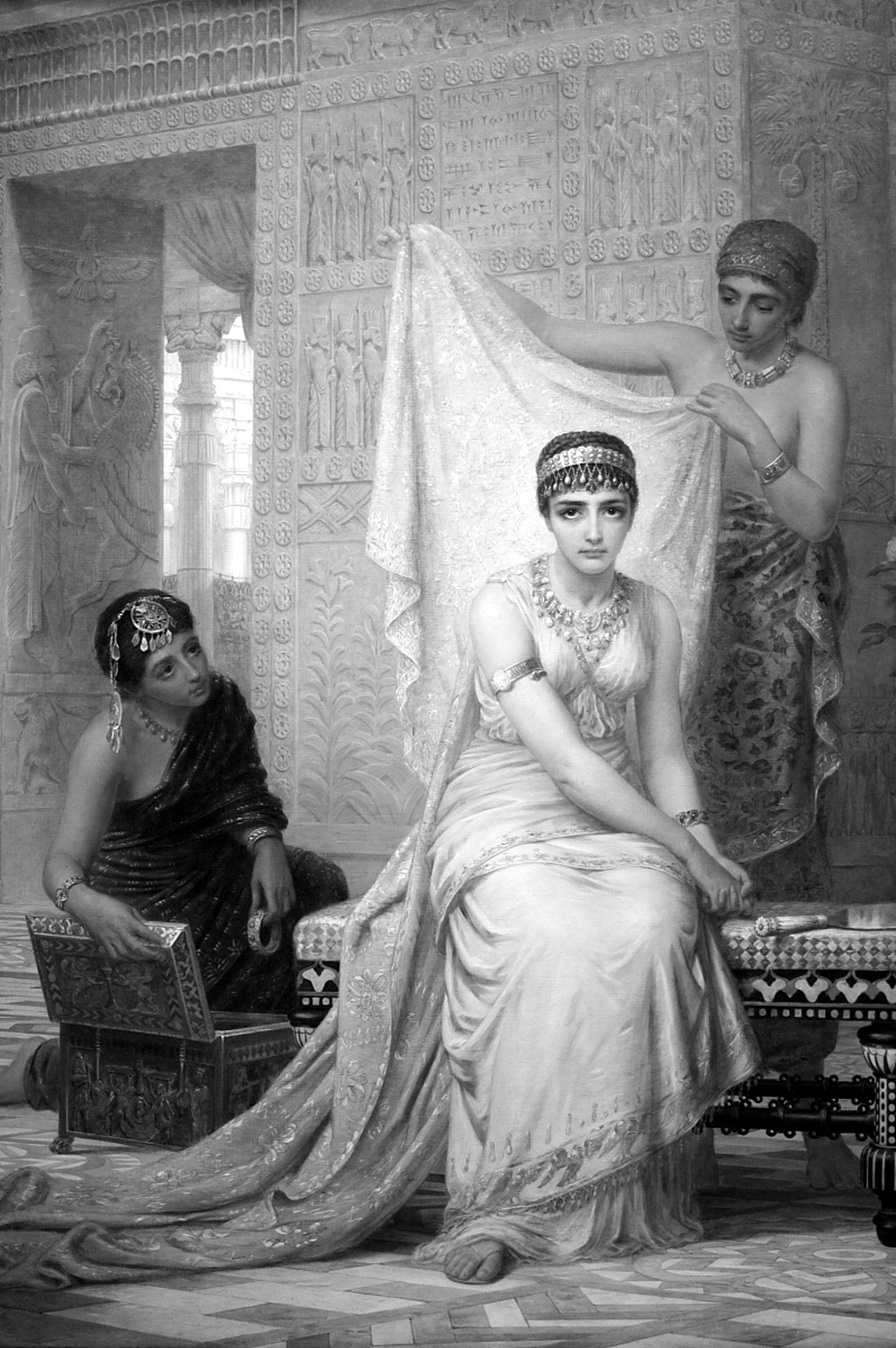
Queen Esther was selected as a consort for the great king from young ladies throughout the empire. Only the fairest need apply, for the selection was on the basis of beauty and grace — not pedigree, social standing, or position. The king in this episode is “Ahasuerus,” which is a rendering of the Hebrew name applied to the king. He is better known in Greek history as Xerxes.
Esther was not called to be the queen of the empire. That was a person known to us from the narratives of the Greek historian Herodotus, who gives her name as Amestris. The events of her life described by Herodotus show her to be a very vindictive person, not what we might suppose of Esther. Beyond this there are certain historical facts about Amestris that make it certain that she is not the same person as Esther. Amestris was the daughter of Otanes, a Persian general who was uncle to Ahasuerus — not a Jewess, such as young Esther. Amestris was married to Ahasuerus before the events of the book of Esther unfold. Her sons were men of age before Esther was ever introduced to the king (Mc&S, “Esther,” page 307).
The position to which Esther was called was queen of the royal harem. That was the position occupied also by Vashti, Esther’s predecessor. This accords with the use of the expression “keeper of the women” in Esther 2:3,8,15. Amestris, the wife of Xerxes, had regular access to him, whereas Esther, even when exalted as queen of the harem, was in trepidation of her life for approaching the king unless he called for her.
A PICTURE OF THE CHURCH CLASS
Esther, selected for her beauty and grace, represents the Church class that is called to highest station based on their beauty and grace of character. The book Song of Solomon likewise depicts the church as exquisitely lovely. The meaning for the Church class is that we must be fair, lovely, gracious, in character, heart, mind, thought, if we are to be attractive to our king Jesus. Any Christian person knows that outward appearance is not what either God or Christ are concerned with. “Jehovah looketh on the heart” (1 Samuel 16:7).
Jesus said in John 15:8, “Herein in my Father glorified, that ye bear much fruit; so shall ye be my disciples.”
There are two well know lists of the kind of spiritual fruitage that we are to bear. Galatians 5:22,23 gives this list: “love, joy, peace, longsuffering, gentleness, goodness, faith, meekness, temperance.” 2 Peter 1:5-7 says to add to our faith these seven qualities: virtue, knowledge, temperance, patience, godliness, brotherly kindness, charity. To re-express this list in more apparent terms, we are to be moral, understanding, self-controlled, enduring, godly, and add two kinds of love: phileo (brotherly affection) and agape (unselfish love, concerned for the highest welfare of the other).
Inasmuch as we have two lists of these qualities of character, one from Paul and one from Peter, sometimes we use the expression “fruits and graces of the Spirit,” which may derive from these two lists. We should apply ourselves to these qualities not casually, slowly, with indifference, but as Peter expresses it, “giving all diligence.” The experiences of life are the means by which we grow into what may be considered lovely, to our heavenly groom. We should apply ourselves to these experiences. We should consider our reactions, our motives, our words, our thoughts, our conduct, in light of what we are seeking to achieve from our experiences. We should be assiduous respecting this. A bride does not casually prepare for her wedding.
ESTHER, CHAPTER ONE
“Now it came to pass in the days of Ahasuerus (this is Ahasuerus which reigned from India even unto Ethiopia, over 127 provinces), That in those days, when the king Ahasuerus sat on the throne of his kingdom, which was in Shushan the palace, in the third year of his reign, he made a feast unto all his princes and his servants; the power of Persia and Media, the nobles and princes of the provinces, being before him: When he shewed the riches of his glorious kingdom and the honour of his excellent majesty many days, even 180 days” (Esther 1:14).
The number of provinces is 127. This number is not common, but it appears conspicuously in the age attained by the only woman in the Old Testament whose age at death is recorded. That is, Sarah, the wife of Abraham. In Galatians chapter four Paul says that Sarah and Hagar represent two covenants. The two covenants that Paul discusses in chapter three are the Abrahamic Covenant and the Law Covenant. Hagar is clearly associated with the Law, so Sarah evidently connects with the Abrahamic Covenant.
However, that covenant pertains to three ages. The Jewish people were under this promise. Paul says that the Law was added to it, but did not abrogate the original promise (Galatians 3:17, 19). However, as Sarah was long barren before producing the child or seed through which the blessings would come, so the covenant was “barren” of producing the real heir, Christ, for many centuries. Then Sarah did have her child of promise, Isaac. He represents Jesus, but also the Church class, “If ye be Christ’s, then are ye Abraham’s seed and heirs” (Galatians 3:29).
Thus Sarah in particular represents the spiritual part of the Abrahamic covenant. By contrast, Keturah, who bore six sons, represents the earthly part of the Abrahamic covenant. Sarah pertains to the Gospel Age, Keturah to the Millennial Age. Keturah’s six sons represent mankind. Evidently these were produced while Keturah was still a concubine (1 Chronicles 1:32). But after the passing of Sarah (the end of the Gospel Age), Keturah became a full wife and the status of her children was elevated, as it will be with the world during the Millennium.
Sarah, who attained the age of 127, corresponds to the heavenly calling of the Church, represented by Esther, whose king ruled 127 provinces. There is the connection. Both numbers pertain to the saints. This number is a prime number, it is not evenly divisible by any other whole number (other than one). So perhaps the meaning of this number is simpler — the first two digits (12) and the final digit (7) each depicting the heavenly calling in its own way. In Revelation, the elect church is depicted by the number 144, or 144,000 (Revelation 21:17, 14:1), which involves 12 x 12. The church is also depicted as in seven parts, the seven churches of Revelation, and seven “days” of Leviticus 8:33.
HISTORICAL BACKGROUND
Ahasuerus, Xerxes, was one of 11 rulers of the MedoPersian Empire. Here is the sequence — Cyrus, Cambyses, Smerdis, Darius, Xerxes, Artaxerxes — that takes us from the days of Daniel to the days of Nehemiah. Then followed Darius II, Artaxerxes II, Ochus, Arogos, and finally Darius III, also termed “Codomanus” in Volume three. It was that king that was defeated by Alexander the Great. He is also referred to in Nehemiah 12:22 as “Darius the Persian” in whose time Jaddua served as high priest — the latest historical reference in the entire Old Testament.
Cyrus was in the days of the aged prophet Daniel. The first Darius is known in history as Darius Hystaspes (Hystaspes was his father). This was the Darius mentioned in the books of Haggai, Zechariah, the fourth chapter of Ezra, and in Ezra 6:15, when the temple rebuilding was completed. Xerxes is the Ahasuerus of Esther, and Artaxerxes was the king under whom Ezra returned (year seven) and Nehemiah returned (year 20).
Smerdis reigned but a few months, but recognizing his reign is critical to the fulfillment of the prophecy in Daniel 11:1-2. During the reign of Cyrus, Gabriel told Daniel, “There shall stand up yet three kings in Persia [Cambyses, Smerdis, Darius]; and the fourth [Xerxes, Ahasuerus] shall be far richer … and by his strength through his riches he shall stir up all against the realm of Grecia.”
Here the prophecy of Daniel connects to the story of Esther. The Grecian campaign of Xerxes is the reason for the six-month conclave mentioned in Esther. Ahasuerus was preparing his conquest of Greece. In picture, this represents that Jesus also was preparing for a conquest of the Gentile world, represented by the Greek-speaking believers who were served the Gospel by Paul and others.
Notice this concept of conquering the “Grecian” gentile world also in Zechariah chapter nine. Verse 9 is famously about Jesus, “Thy King cometh unto thee … lowly, riding upon an ass, and upon a colt the foal of an ass.” Verse 13 then speaks of a campaign against Greece. “I have bent Judah for me, filled the bow with Ephraim, and raised up thy sons, O Zion, against thy sons, O Greece.” This was fulfilled literally during the Maccabean battles of Israel against their Greek-Syrian overlords, but spiritually fulfilled by the “battles” to convert Gentiles to Christ.
Xerxes made great in-roads into Greece, but he did not conquer the country. Likewise Jesus made great in-roads into the Gentile world with the Gospel, but he does not convert the world in this age. His conquests, “thine arrows are sharp in the heart of the king’s enemies” (Psalms 45:5, Revelation 6:2), cause arrows of truth to enter the hearts of unbelievers, converting them to be followers of Christ.
Thus the historical background of the book of Esther fits well as an episode depicting the beginning of the Gospel Age selection of the Church.
VARIOUS SPECIFICS
Esther 1:6 says there were hangings of white and blue, fastened with cords of fine linen and purple to silver rings and pillars of marble. There were beds of gold and silver, and a pavement of red, blue, white, and black marble. The opulence shown here symbolizes the preciousness of our calling. God’s people may be poor in this world’s goods, but the wealth and treasure of their calling is beyond compare. The colors white (purity), blue (faithfulness), purple (royalty) are all fitting to the meaning. (The color green in verse six is evidently a mistranslation.)
The pavement included red (redemption) and black (Song of Solomon 1:5) marble, the element that is depicted in Song of Solomon 5:15 as the foundation established in Christ. The scene is in the third year of the reign of Ahasuerus, three being a picture of redemption, is also fitting for the opening of the Gospel Age.
The six months of preparation for the conquest is picked up later in the story in six months of oil, and six months of perfume, in the preparation of Esther (Esther 2:12), perhaps showing that the Gospel Age is still a time of imperfection while the curse of 6000 years rests upon the world.
Esther 1:7 says there was abundant royal wine for the guests, picturing the wine of redemption, in diverse vessels of gold, referring to divine truths of diverse sorts in the Gospel. In drinking, “none did compel” (verse 8), just as redemption now is available for those who wish it, but none are compelled.
— To be continued