
Prophetic Events Closing Zechariah
The closing three chapters of Zechariah narrate the sequence of prophetic events that take Israel and mankind from blindness into Kingdom blessings. In 12:1-9 we find the deliverance of Judah and Jerusalem and the judgment of the nations; 12:10-14 links this future deliverance to recognizing the Messiah by a faithful portion of the Jewish people; 13:1 speaks of opening the wonderful fountain of grace and supplication; 13:2-6 gives us an insight into the very personal struggle to cut-off the many modern forms of idolatry that separate man from God; 13:7-9 speaks of the judgment that begins with the house of God and continues through the uplift of the willing and obedient who come into the New Covenant. Finally, chapter 14 casts an eye back and gives a rich description of the battle in which the Lord of Host’s power will be revealed.
There will be two phases to this kingdom — heavenly and earthly — north and south (D650-655). The stream of blessing will flow from Jerusalem and obedience will be demanded from the Gentiles when every impulse shall be “Holiness unto the Lord.”
However, the time sequence in these passages also refers to past events that show part of the divine program already accomplished. For example; Zechariah 13:7 says, “Awake, O sword, against my shepherd, and against the man that is my fellow, saith the LORD of hosts: smite the shepherd, and the sheep shall be scattered.”
This is cited by three Gospels writers as fulfilled at the death of our Lord (See Matthew 26:31, Mark 14:27, John 16:32).
SYMBOLIC AND LITERAL LESSONS
This prophecy has both literal and spiritual applications, but the symbolic sense should be our focus. To quote directly from Pastor Russell (D650): “The establishment of the New Jerusalem … as the new government in the earth, will mean the beginning of the restoration of divine favor to Jehovah’s footstool, [as] is clearly set forth through the Prophet Zechariah 14:4,5. Jehovah’s Feet on the Mount of Olives … [are] the feet of our Lord Jesus, at his second advent: and indeed, those who … assert that it will be the feet of flesh, pierced with the nails of Calvary … [are] not realizing that our Lord gave his human nature, complete and forever … And if the placing and resting of Jehovah’s “feet” is symbolic … so, we may be sure, other features connected in the same prophecy are symbolic: the Mount of Olives, its peculiar division, its valley, the flight of the people, the waters of life from Jerusalem (Ezekiel 47:1-9) are all symbolic — pictures of grand spiritual truths.”
And yet, this prophecy refers especially to the literal nation of Israel. The proof is in its words — Zechariah 12:6: “Jerusalem will remain intact in her place” (NIV). Although it is true that we can interpret Jerusalem as the symbol of the city of peace, or, based on Revelation 21:2 as New Jerusalem, this description of Jerusalem being “intact in her place” leaves no doubt that it points to the physical location of Jerusalem where it has existed continually for 3000 years. Parts of this prophecy which refer to great distress also refer to other nations, based on the rule from Romans 2:9-10, “Tribulation and anguish, on the Jew first, and also of the Gentile; glory, honour, and peace to the Jew first, and also to the Gentile.”
JERUSALEM AS A BURDENSOME STONE
“And in that day will I make Jerusalem a burdensome stone for all people: all that burden themselves with it shall be cut in pieces, though all the people of the earth be gathered together against it” (Zechariah 12:3).
If we say this prophecy is about literal Israel, we note that for the past century Jerusalem has truly become a burdensome stone to all the nations. One proof is the number of resolutions by the United Nations Security Council regarding this tiny portion of our planet. As Prime Minister Netanyahu said reproachfully to the United Nations Secretary, “The Human Rights Council has issued more resolutions condemning Israel, than against all other countries combined.” Since the very beginning, Jerusalem’s status has remained the focal point of the conflict, precluding any peace agreements.
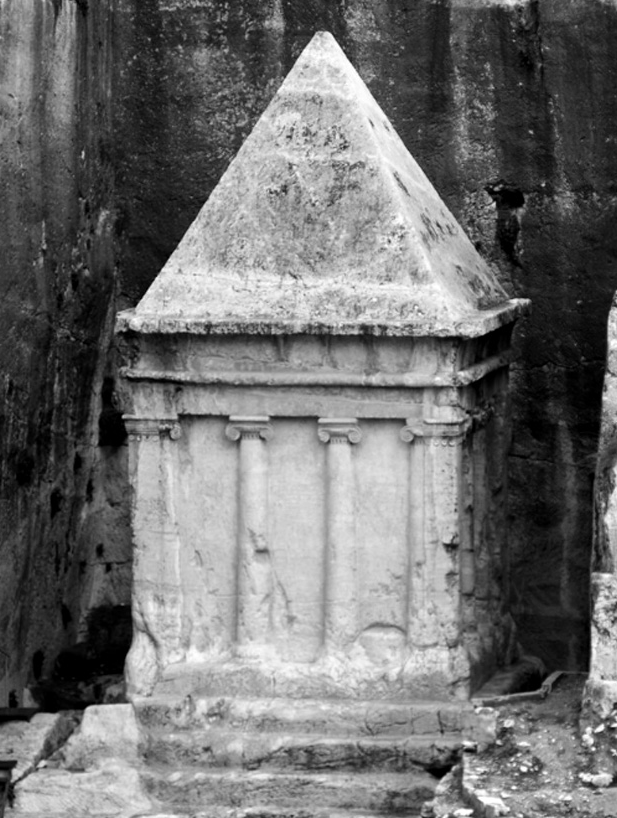
The tomb of Zechariah
Natural Jerusalem has now become Israel’s capital. The sequence of events as set forth by Pastor Russell in 1879 still works and we are between point 3 and 4 (R26). Here are the events he describes:
(1) The ‘Time of trouble” such as was not since there was a nation.
(2) The Jews return to Israel and the Jewish nation is reorganized.
(3) The gathering of great wealth to Jerusalem which tempts the hordes of Gog, Togarmah [Turkic peoples] and many peoples to go up “to take a spoil.”
(4) ‘The battle of the great day of God Almighty’ fought at Jerusalem.
(5) The partial success of the invaders and in the hour of darkness to the Jew the power of Messiah is manifested effecting their deliverance.
(6) Their recognition of the long waited for Messiah and the cry “Lo this is our God, we have waited for Him and He will save us.”
(7) Their recognition of him as the one “whom they have pierced” (Zechariah 12).
(8) God will “pour upon them the spirit of grace and supplication” and they shall mourn and be accepted again into fellowship with God.
PRINCES OF JUDAH
“And the governors of Judah shall say in their heart, ‘The inhabitants of Jerusalem shall be my strength in the LORD of hosts their God’ ” (Zechariah 12:5).
The word “governors” of Judah in this verse is better translated “chieftains” (H441). It is a term used for the leaders of many of Israel’s foes and is translated “dukes” in King James. These may refer to Israel’s leaders of today who are confident of victory. They rely on the cooperation of Israel’s and Jerusalem’s citizens, believing that they can count on the Israeli Defense Force’s religious zeal to preserve Israel’s safety (Isaiah 37:35, 2 Chronicles 13:18).
THE TENTS OF JUDAH FIRST
“The LORD also shall save the tents of Judah first, that the glory of the house of David and the glory of the inhabitants of Jerusalem do not magnify themselves against Judah” (Zechariah 12:7).
Usually the open countryside and small towns of Judah were the first to be taken by the enemy (Jeremiah 34:7, 2 Chronicles 32:1-8). The citizens of Jerusalem of that day were prone to look down on the rural population, exhibiting a state of mind not altogether uncommon also in our day.
Tradition says that Messiah first arrives by the Eastern gate of Jerusalem. Both pious Jews and Moslems have sought to have their tombs close to the Eastern gate, expecting the resurrection and last judgment to begin there. Zechariah 12:7, speaking of “the tents of Judah,” does not support this tradition. The Eastern Gate was destroyed during the Roman conquest of Jerusalem, and the subsequent destruction of the Temple in AD 70, thus fulfilling Christ’s prophecy that “not one stone will be left on top of another” (Matthew 24:2). Prior to this, the Eastern Gate had never been sealed. Sometime in the sixth or seventh century, the Byzantines rebuilt the Eastern Gate. However, the Ottoman Sultan Suleiman I sealed the Eastern Gate in 1541 AD. Though Jerusalem is strongly fortified, the Royal City, the City of God’s Temple and the location of King David’s palace, yet Judah, the Holy Land outside the city’s limits, is delivered first.
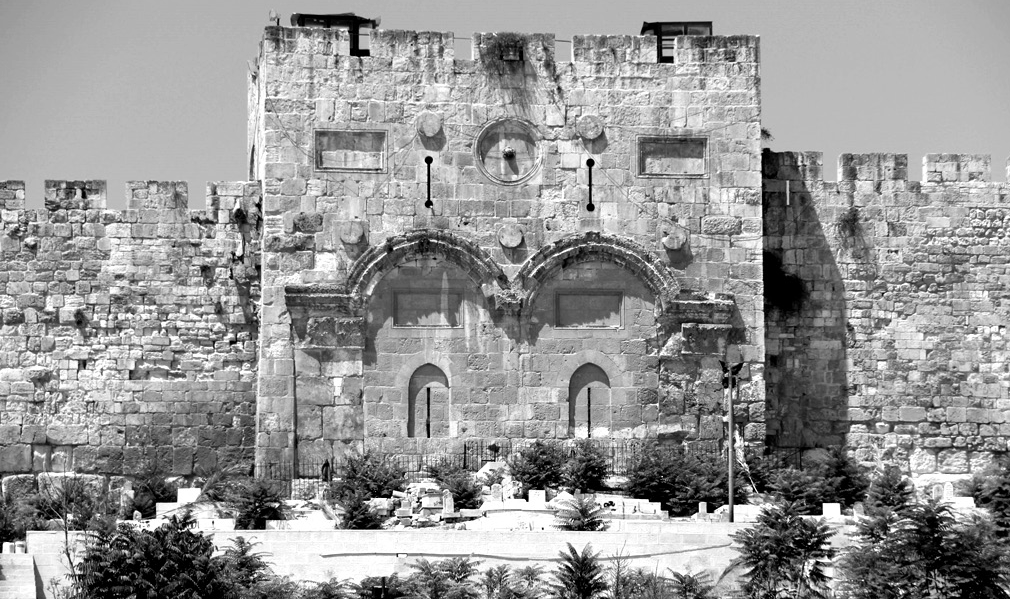
The sealed Eastern Gate of Jerusalem
This is supported by Ezekiel 20:33-37 as it speaks of deliverance outside the city. “And I will bring you into the wilderness of the people, and there will I plead with you face to face.” As in the 40 years wilderness wandering, the rebels will be purged out of the people. Applying both the tents and city on a natural level, possibly, the strikingly different outlooks on life can be expected when comparing city versus tents. Haves vs. have-nots may be the symbolic meaning. Despite the unprecedented miracle of Israel’s technological and economic success, the immigration to Israel has disproportionately drawn from poor Jews. The tents of the have-nots will be the first delivered. [Editor’s note: Or, the “tents of Judah” — the faithful church — will be resurrected first; so that fleshly Israel will not exalt themselves above the Christ/Anointed class. JBP]
Relationships of these groups. The political leaders of the current state of Israel (Princes of Judah) will find their office taken by the Ancient Worthies (Micah 5:5). These are assisted by the House of David, the Tents of Judah, and the Inhabitants of Jerusalem, all who share in joyful service. Zechariah 12:9 speaks of Israel’s enemies, “And it shall come to pass in that day, that I will seek to destroy all the nations that come against Jerusalem.”
INHABITANTS OF JERUSALEM AND THE HOUSE OF DAVID
“In that day shall the LORD defend the inhabitants of Jerusalem; and he that is feeble among them at that day shall be as David; and the house of David shall be as God, as the angel of the LORD before them” (Zechariah 12:8).
The inhabitants of Jerusalem and the house of David are warned of pride in verse 7 and will then (D627) mourn for the one pierced (Zechariah 12:10-12). Clearly, these must both be earthly classes.
Inhabitants of Jerusalem. After the return from Babylon, Jerusalem was inhabited by a portion of all those who came back. Nehemiah 11:1 states: “And the rulers of the people dwelt at Jerusalem: the rest of the people also cast lots, to bring one of ten to dwell in Jerusalem the holy city, and nine parts to dwell in other cities.”
The inhabitants of Jerusalem symbolize those who in our day — mindful of the promises — returned and now live in the Holy Land, just as they did in Nehemiah’s time. What distinguishes this class may be that they are the educated, cultured, and wealthy Jews who have returned, possibly even dwelling in Jerusalem (OV81:3). The inhabitants of Jerusalem now comprise about 10 percent of Israel’s entire Jewish population.
The House of David signifies King David’s descendants. It would be hard to identify the literal offspring of King David among today’s Jews. Zechariah 12:10 speaks about outpouring of the spirit of grace and supplications upon the house of David. This may point to a group described today as Messianic Jews. The House of David then may include these Messianic Jews and will come into the New Covenant and directly assist the Ancient Worthies.
THE SPIRIT OF GRACE AND SUPPLICATIONS
“And I will pour upon the house of David, and upon the inhabitants of Jerusalem, the spirit of grace and of supplications: and they shall look upon me whom they have pierced, and they shall mourn for him, as one mourneth for his only son, and shall be in bitterness for him, as one that is in bitterness for his firstborn” (Zechariah 12:10).
The outpouring of the holy Spirit follows Israel’s deliverance and is also elaborated on in Joel 2:28,29 (R2504:5, R376:5). Israel’s eyes will be opened to recognize Him whom they rejected. Part of this work of grace is the message that the land of Israel is theirs, that their period of chastisement is at an end, and that Israel’s prayers and supplications will bring the blessings of the New Covenant. This will come to them as newly converted Messianic Jews, believing in Jesus (Yeshua HaMashiach, i.e. Jesus the Messiah) (R3970:3, R4735:6, Q94:1).
The word “grace” here is better understood as “pardon.” The people are going to pray and beg forgiveness. It will be a special moment, with the return of Yeshua HaMashiach, the son of David, the one they rejected. It will be a moment of “grace and pleading,” a great cry of repentance of the people. (Isaiah 11:2-5, Ezekiel 11:19-21, Jeremiah 32:39-41, Jeremiah 31: 31-33, Ezekiel 36:26-27).
EVERY FAMILY SHALL MOURN
“The land shall mourn, each family by itself: the family of the house of David by itself, and their wives by themselves; the family of the house of Nathan by itself, and their wives by themselves; the family of the house of Levi by itself, and their wives by themselves; the family of the Shimeites by itself, and their wives by themselves; and all the families that are left, each by itself, and their wives by themselves” (Zechariah 12:12-14).
A symbolic fountain will be opened for cleansing sin.
The interpretation of the individual mourning groups depends on the identification of the families. The house of David and that of Levi are self-evident, but Nathan and Shimei are more difficult. Some commentators say Nathan is the prophet Nathan from 2 Samuel 7:2,4,14; others claim he is the son of David from 2 Samuel 5:14. From Luke 3:31 we see that Mary descended through the line of king David by this son Nathan. (See Beauties of the Truth, November 2015, “Mary, the Mother of Jesus.”)
Shimei poses an even bigger problem. Rashi comments that it is David’s first son by Bathshua (1 Chronicles 3:5); others point to Levi’s grandson (Exodus 6:17) or to Shimei from the house of Saul, who cursed David in 2 Samuel 16:5.
Weeping in separate groups may mean weeping for different reasons and in different ways — just like there are tears of joy and tears caused by sadness.
Some, like the house of David (Messianic Jews), and the house of Nathan (prophets) cry for joy, seeing the long-awaited Messiah. Others — the house of Levi — are the spiritual leaders. The house of Shimei from the line of Saul and the tribe of Benjamin would represent those who persecuted Jesus and His followers. Their bitter weeping and heart condition will resemble those of another Benjamite, the Apostle Paul, who long ago saw the Messiah on the way to Damascus and repented of his maltreatment of the early church.
In Matthew 24:30 Jesus described the time when “all the tribes of the earth will mourn.” Revelation 1:7 has a similar description. These passages speak of the world of mankind coming into the kingdom, all in grievous error. All mankind will have much cause to mourn, but their reasons for mourning differ from those of the Jews in Zechariah 12.
The expression in verse 12:14, “all other families,” probably does not refer to the remaining 10 tribes, scattered during the Assyrian captivity. Each Jewish family weeping by itself indicates that the recognition of Messiah will be very, very personal. Each family will reflect on the mishneh (double) of pain and suffering that their nation has experienced.
THE FOUNTAIN OPENED
“In that day there shall be a fountain opened to the house of David and to the inhabitants of Jerusalem for sin and for uncleanness” (Zechariah 13:1).
The willing inhabitants of Jerusalem and of the house of David will be permitted to wash their sins at the open fountain. By faith in the blood of Christ they will be made every whit whole. They will be blessed with restitution to all the privileges and qualities and powers of mind and body lost by Adam’s disobedience (R1710). The purification process will affect not only their bodies, but will cleanse the world of any idol worshiping. Every false prophet will be exposed. The practical steps in this process are listed in Isaiah 58:6-14. Note especially the word arukah (H724), “health,” in Isaiah 58:8. This suggests a direct health benefit to one’s heart repentance.
As mentioned before, the cleansing from sins will apply first to the house of David and the inhabitants of Jerusalem. Pastor Russell explains it well: “While Israelites in various stages of unbelief will be gathered back to Palestine under divine favor, according to promise, yet none shall be in any degree reckoned as a part, or even as supporters of, or associated with the earthly phase of the Kingdom, except as they shall first recognize Christ Jesus as the Son of God, the only Redeemer and Deliverer for Israel and the world” (D625).
REMOVAL OF FALSE IDEOLOGIES
“And it shall come to pass, that when any shall yet prophesy, then his father and his mother that begat him shall say unto him, Thou shalt not live; for thou speakest lies in the name of the LORD: and his father and his mother that begat him shall thrust him through when he prophesieth” (Zechariah 13:3).
We see from this passage that some false worship, sinful ways and wrong ideologies will continue into the Kingdom. It could not be otherwise. However, most will be ashamed of their former ways (Zechariah 13:4-6) and reform. Perhaps the recovery of these erring ones will employ something similar to the “truth commissions” operating in over 41 countries today.
Israel, and all, will come to repentance at the cross of Christ.
“And it shall come to pass, that in all the land, saith the LORD, two parts therein shall be cut off and die; but the third shall be left therein. And I will bring the third part through the fire, and will refine them as silver is refined, and will try them as gold is tried: they shall call on my name, and I will hear them: I will say, ‘It is my people:’ and they shall say, ‘The LORD is my God’” (Zechariah 13:8,9).
These verses speak of the division of the land into three parts. This is reminiscent of what transpired at the First Advent. There, two groups united were against our Lord. The first group consisted of those with worldly ambition like Caiaphas, a Sadducee, who spoke lofty words about serving “the nation,” while, in reality, they were worried about losing their position (John 11:50). The second group were the religious conservatives, Pharisees, who were offended by Jesus for setting aside their unwise rules (see Mark 3:5).
Verse 9 appears to directly reference Isaiah 1:21-26 where the “two parts” are identified as the “dross” and “tin.” The “dross” suggests this first secular, worldly, ambitious element of Israel’s society, like Caiaphas of old. The “tin” suggests the multitude of unscriptural traditions. Tin appears as “silver,” i.e. “truth,” but it is not. These are the forces that crucified Jesus.
The three parts appear to be speaking of conflicting ideologies that still live on today. One part, like Caiaphas, includes the views held by atheists, secular Jews, liberals etc. There will be no place for these ideologies in the Kingdom. On the other end of the spectrum, one third of the regathered Jewish people are comprised of “ultra- orthodox” Jews and other far-right nationalists, whose ideology is much different from that of the Messiah’s Kingdom.
These extreme views, today popularly called left-wing and right-wing, will then become totally disgraced in the eyes of all people, and thus slain. We can expect, however, that the third part — the center — to carry ideas that after cleansing and trying like silver and gold will be developed in the Kingdom. Among these ideas may be the need for Israel to continue being an example for the world, assisting other nations. Israel’s present ability to reclaim desert places and other similar programs will grow and prosper under the kingdom arrangement.
REVIEW OF THE BATTLE FOR JERUSALEM
Many prophecies mention the gathering of all nations both to tear down the old order and to oppose Israel (Joel 2:1-11, Ezekiel 38:2-8, Micah 5:4). Joel 2:12-18 suggests that those who pray for deliverance will survive. Perhaps the desolation and destruction are meant for those who will not trust in God, but — just as we see today — they will attempt to defend themselves with their own weapons. In Zechariah 14:1-3 we find that things will go against Israel at the start of this battle. Joel 2:12-18 speaks of a solemn fast that is called by the faithful Jews. Micah 5:5 suggests that the Ancient Worthies (eight princes of men) will be resurrected. Hence, we would likely expect that the church and Great Company will be off the scene by that time.
As the situation becomes extreme, the Lord fights as “in the day of battle” against the nations who are oppressing His chosen people. He will fight as only He, the Man of War, the One God, can fight. (Exodus 15:3). God will fight on behalf of His own people, the people of Israel. It is so amazing. On this day God’s justice and judgment, as well as His grace and mercy, will be manifested in a manner far surpassing human understanding and thought. This certainly means a combination of many elements; including unnatural phenomenon (Joshua 10:14,42,25); confusing Israel’s enemies so they turn their own weapons on each other (Judges 7:21-22, 2 Chronicles 20); confusing Israel’s enemies so that Israel has a strategic advantage (2 Kings 3:9-27); severe weather (Joshua 10:11, 1 Samuel 7:10), and plague (Isaiah 37:36). Giving special strength to Israel (Judges 4:15, 1 Chronicles 14:9) will come, but not until late in the battle. Zechariah 14:12 also mentions the plague element.
JERUSALEM, THE WORLD CAPITAL
The city of Jerusalem will serve as the world capital and all nations of earth will send their ambassadors to Jerusalem (Isaiah 33:20; OV69:1). The earthly representatives of Jesus and the church will be the Ancient Worthies, for Jesus and the church will not be visible to man.
Zechariah closes with a joyful description of keeping the Feast of Tabernacles, or Succoth, in the Kingdom (Zechariah 14:19). Tisha B’Av,1 and three additional fasts, will now be feasts of joy (Zechariah 8:18,19). According to Ezekiel, the Passover will also be celebrated in the future (Ezekiel 45:21). Although both prophets describe offering sacrifices, these may not consist of actual animals or food; rather — as Peter says in 1 Peter 2:5 — they may be spiritual sacrifices. As we read in the Psalms, “Thou desirest not sacrifice; else would I give it: thou delightest not in burnt offering. The sacrifices of God are a broken spirit: a broken and a contrite heart, O God, thou wilt not despise” (Psalms 51:16,17). But whether the sacrifices be actual animals as part of the education process for the world and in remembrance of the night of sin, or whether they are not, their spiritual lesson will be of the utmost importance.
— Condensed from an “after-hours” panel at the
2016 International Convention, Szczyrk, Poland.
(1) “Tisha B’Av” is Israel’s mid-summer period of mourning during which Jews remember the events that led to the Babylonian conquest of Jerusalem and the destruction of the first temple.