
Ancient Hebrew Text
Discovery of a text that may be the most ancient example of Hebrew writing.
An ancient text was discovered on a shard of pottery in Israel, and turned out to be the earliest known example of Hebrew writing. Scientists have discovered the earliest known Hebrew writing – an inscription dating from the 10th century BC, during the period of King David’s reign.
The breakthrough could mean that portions of the Bible were written centuries earlier than previously thought. 1 Until now, [some] held that the Hebrew Bible originated in the 6th century BC, because Hebrew writing was thought to stretch back no further.2 But the newly deciphered Hebrew text is about four centuries older, scientists announced this month.
“It indicates that the Kingdom of Israel already existed in the 10th century [BC] and that at least some of the biblical texts were written hundreds of years before the dates presented in current research,” said Gershon Galil, a professor of Biblical Studies at the University of Haifa in Israel, who deciphered the ancient text.
The writing was discovered (~2008) on a pottery shard dug up during excavations at Khirbet Qeiyafa, near Israel’s Elah valley. The excavations were carried out by archaeologist Yosef Garfinkel of the Hebrew University of Jerusalem. At first, scientists could not tell if the writing was Hebrew or some other local language.
Finally, Galil was able to decipher the text. He identified words particular to the Hebrew language and content specific to Hebrew culture to prove that the writing was, in fact, Hebrew.
“It uses verbs that were characteristic of Hebrew, such as asah (“did,” Strong 6213) and avad (“worked,” Strong 5647), which were rarely used in other regional languages,” Galil said. “Particular words that appear in the text, such as almanah (“widow,” Strong 490) are specific to Hebrew and are written differently in other local languages.”
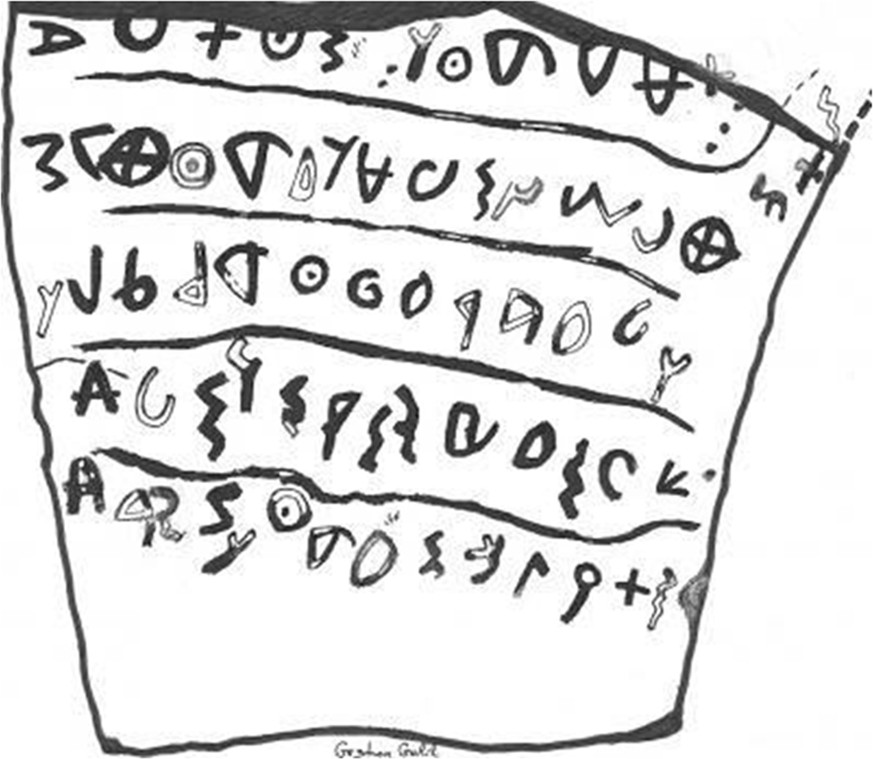
Reproduction of text that may be the oldest extant Hebrew writing.
The ancient text is written in ink on a trapezoid-shaped piece of pottery about 6 inches by 6.5 inches (15 cm by 16.5 cm). It appears to be a social statement about how people should treat slaves, widows and orphans. In English, it reads (by numbered line):
“You shall not do [it], but worship the [Lord] • Judge the sla[ve] and the wid[ow] / Judge the orph[an] • [and] the stranger. [Pl]ead for the infant / plead for the po[or and] • the widow. Rehabilitate [the poor] at the hands of the king • Protect the po[or and] the slave / [supp]ort the stranger.”
The content, which has some missing letters, is similar to some Biblical scriptures, such as Isaiah 1:17, Psalms 72:3, and Exodus 23:3, but does not appear to be copied from any Biblical text.
(Reported in Clara Moskowitz, “Bible Possibly Written Centuries
Earlier, Text Suggests,” Live Science, 15 January 2010.)
(1) By higher critics – Editor’s note
(2) The new find may be the oldest Hebrew writing identified to date. However, other Hebrew inscriptions have been found that are older than the 6th century BC. For example, an inscription in Hezekiah’s tunnel has long been thought to date back to the 8th century BC. – Editor’s note