
Cain and Abel
Cain was Eve’s first child. “I have gotten a man from the Lord” said Eve reverently, according to the A.V. of Genesis 4: 1. God had already promised Eve that her seed would become the means of undoing the damage that had been done in Eden, that he would “bruise the serpent’s head,” which could only mean the overthrow of sin and the restoration of primitive sinlessness, and without any doubt at all she saw in the birth of this child the first step to the fulfillment of that promise.
Hopes must have run high, therefore, as the lad grew to manhood’s estate, joined later on by his younger brother Abel, and, of course, sisters. With the elder devoting his energies to cultivation of the soil and the younger to the raising of sheep and goats the family must have been reasonably happy, waiting for the next move in the Divine purpose, and with no indication of the tragedy soon to come.
 There is very little guidance as to the time scale of these events. The genealogical tables in Genesis state that Seth, the third son, was born when his father was one hundred and thirty years old according to the Masoretic. Ignoring this for a moment, there is evidence from sources outside the Bible that the life span of early man was inordinately long compared with modern experience, and it is probable that both Cain and Abel were grown men, perhaps married – to their sisters – at the time of the tragedy. The one chronological fact which stands is that Seth was the third son and Abel was already dead when he was born.
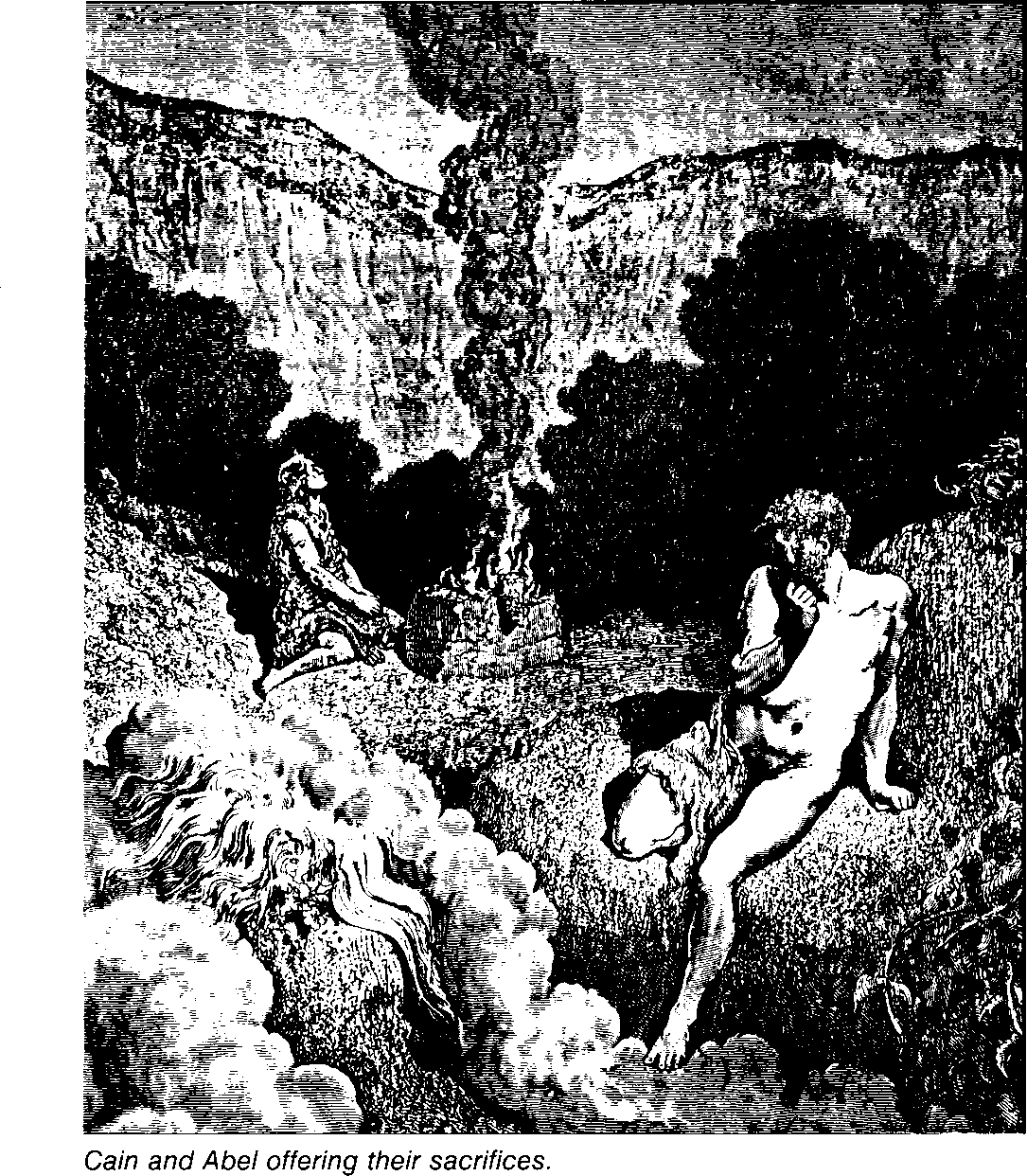
“In process of time” therefore – perhaps anything up to a century after the Fall –”Cain brought of the fruit of the ground a offering unto the Lord. And Abel, he also brought of the firstfruits of his flocks and of the fat thereof And the Lord had respect unto Abel and his offering. But to Cain and to his offering he had not respect. And Cain was very wrath, and his countenance fell.” (Genesis 4:3-5)
Dr. Young’s translation says that Abel brought “the female firstlings of his flock, even from their fat ones” In other words, rightly surmising that God should have the first and the best of his flock, he chose the fattest and best of the firstborns as his contribution. Why he chose female instead of male, thousands of years before the Mosaic Law provided for female offerings, is a point of interest. For some reason Abel must have considered female the more appropriate, as, in some sense, better than the male. Perhaps, in the rudimentary state of knowledge of that first family, the female was considered the channel of life, life that came from God. That would explain Eve’s crediting the coming of Cain to God rather than to her husband. It is significant that it was Eve and not Adam who named Seth, and perhaps the other sons too. But Cain did not bring the best of his produce. This is shown by the words used. The “firstfruits,” in the sense of the earliest to ripen, is bikkar. The firstfruits in the sense of the best of the produce is reshith. Both these terms are used in the Old Testament to refer to the offerings of firstfruits in Israel. The term for fruit in general is peri, and this is the word used in Genesis 4:3. Cain did not bring firstfruits as did Abel; he brought of the fruit of his labors, but it was not of the best or choicest or earliest, and that was why his offering was rejected. That was why “Abel offered to God a ore excellent sacrifice than Cain.” (Hebrews 11:4). The Almighty can only accept of our best, and Cain did not give of his best.
ANGER, THEN MURDER
So “Cain was very wroth, and his countenance fell”and the Almighty spoke to him. “If you do well” He said “will you not be accepted? And if you do not well” – and here came the warning – “sin is crouching at the door; its desire is for you, but you must master it” (Gen. 4:7 RSV). Here is the first intimation that man has a positive responsibility to strive against sin. The basic promise that sin would one day be undone because the seed of the woman would bruise the serpent’s head did not authorize man to adopt a static and non-commital attitude, passively waiting for the Lord to execute his word. Sin was an active reality, waiting to ensnare men; it was imperative to give heed and not be entrapped. God apparently passed over Cain’s failure to offer of his best, and stressed as of greater consequence his unjustified wrath which could so easily-and quickly did-lead to jealousy, violence and finally murder. The Lord exhorted Cain to take stock of his position and fight the dark thoughts that were crowding into his mind before it was too late. Cain did not heed the warning.
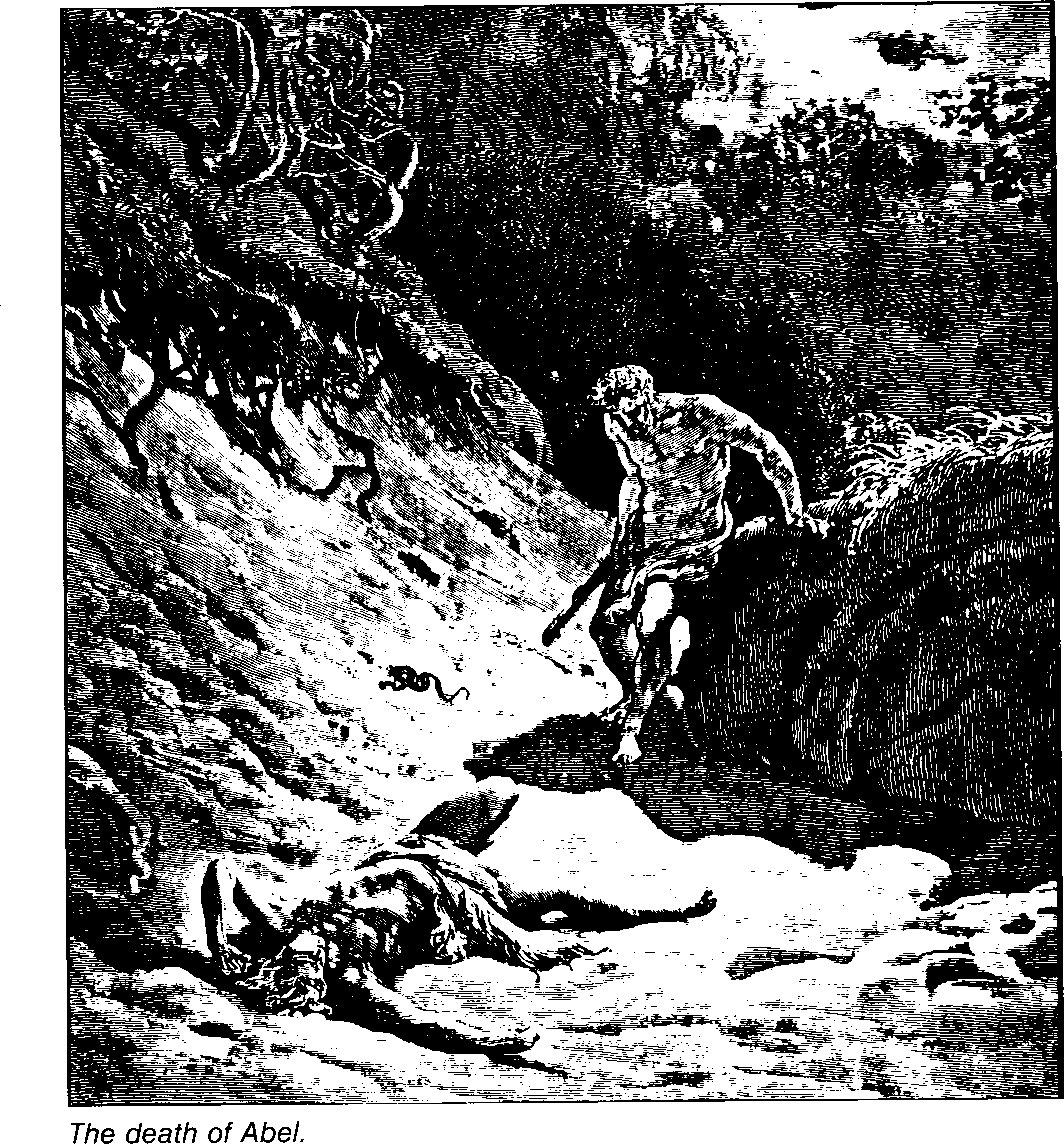 Tragedy followed swiftly. According to the Septuagint, Cain invited his brother into “the field,” the Hebrew word denoting cultivated or irrigated land as distinct from pasture or wild land. In other words, Abel was enticed away from the family home into Cain’s own area of labor. There, in the field, Cain slew his brother. It may have been a premeditated act; it may have been a sudden uncontrollable upsurge of jealousy. In any case it is a sad commentary upon the ease with which human free will, undisciplined by loyalty and allegiance to the Divine way of life, can sink to actions so contrary to the basic instincts of man. These two must have grown up as boys together in the wonder of a world revealing ever new and increasingly exciting discoveries. The knowledge that death must one day come, because of the original sin, was with them, but in the vigor of their near-perfect manhood the event must have seemed almost inconceivably far away. It is not likely that Cain intended the death of his brother, but rather that in the intensity of his resentment he struck a blow which proved fatal. But the sequel of his animosity proved the reality of the Lord’s warning. Sin was already there, crouching at the door, waiting to obtain the mastery. He could overcome it if he would, but he must exert his will so to do. And Cain, like Eve his mother before him, failed to do so.
His immediate reaction was fear, a futile endeavor to avoid the consequence. In what manner the Lord spoke to Cain we know not, but the dialogue between the two must have been real in Cain’s mind. “Where is Abel thy brother?” came the accusing question from Heaven. “I know not” the surly yet apprehensive reply, “Am I my brothers keeper.” Then was pronounced the fearful condemnation before which Cain quailed and was broken. “What has thou done? the voice of thy brothers blood crieth unto me from the ground … when thou tillest the ground, it shall not henceforth yield to thee her strength,- a fugitive and a vagabond shalt thou be in the earth.”The “ground” and the “earth” from which Cain was banished is adamah, the land of their habitation, but the “earth” in which Cain was to be a fugitive and vagabond is erets, meaning the earth as we use the term, the whole extent of the world, the earth as a planet. Cain was to be exiled from his home, his family, and his land and doomed to wander -”fugitive” is a wanderer fleeing as an enemy or from justice; “vagabond” a wanderer as having no home an exile in the earth.
“My punishment is greater than I can bear” cried Cain. He was to be cast out into the desolate earth with no means of subsistence, he was to be hidden from the presence of God; and he was to be in danger of death at the hands of his fellow men. “Thou hast driven me out this day from the face of the earth” he cried “and from thy face I shall be hid, and I shall be a fugitive and a vagabond in the earth,- and it shall come to pass, that everyone that findeth me shall slay me.” His dismay at being banished from the Divine presence is thought by some to be an indication of some residual reverence for God which led him to lament the separation; more likely, perhaps, it reflected a fear that banishment from God’s presence implied withdrawal of Divine protection, leaving him with no shield against possible avengers. There is a fundamental principle here. Fear of the consequence of sin is no basis for acceptance with God. An upright life gains no credit in the books of Heaven if that uprightness is dictated only by fear of the alternative. Had Cain admitted the enormity of his crime, given evidence of sincere contrition, and placed himself in the hands of God for judgment, the outcome would have been different. But he did not, and he went out into the wilderness unrepentant and resentful.
FEAR OF VENGEANCE
The birth of Seth was the next event recorded as worthy of note following the death of Abel. Since the story must be considered against its own claimed background, it is logical to accept these long life spans as part of the picture presented. Cain and Abel, then, might well have already become the fathers of several sons and daughters so that the family springing from Adam and Eve already numbered grandchildren. There is however, no mandate in Genesis for thinking that other human beings, not derived from Adam, existed in other parts of the earth. The whole Bible stands or falls on the position that all humanity came from Adam. It becomes necessary then to examine the hypothetical “every one” that meeting Cain, might conceivably slay him. Cain’s fear in vs. 14 is usually understood in English as that any individual man of all possible men might be the slayer. Verse 15 supports this by saying that the Lord set a mark upon Cain lest “any” finding him should slay him. But the Hebrew in both cases is the same, “chol,” which in the grammatical case here used means “everyone” in the sense of a whole or a totality. Cain’s fear, and the Lord’s action, both presupposed the whole of the race of mankind then existing acting together as a unit, as a single body, in this matter of slaying. The narrative therefore implies, not that he might meet death at the hands of some stranger in a chance encounter, but that his own family, in the face of this crime that he had committed against them all, might consider it imperative to capture or seize or fall upon him-this is the meaning of matsa, rendered “find” in this context-and put him to death.
It is impossible to conjecture what was the reaction of Adam and his family to this terrible calamity which had befallen them, a circumstance for which no precedent existed, and it is not likely that any kind of Divine law had been given them to deal with such a contingency, but it is conceivable that they might reason that Cain, who had shown himself capable of destroying one life, might well do the same thing again, and must himself be destroyed to avoid the possibility. Hence God stepped in with his prohibition. The “mark,” Hebrew oth, meaning a sign, set upon Cain, need not have been a physical disfigurement as is often popularly thought, but an indication of some kind to his fellows that he must not be interfered with, but left to go his way into exile.
TO THE LAND OF NOD
So Cain departed, taking his wife, “and dwelt in the land of Nod, on the east of Eden.” This is one of the geographical indications which date the first writing down of the story, for the Hebrew “Nod” is the Sumerian land of Nadu, on the eastern side of the Persian Gulf (modern Iran), as it was known twenty-five centuries before Christ. (Later on the land became known as Manda and this name survives to this day as that of the main river of the district.) The Sumerians believed that the primeval Eden was an area now covered by the waters of the Gulf, so that the whole story is geographically consistent. Cain went east, out of the valley, into the mountains where his descendants were afterwards the first men to work in metals – metals that are still mined in those same mountains.
There he disappears. His descendants to the eighth generation are recorded, and then, silence. The man who was the firstborn of the first family, peculiarly one who was God’s own and might have become the first link in the line leading to the promised Seed through whom all families of the earth shall yet be blessed, the firstfruit of the procreative power God had implanted in those to whom He had entrusted the populating and the dominion and the enjoyment of the earth, so far failed to appreciate the goodness of God that when he came to make his acknowledgment he only brought God his second-best. Because of God’s inevitable rejection of second-best he allowed resentment, jealousy, hatred, to take possession of his soul and drive him into the commission of sin – sin which was never repented of and the consequence of which, because it was never repented of, was alienation from God and loss of the honored future he could have had. The lesson of Cain’s tragedy is that the placing of God first in the life, the giving of one’s self unreservedly to him for his purposes, and the best of our abilities and talents and achievements to his service, is a sure defense against the “wiles of the devil.” Satan cannot gain entry where God already reigns. Sin is ever crouching at the door, ready to spring -but in the power of God we gain the mastery. And it is all really so very simple. Micah knew the secret. “He hath shown thee, 0 man, what is good, and what doth the Lord require of thee, but to do justly, and to love mercy, and to walk humbly with thy God.”
– Condensed from “Bible Study Monthly,” Sept./Oct. 1987