
Elisha’s Typical Experiences
Following the taking of Elijah into heaven by a whirlwind, Elisha recrossed the Jordan and became involved in a succession of fourteen episodes recorded in 2 Kings 2-10. Since Elijah represented the church taken to glory, and Elisha the Great Company whose experience this side the veil ends soon after, it has been customary among many brethren to suppose Elisha represents the ancient worthies after his second crossing of the Jordan.
We agree with this view, and the reader can trace the same view in Reprints 4757, “Elisha Successor to Elijah,” Reprints 5779, “Elisha’s Restitution Ministry,” and Reprints 5782, “Other Restitution Types” The particulars of these episodes have recently engaged our attention, and these are the subject of the present article.
The fourteen episodes, each abbreviated to a single term, involve:
(1) Waters (2:19-22)
(2) Bears (2:23-25)
(3) Moab (3:4-27)
(4) Oil (4:1-7)
(5) Son (4:8-37)
(6) Pottage (4:38-41)
(7) Loaves (4:42-44)
(8) Naaman (6:1-27)
(9) Axehead (6:1-7)
(10) Syria (6:8-23)
(11) Siege (6:24-7:20)
(12) House (8:1-6)
(13) Hazael (8:7-15)
(14) Jehu (9:1-10-38)
(1) WATERS SWEETENED (2:19-22)
The first of these episodes is a miracle, like several of the others. It reminds us of the sweetening of the bitter waters of Marah (Exodus 15:23), and there are parallels between the two incidents. The one in Exodus was the first of several episodes following the crossing of the Red Sea, the one in Kings the first of several episodes following Elisha’s crossing of Jordan. Both immediately follow a period of “three days” (Exodus 15:22, 2 Kings 2:17). That in Exodus pictured the opening of the Gospel Age, that in Kings the opening of the Kingdom.
In the former, the sweetening was effected by casting a tree into the waters, symbolic of the ransom given on a tree by our Savior. The salty waters probably represented God’s Law, whose perfect standard prevented the Jews from receiving life-giving refreshment from the ordinances which otherwise were “holy, just, good” (Romans 7:12), because “the letter killeth” (2 Corinthians 3:6), just as salt does. But our Lord’s death removed that imposing standard, so that now “the righteousness of the Law [is] fulfilled in us, who walk … after the spirit” (Romans 8:4, Galatians 3:13, Hebrews 9:15).
But in Elisha’s first miracle the bitter waters were sweetened by adding salt – just the opposite of expectations. This is because at the opening of the Kingdom the added ingredient will be the teaching influence of the church beyond the veil, as kings, priests, instructors. Those who during this life are the preservative “salt of the earth” (Matthew 5:13) will then bless, nurture and restore mankind, and cause the blessings of life and truth to indeed refresh and enliven the dead world. The “new cruse” of salt shows this church class a fresh, “newly” developed class which will provide mankind the sweet waters of life.
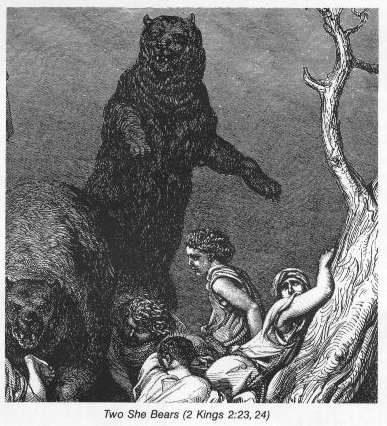
(2) TWO SHE BEARS (2:23-25)
As Elisha went up to Bethel, probably symbolic of the ancient worthies appearing on the scene and ascending immediately to the leadership of “the house of God” as Bethel means, some youthful detractors appeared, calling mockingly “Go up, thou bald head; go up, thou bald head” They came from “the city,” which indicates that youths (undeveloped Christians) from the city (Christendom) will be disposed to mock the presumed authority of the resurrected prophets.
Hair in the scriptures represents fidelity to God, as Samson’s hair for example represented his nazarite vows, which in turn represent our vows of consecration to God. In Songs of Solomon 4:1 the bride of Christ is complimented for her “hair as a flock of goats” – deep, voluminous, abundant. So the charge of “baldness” symbolically means the standing of the ancient worthies as God’s devoted representatives is challenged, disrespected.
But for this there will be consequences. In fact, Christendom will be brought low – and this will follow, not precede the advent of the ancient worthies. When they appear everything will not be peace and amity. Indeed, the ancient worthies are raised when the trouble at Israel is cresting, and this will be followed both by the demise of Israel’s immediate invaders and by the subsequent collapse of Christendom and other nations.
Micah 5:5 says of that time, when Israel is pressed by the invaders from the north (Assyria typically, actually), “then shall we raise against him seven shepherds [kings) and eight princes [margin] ‘ ” The seven kings who intervene for Israel are the church, developed through the seven stages of the Gospel Age (also of Revelation 15:6). The “eight princes” are the ancient worthies, “princes in all the earth” (Psalms 45:16), who are raised to point Israel to the source of their deliverance – Christ. Then “they shall look unto him whom they have pierced, and they shall mourn for him, as one mourneth for his only son, and shall be in bitterness for him!’ (Zechariah 12:10).
But the relief of difficulties in Israel will be the precursor of difficulties abroad. As Revelation 16:14-19 shows, Armageddon is in two parts – first a battle (at Israel) and second a revolution (back in the home countries of the nations gathered at Israel). In that “great earthquake, such as was not since men were upon the earth, so mighty an -earthquake, and so great,” Christendom will fall. “The great city [Babylon) was divided into three parts [the three parts which had coalesced in plague 61, and the city [Sinaitic manuscript] of the nations fell: and great Babylon came in remembrance before God, to give unto her the cup of the wine of the fierceness of his wrath” (Revelation 16:18, 19).
The wounded youths who mocked Elisha numbered 42, and the number itself, specified so precisely, and appearing infrequently in scripture, is a pointer to the meaning of the episode. It reminds us of the 42 months Revelation 13:5, 7 gives as the period of great Babylon’s reign of power, during which she oppressed the saints. So here is the time of retribution for those 42 months.
That bears, and specifically their paws which “tare” or mauled 42 youths, were the instruments of revenge reminds us that great Papacy was described as having “feet of a bear” (Revelation 13:2) during its persecution of the saints. That they were “she” bears reminds us that the subject of the persecution was feminine, the “bride of Christ,” in another symbol the “woman!’ of Revelation 12:1. That the bears were “two” in number reminds us that during that reign of darkness the two witnesses (Old and New Testaments) were suppressed (Revelation 11:3).
The number 42 comes up again in a later episode, the last of the 14 listed above, when Jehu is anointed to cut off the residue of the house of Ahab (2 Kings 10:14). After killing King Joram, the son of Ahab, Jehu asked the people to behead the 70 sons of Ahab, and they complied. It reminds us of a deed in another picture, Judges 8, describing Abimelech who usurped power and reigned as a king during the period of the Judges. He was later killed by a millstone, representing how Papacy is to be overthrown as a millstone (Revelation 18:21). To acquire power Abimelech slew 70 sons of Gideon (though one escaped), just as Papacy, to gain power, had to subdue the saints, represented by the 70 sons of Gideon. (Seventy was the number of Jesus early disciples.)
So – to our point – if killing 70 sons of Ahab represents retribution for the persecution of the church, then the subsequent slaying of 42 others, brethren of the Judean king Ahaziah who were sympathizers of Joram, was probably also symbolic, in this case reminding us of the oppression of the church for 42 months. (1 Kings 10:14 and 1 Kings 9:28 may also be pertinent.)
At the end of Elisha’s second episode 2 Kings 2:25 records one further detail. Before returning to Samaria, the seat of the Kingdom of Israel, Elisha went to mount Carmel. This simple reference to the famous mount reminds us of Elijah’s victory there over the priests of Baal, which closed the 3 1/2 years (42 months) of drought.
(3) THE BATTLE AGAINST MOAB (3:4-27)
The matter of difficulty and conflict is continued in the next episode. Moab rebelled which precipitated a conflict with Israel in which King Joram joined himself to two allies, Judah and Edom. We propose that Moab here, as in Psalms 83:6, are the Arabs who have a conflict with Israel. The king of Judah was Jehoshaphat, a king of faith who maintained the worship of Jehovah, in contrast to Joram who did not. These two parts of the nation represent the two components in present day Israel, those of faith and those not of faith. Edom (descendants of Esau) probably represents Christendom – just as Esau who lightly esteemed his birthright represents Christendom, in contrast to Jacob who highly esteemed it and represents the Church. So today Israel, both believing and unbelieving, for both aspects are present in the modern state, depends in substantial measure on the west, Christendom, Edom, as a military ally for support.
They decided to take a southern route “through the wilderness of Edom,” and the journey of seven days may represent Israel’s sojourn in Christendom during the seven stages of the church. This trip through a desert area left them without water and in great need (verse 9). In their desperation it seemed advisable to inquire of a prophet, and the news was supplied that Elisha was near. Jehoshaphat urged that “the word of the Lord is with him,” and persuaded the others to seek Elisha’s assistance.
Elisha would not have given Joram the proverbial time of day, except that out of respect for Jehoshaphat he agreed to help. He called for a minstrel, and while he played “the hand of the Lord came upon” Elisha. He said they would not see rain or wind, but nevertheless the valley at their location would be filled with water, and urged them to dig as many ditches as they could to receive the expected inflow. Further, Elisha said the Lord would give them victory over Moab.
Evidently there was rain in the mountains to the east some distance away, for neither the Israelites nor the Moabites saw the storm itself. But “it came to pass in the morning [the millennial morning], when the meat offering was offered [the meal offering, representing Christ, and here the application of his ransom], that, behold, there came water by the way of Edom [the water of refreshment for Israel is essentially the same as the water of truth which Christendom has had for centuries, but not fully appreciated], and the country was filled with water” (2 Kings 3:20).
When Moab looked toward their enemies in the morning they saw the rising glow of the sun reflecting on the water, thought it to be blood, and supposed the three armies had self destructed. Just so, the enemies of Israel will suppose Israel to be in dire straights, and mistaking their trust in the Lord for weakness will be induced to forward the attack. But to their surprise what they thought was weakness was strength, and they were vanquished.
When the king of Moab saw himself being overwhelmed, he took 700 choice men “to break through unto the king of Edom “but could not. So the Arabs may wish to gain the support of the west in their losing cause, but will not be able. “Then he took his eldest son that should have reigned in his stead, and offered him for a burnt offering upon the wall. And there was great indignation against Israel: and they departed from him, and returned to their own land” (verse 27). The death of the firstborn reminds us of the death of the firstborn in the 10th plague in Egypt, and has the same meaning – the inheritance of this age, and its order of things, will not pass to a succeeding generation after Armageddon.
(4) THE POT OF OIL (4:1-7)
There was a “woman of the wives of the sons of the prophets,” now widowed and fearful of losing her two sons to bondage to pay a large debt, who pleaded her case before Elisha. She reminded him that her husband “did fear the Lord,” and on this merit sought the prophet’s intervention.
The woman represents Israel, her two sons probably the two kingdoms into which the nation had split, and her late husband the faithful leaders of Israel, the stalwarts of faith of the Old Testament. Israel has a debt to pay, a large debt, incurred at their rejection of Messiah, and without divine assistance they could not properly remedy the situation.
Elisha asked what of value there may be yet in her possession, and she replied “Thine handmade hath not any thing in the house, save a pot of oil” (verse 2). Indeed, that is about all of value Israel has left – a single pot of oil, a single receptacle of the holy Spirit – the Old Testament they have cherished so long. They haven’t even the two olive trees of Zechariah, the Old and New, but only one pot – only the Old. But their devotion to it will be honored, prospered, and blessed … for the “fathers’ sakes” (Romans 11: 28), and for the sake of all their devoted leaders of the past.
Elisha bade them gather a multitude of vessels from “all thy neighbors” and come into their home, shut the doors, and go to work. One by one they filled the collected vessels with the precious oil, which to their delight and benefit continued to pour out, miraculously, not diminishing in supply. “When the vessels were full, she said unto her son, Bring me yet a vessel. And he said unto her, There is not a vessel more. And the oil stayed” (verse 6). Elisha then advised, “Go, sell the oil, and pay thy debt, and live thou and thy children of the rest” (verse 7).
What a lovely picture of Israel’s role in the Kingdom. It will be their privilege to gather all the empty vessels world wide, the whole human race, and fill them one by one with the blessed influence of the holy Spirit, under the advice and counsel of the ancient worthies. The holy Spirit will multiply and continue until every willing vessel is filled full. Then by their own labors to bless and uplift all their fel”s, Israel will have shown through their actions not through mere words, the depth of their repentance. What greater testimony of their conversion can be wrought than to cooperate with Messiah in the blessing of all the families of the earth? Then, at last, their debt will be paid. “Israel shall blossom and bud, and fill the face of the world with fruit … by this therefore shall the iniquity of Jacob be purged; and this is all the fruit to take away his sin; when he maketh all the stones of the altar as chalk stones that are beaten in sunder” (Isaiah 27:6, 9)
(5) A SON RAISED TO LIFE (4:8-37)
As Elisha passed through Shunem a lady of influence, evidently well to do, “constrained” the prophet to accept of her hospitality. “And so it was, that as oft as he passed by, he turned in thither to eat bread” (verse 8). She advised her ‘husband that yet better provision be made for this holy man, and accordingly they constructed a little chamber with a bed, table, stool and candlestick for his comfort, and Elisha received these kindnesses with grace and thanks.
As time went on he asked his servant Gehazi what might be done for this woman who so delighted in honoring the Lord’s servant. He asked the woman whether perhaps she would appreciate being introduced to the King, or to the leader of the army, but she deferred the honor, saying “I dwell among mine own people;’ and did not aspire to further honors. Then Gehazi pointed out that “she hath no child, and her husband is old” (2 Kings 4:14), and Elisha announced the good tidings to the woman that she would soon bear a son. She received the news with some apprehension. “Nay, my lord, thou man of God, do not lie unto thine handmaid (verse 16) – such a favor seemed too good to believe. But in due season she did bear a child, a son.
The meaning is similar to the previous picture, the woman being the polity of Israel, hoping for a future, wishing for a seed to inherit the blessings promised to their forefathers, but leery of getting their hopes high in light of the passage of time, and the apparent unfruitfulness of their expectations.
The child grew and developed, just as the Israelites prospered more or less until the advent of Messiah. But when the child was grown, disaster struck. “It fell on a day, that he went out to his fathers to the reapers. And he said unto his father, My head, my head. And he said to a lad, Carry him to his mother. And when he had taken him, and brought him to his mother, he sat on her knees till noon, and then died” (verses 18-21).
This is just the disaster which overtook the Israelites at the advent of Christ. It was during a time of harvest. The problem was one of the head – they “knew not the time of their visitation!’ (Luke 19:44). He sat on the knees of his mother, the teachings of the past, “till noon,” when at the height of their favor under the gospel sun, in the very presence of their Messiah, they failed to keep faith and, as in the parable of the Rich Man and Lazarus, died.
The mother went up and “laid him on the bed of the man of God,” symbolically hoping that the bed of faith occupied by the faithful leaders of Israel past might stimulate some life in the child, and “shut the door” of the hope of Israel upon him. Then she went seeking help.
She called to her husband to send an escort as she went to find Elisha, but he mildly objected, saying “it is neither the new moon, nor sabbath” – precisely the two occasions which Ezekiel 46:1 uses to represent the kingdom. No matter, something had to be done, and she proceeded. As she approached Elisha Gehazi first spotted her, and asked if all was well of course it was not, all was desperately wrong, but she wished only to speak to Elisha, and therefore hid the truth. When she found him she threw herself at his feet, imploring for assistance, reminding the prophet that she had not asked for the child, “did not I say, Do not deceive me?” (verse 28). In light of everything past, would Elisha not assist in bringing it back to her?
Elisha then proposed a plan which, almost uniquely among the prophets, was something that did not work. He called on his steward Gehazi to take his staff and proceed directly to the child, greeting no one in his path, and lay his staff upon the child. But no change. Just so the hope of Israel for these many centuries since Christ has been to have the staff of the Law, the heritage of the prophets, laid upon them, but to no avail. No life results from the Law.
No, only Elisha himself, personally attending to the child, can restore its life. Only the ancient worthies, attending to Israel in the Kingdom, can bring life back into Israel. Today, as Ezekiel 37 shows, they have been regathered, dry bone to dry bone, ligaments and sinews restored, flesh and even skin upon them, as a nation again, complete. But there they lie, a dead body, without the breath of faith which will only come when the four winds of trouble breathe the life of faith into them again, when the ancient worthies, raised as their deliverers, guide them to the source of life, the Messiah of Israel (Ezekiel 37:9).
Elisha entered the house (the ancient worthies back!) and shut the door upon the two of them, and prayed to the Lord. He laid himself upon the child, mouth to mouth (as though to breathe into him), eyes to eyes, hands to hands, and the flesh of the child began to grow warm again. This was repeated, the child sat up, sneezed seven times (as though to show the centuries of affliction during the seven stages of the church are thrown off), the child opened his eyes -Israel at last receiving sight of their Messiah and he lived again. The wondering woman bowed at the feet of the prophet, took up her son, and went out with unspeakable joy. So it will be when Israel lives again.
(6) THE POTTAGE MADE WHOLESOME (4:38-41)
This is a brief incident of four verses. Elisha came again to Gilgal, which in a previous context represented Christendom, from which Elijah (the church) first departed at the outset of the Gospel Age Harvest
(2 Kings 2:1). Here the same application fits well, Gilgal is Christendom. As the sons of the prophets prepared their nourishment, “one went out into the field to gather herbs, and found a wild vine [the “vine of the earth” of Revelation 14:181, and gathered thereof wild gourds his lap full” and shred them into the pot of pottage, “for they knew not” that it was poisonous. As they began to eat they realized “there is death in the pot” (verse 40).
Just so there is death in the pot of stew of the doctrines of Christendom – the three-part godhead of the trinity, hell-fire or purgatory, the consequences of the immortal soul doctrine, the grossly limited view of the atonement only for a few, etc. But there is a remedy. When once the ransom doctrine, properly understood with all its implications, is added to the mix, it will bring understanding where confusion was, and nutritious doctrine where once was a poisonous stew.
Elisha cast meal (a picture of the Ransom, just as the time of meal offering in 3:20) into the pot, and he said “Pour out for the people, that they may eat, And there was no harm in the pot”
(7) 20 BARLEY LOAVES (4:42-44)
“There came a man from Baal-shalisha7 – a place only once elsewhere mentioned, in 1 Samuel 9:4 when the Kingdom of Israel was just beginning and now mentioned respecting the time the Kingdom of Israel is restored under their true righteous King Jesus.
He brought with him 20 loaves of barley bread, in addition to some fresh ears of barley, and said “Give unto the people, that they may eat” A servant objected that this small provision could not suffice for the 100 souls to be fed, but Elisha insisted “they shall eat, and shall leave thereof.” And so it was.
The barley loaves represent Christ Jesus (Judges 7:13), and the firstfruit barley sheaves the same (Leviticus 23:10-12, 1 Corinthians 15:20). They were offered to the Lord on the morning of the 16th of Nisan, just as Jesus was received from the dead on the same day, as the firstfruit from the dead.
The barley loaves, and the miraculous multiplying to feed the need at hand, put in comparison the opening of the Gospel Age (when Jesus fed the multitudes with barley loaves) and the opening of the Kingdom, when he offers first to Israel the same nourishment. That there were 20 loaves reminds us of the great dearth when Israel symbolically ate mixed (defiled) bread, “20 shekels a day” (Ezekiel 4: 10) during the centuries of their punishment. But then, in the Kingdom, abundance commensurate with the need will be available to all.
(to be continued … )