
Feeding the Multitudes
“You men of little faith, why do you discuss among yourselves that you have no bread? Do you not yet understand or remember the five loaves of the five thousand, and how many baskets full you picked up? Or the seven loaves of the four thousand, and how many large baskets full you picked up? How is it that you do not understand that I did not speak to you concerning bread? But beware of the leaven of the Pharisees and Sadducees” (Matthew 16:9-12).
Can you name the only miracle recorded in all four Gospels? It is the feeding of the 5000. This repetition means we should pay close attention to the details. First came the feeding of the 5000 followed by just a few recorded events, and then a feeding of the 4000. There are tremendous similarities between the two feedings. These were startling miracles — even for Jesus — for never had he affected so many at one time, and he did it twice!
Jesus draws the two events together after the fact in Matthew 16:5-12. Then the disciples understood that he did not say to beware of the leaven of bread, but of the teaching of the Pharisees and Sadducees. We know that the lessons were given for a much bigger reason than filling peoples’ bellies.
We suggest the 5000 represents the Gospel applied to Jewish Christians — the call and feeding of the church when it was exclusively to Israel, taught by Jesus and the 12 Apostles. In contrast, the 4000 represents the Gospel applied to Gentile Christians — the balance of the call and feeding of the Church — from the conversion of Cornelius all the way through the Gospel age.
FEEDING OF THE 5000
Matthew 14:13-15, Mark 6:32-36, Luke 9:12: (NASB) “Now when Jesus heard about John, he withdrew from there in a boat to a secluded place by himself; and when the people heard of this, they followed him on foot from the cities.”
This event happened near the time of Passover. John the Baptist had just been beheaded and the age of the prophets had just ended. It is as if the opportunity for the Gospel now was opened. Jesus arrived and the crowd was waiting to be healed and eventually to be fed. They were like sheep without a shepherd; and in Matthew 10:6 Jesus had said, “but rather go to the lost sheep of the house of Israel.”
The crowd might have gone into the surrounding countryside and villages to buy food for themselves and find lodging. They might also have left Jesus to find other spiritual food, but it would be food from the Pharisees that was not good for them. They could lodge within the community of the Law that surrounded them.
The Gospel was now beginning!
BETWEEN THE FEEDINGS
Let us examine the events between these two miracles.
(1) Walking on water (Mark 6:48, Matthew 14:25, John 6:19). That Jesus walked on the water after the first feeding, perhaps indicates that the later feeding of the 4000 represents something that occurred after Jesus attained his glorified state. He “walks” over the tumult of mankind and rescues his followers in their struggle with this tumult.
(2) Healing many (Mark 6:53; Matthew 14:34).
(3) Bread of life (John 6). Jesus taught an in-depth lesson, perhaps setting the stage for the spiritualized lesson of both feedings.
(4) Healing the daughter of the Syro-phoenician woman, a Gentile (Matthew 15:22, Mark 7:26). Jesus cast out her demons, perhaps picturing that Jesus would soon cast out the Satanic and pagan influence of the Gentiles.
(5) Healing a deaf mute (Mark 7:31-37). Jesus healed him in private, physically separating him from the people and verbally commanding his ears to open. Usually Jesus did this in front of a crowd. Perhaps this shows us that when it came time for the enlightenment of the Gentiles, there would be a private opening up of their ability to hear and understand the gospel.
There seems to be a connection in what happened to the feeding of the 5000, the interim activities, and then the feeding of the 4000.
FEEDING THE 4000
Mark 8:1-3 (NASB). “In those days, when there was again a large crowd and they had nothing to eat, Jesus called his disciples and said to them, I feel compassion for the people because they have remained with me now three days and have nothing to eat. If I send them away hungry to their homes, they will faint on the way; and some of them have come from a great distance.”
Again there was a large crowd, to whom Jesus also showed compassion. But although he cared for their physical well being, they had been with him three days before he would feed them. They must have had just enough of their own provisions to get them to this point. This reminds us of Cornelius in Acts 10:4 (NASB): “Your prayers and alms have ascended as a memorial before God.” This tells us that while Cornelius was worshipping the God of heaven, his prayers and dedication rose before God as a dedication and a memorial. It sustained Cornelius until the point where he could be fed spiritually.
The crowd of 4000 was too far from their homes to make it back without fainting, and Jesus, having compassion on them, knew they needed sustenance. What greater distance to have traveled than from Paganism, and how appropriate that the further from Christ they would travel, the more likely they would faint.
(Mark 6:37-38, Matthew 14:16, John 6:5-7 NASB). “But he said to Philip, Where are we to buy bread? They do not need to go away; give them something to eat! This he was saying to test him, for he himself knew what he was intending to do. Philip answered him, Two hundred denarii worth of bread is not sufficient for them, for everyone to receive a little. And he said to them, How many loaves do you have? Go look!”
Jesus opened up the feeding with a question: “Where are we to buy bread?.” Jesus included the Apostles in the question. Philip’s response seems a natural reaction: they cannot afford it! One denarius was likely about a day’s wage and we assume their treasury had 200 denarii.
But Jesus was not interested in money. His follow up question was, “How many loaves do you have?” There was a lesson for the twelve that the spreading the Gospel does not require our ability to shoulder the expense, but instead a willingness to pass on that which nourishes us— the bread of life. Jesus taught them to walk away from the money and towards the preparedness of the bread.
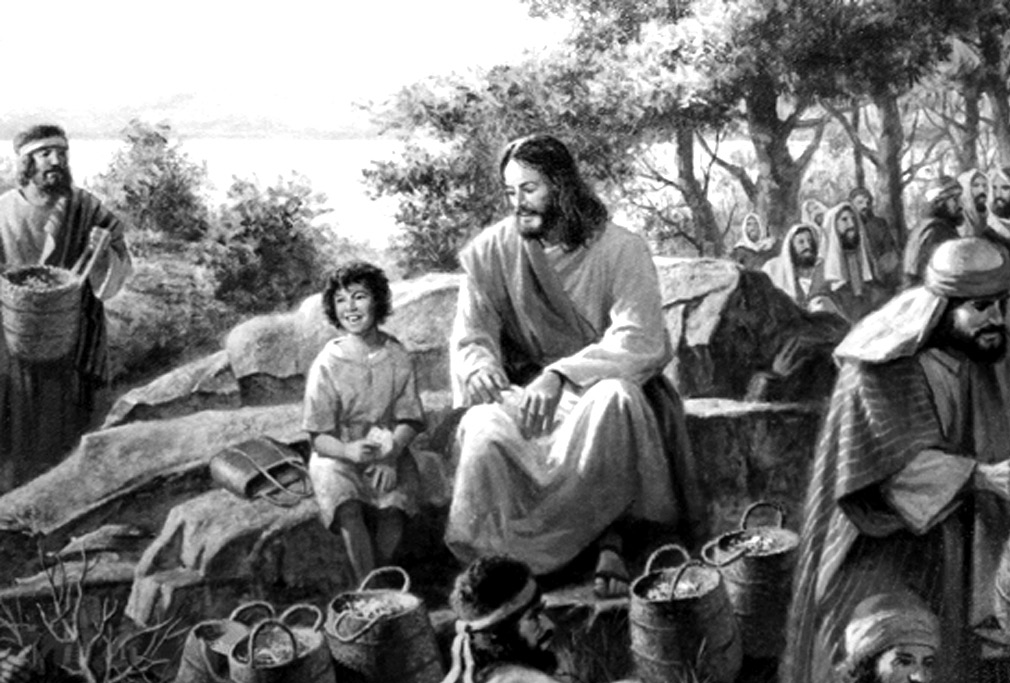 Jesus at the Feeding of the 5000
“GO LOOK!”
The novelty of the Gospel made it difficult to know what to expect and what would be important, for this was a new way. How could they have known they were not supposed to focus on the money? Jesus was showing them step by step how to clear their minds of what had been and accept what was now to be.
“The disciples said to him, ‘Where would we get so many loaves in this desolate place to satisfy such a large crowd?’ And Jesus said to them, How many loaves do you have?” (Matthew 15:33-34 NASB).
The Apostles had learned! They did not mention money. They are already focused on the bread, the bread of life! They saw what Jesus was able to do with the feeding of the 5000 and are now grasping the import of the Gospel.
Interestingly, the disciples labeled their location a desolate place. The word here means a literal waste, and is not that appropriate for where the Gentiles would be to receive the bread of life? They would have come from a spiritual wasteland. Compare this to the place of the feeding of the 5000 earlier. There a completely different word is used for desolate. It means uninhabited and solitary, a place having the ability to be cultivated, or at least be as pasture land, as was the nation of Israel. The feeding of the 5000 was also remote, but it was different in that it had potential.
What Jesus was really asking, “What feeds you that you have to feed them?” The apostles would have to give the Gentiles what the apostles themselves had been given — not what was based on the Law, not based on the money, not based on what had been, but on what was to come.
They would be prepared now for this question and would have understood what Jesus was asking. The potential for feeding the multitude was already counted and in their hands, even though it seemed like too small a provision. So, for comparison:
Feeding of the 5000
- Gospel as applied to Jewish Christians
- Solitary place with green grass growing
- Apostles did not understand the preparation
- Apostles did not understand what Jesus meant
Feeding of the 4000
- Gospel as applied to Gentile Christians
- Desolate place, a wasteland
- Apostles understood how to prepare
- Apostles ready to move forward, even though they could not do it without Jesus.
There were differences in the approach, what happens, and the timing, but the end results were ultimately the same.
THE 5000 — FIVE BARLEY LOAVES AND TWO FISH
John 6:9 (NASB). “There is a lad here who has five barley loaves and two fish, but what are these for so many people?”
Who had the bread of life in the form of five loaves? It was a young man. Perhaps it is a picture of Jesus himself in his innocence being prepared, a young man being about his Father’s business.1 Two fish — perhaps the Old and New Testaments? What are these for so many? How could Israel be given spiritual food from such humble and insignificant beginnings? By the grace of God and by the miracles of God through Jesus.
THE 4000 — SEVEN LOAVES AND A FEW SMALL FISH
In Matthew 15:34, for the feeding of the 4000 there are seven loaves. Seven is a number of spiritual perfection — there would be ample provision for the entire Gospel Age. In contrast with the 5000, where the bread was supplied elsewhere, the disciples this time had these provisions on hand. They had been given the ability to understand that what they had been given, they were now to be giving others. For a “few small fish,” we find in the Sinaitic manuscript (Matthew 15:36) that this may have been two fish. It may be observed that: 5 loaves + 7 loaves + 2 fish + 2 fish = 16 units of food provided x 9000 fed = 144,000. The provisions are small; they are different yet similar, because they are placed at two different parts of the age of gospel development.
PEOPLE ARE PREPARED
For the feeding of the 5000 (John 6:10, Luke 9:14, Mark 6:39-40), we find organized groups “of hundreds and of fifties.” The people were numerically organized, like the Law, implemented with precision. Israel was always recognized by tribe. For the feeding of the 4000 (Matthew 15:35), all were commanded to sit, but with no pattern expressed. In both accounts Jesus blessed and gave thanks. So with the both the feeding of the 5000 and the 4000, we find the same consecration of the bread and the fish and the feeding on the true bread of life. These are two different parts of the same calling.
WHEN THEY WERE FILLED
For the feeding of the 5000 (John 6:12, Mark 6:43, Matthew 14:21), after the crowd had eaten to satisfaction, the apostles were charged with gathering up the fragments. This showed the framework of the immediate future of the Gospel — there were twelve baskets not only satisfying, but abundant, so it can be carried further and shared with others who might be hungry. These baskets were the Apostles themselves, there were twelve and all twelve were filled, giving us a clear picture of the responsibility that those twelve had going forward. They personally were to carry the Gospel and spread it. They had here observed and participated in the miracle. Now Jesus would assign them to go forward and feed others.
For the feeding of the 4000 (Mark 8:8, Matthew 15:38), after eating until they were satisfied, the apostles picked up seven baskets. From the use of the word in Acts 9:25, the size of the basket was big enough to fit a man! This is very different from what the Apostles would have had to carry around with them. The seven are for the seven messengers — the size of these baskets tells us that what was left would have to last a long time — 2000 years of systematic distribution to the church.
So we see both miraculous feedings of the 2 separate multitudes give us a complete picture: The call of the whole church (5000) would begin with Israel, as presented by Jesus and carried forward on the shoulders of the Apostles. The trial and development of the whole church (4000) would expand to the Gentiles and throughout the world and continue on the shoulders of 7 messengers, each providing the meat due at their time, through the entire Gospel age and through the return of Jesus.
The lesson for us is simple. As we look at Jesus giving the Gospel, we know that of necessity it had to go first to Israel. They had to be given a true, full, and complete opportunity. They would reject him. But the Gospel by the plan of God must have its work done and the call must be completed. So the call went to the Gentiles. Putting together the feeding of the 5000 and the feeding of the 4000 shows us the two different parts — the chronologically short period of time with Jesus and the Apostles until the time of Cornelius; and then the feeding of the 4000 — what would happen afterwards.
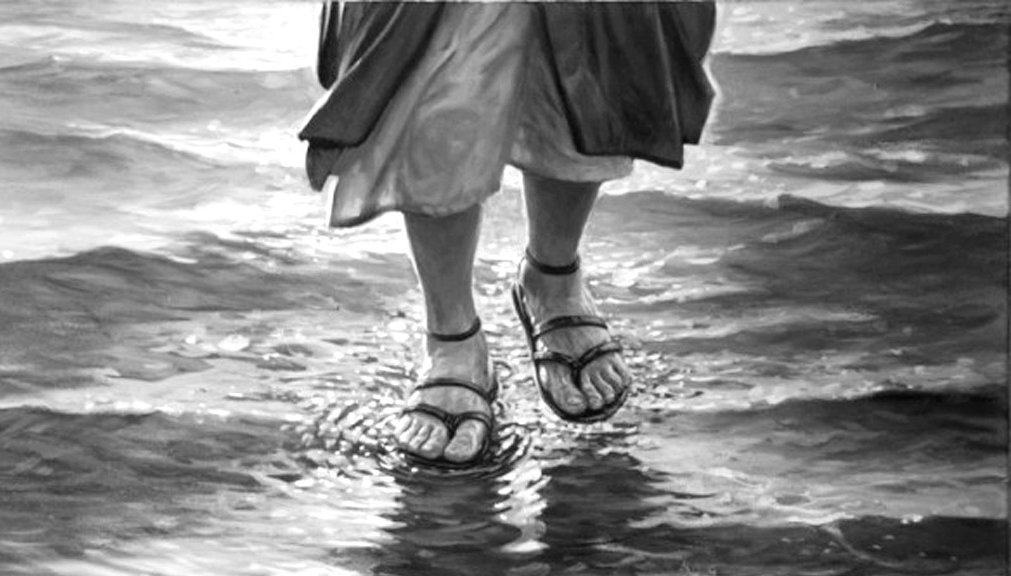
Jesus walked over the water to his disciples, after the first feeding.
Brethren, we out of everyone have the advantage to see all of this history that has gone before us. We have the advantage of present truth, and the Lord is still in the boat with us. Our work is not yet complete. Let us be fed with the bread of life, but do not stop there. Let it nourish us so that we can feed others.
— Summarized from a discourse by Bro. Rick Suraci, Jr.
(1) Editor’s note: if the seven loaves picture the experience of the Gospel Age gentile church, might not the five loaves picture the experience of Israel up to the advent of our Lord? (Luke 16:28)