
Haggai and the Second Temple
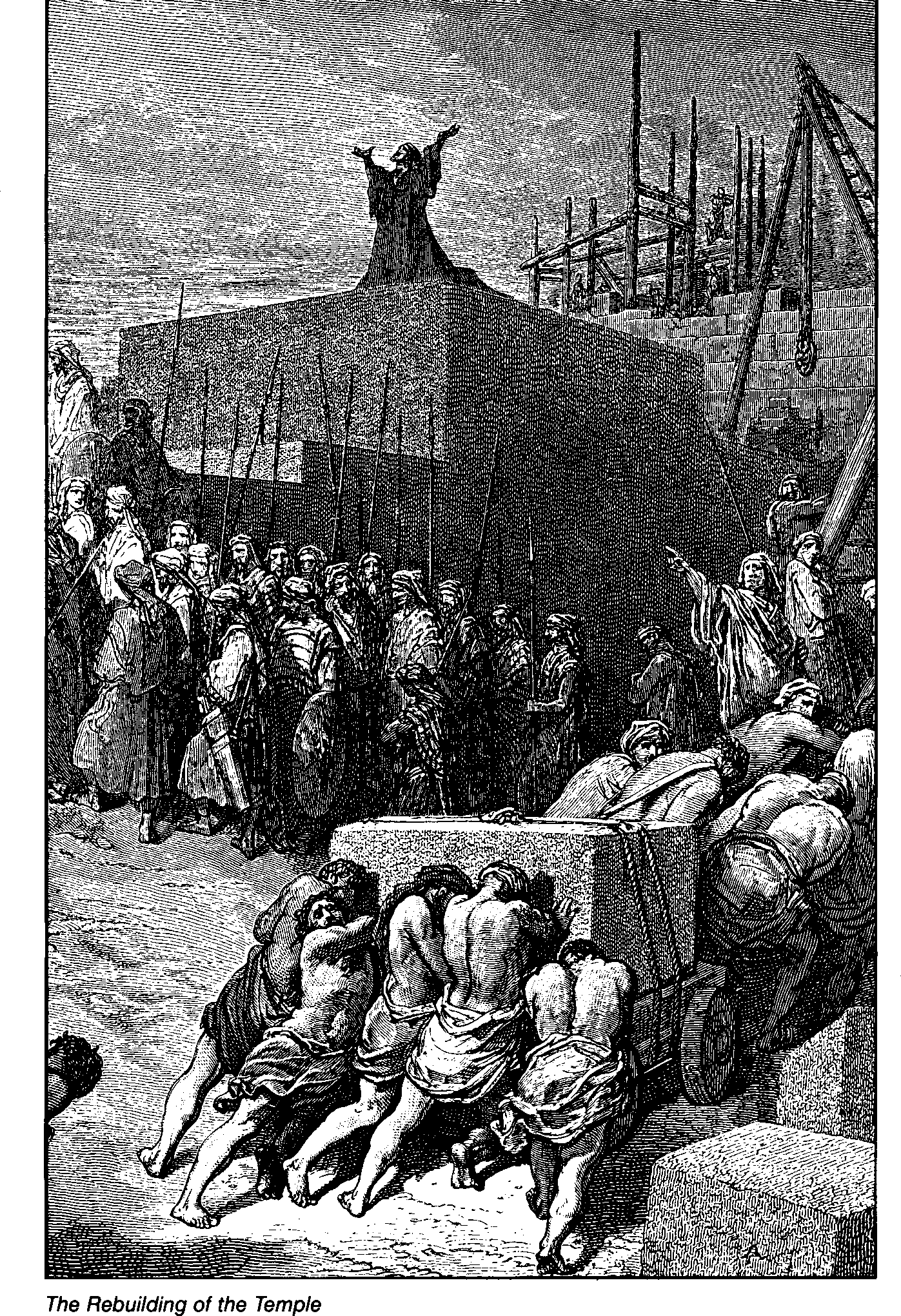
Two years after they returned from their captivity in Babylon the Jewish people began to reconstruct the temple in Jerusalem. They had received permission from Cyrus and the construction went on uninterruptedly during his reign. After the next king, Cambyses, began his reign, the construction was halted due to the intervention of the surrounding nations. Two years after King Darius assumed the throne, the prophet Haggai came to Jerusalem and urged the Jews to begin the work anew.
Haggai was the first prophet of Israel after the Babylonian captivity. His words were heeded and the reconstruction continued. Darius gave his permission and financial aid, and the work was completed in four years.
The book of Haggai tells about the world of that prophet, whose objective was to encourage the Israelites to finish the rebuilding of the temple. The book is divided into five parts, each containing a separate message from the prophet.
In the first message Haggai pointed out that the lack of the Lord’s blessing upon the nation of Israel was because they had given up the temple reconstruction. He urged them to restart the work. After approximately twenty-three days the work was restarted and the prophet came back with his second message. This message was an assurance of God’s help: “I am with you” (1:13). A month later, on the next to the last day of the Feast of Tabernacles (this was probably observed, although there is no mention of it in the account), the prophet brought another message. In this third message he again assured them of God’s help and uttered a prophetic statement about the glorious future of the temple. He also spoke of the “shaking of the heavens and the earth” In the fourth message, he reminded them that before the reconstruction began they were unclean, but now were cleansed from their uncleanness. We believe that this cleansing must have occurred during the observance of the Atonement Day, in the seventh month. The final message was directed at prince Zerubbabel, who was from the royal line. Haggai foretold of his exaltation while all other nations would be engrossed in wars, each man fighting against his brother.
THE INTERPRETATION
An interpretation of the complete prophecy is not found in the works of Bro. Russell. Of the 38 verses in the book of Haggai, only eight are prophetic statements regarding the future. Only these eight are commented on in the reprints. These comments are connected with the interpretation of the picture of the Jews returning from captivity and rebuilding the temple. These are found on reprint pages 2251, 1483 and 3576.
According to this interpretation, the reconstruction of the temple pictures the building of the church after the papal captivity. In his chronological analysis, Bro. John Edgar identifies the rebuilding of the temple with the issuing of the book “Defensor Pacis” by Marsiglio [Marsilius of Padua1], which exposes Papacy. This work was the precursor of the Reformation in Europe. This interpretation is based on the assumption that the nation of Israel returning from captivity represents spiritual Israel, and the temple being rebuilt pictures the spiritual temple, the Gospel Age church. There is no reference to the remaining 30 verses in this interpretation.
When does a prophecy relate to natural Israel and when to spiritual? There are prophecies referring to Israel which leave no doubt that they apply to literal Israel. Examples include the establishing of the New Covenant (Jeremiah 31) and the prophecy of the dry bones (Ezekiel 37). We would next ask, can the interpretation of Haggai be applied to the literal nation of Israel?
ISRAEL REBUILDS A TEMPLE
The obstacle here is the symbol of the temple. We know that during the Gospel Age the church is said to be building just such a temple. We know of no temple that the nation of Israel was supposed to build during this age. However, looking deeper, we do find such a temple. The tabernacle in the wilderness was accessible and visible to the people of the camp in two different ways. The court was accessible and visible from the gate. The Holy and Most Holy were inaccessible and practically invisible from outside the court. How will spirit beings communicate with fleshly men? Most likely it will not be through direct contact but through a special class of people. Such a class will be the visible, earthly representation of the new temple. This earthly part will be literal Israel. Descending from heaven to earth, the new Jerusalem will rest on the earthly foundation prepared earlier. In this way, Israel also builds a temple. But, just like the temple rebuilt in the days of Haggai, the Most Holy was empty (the ark was not there), so in the new temple built on earth, the Most Holy, not made by human hands, will be the spiritual part of the temple, which is the church.
Based on this thought, we proceed to see how the picture of the rebuilding of the temple applies to literal Israel. Looking to Haggai, what elements can his prophecy contribute to this picture?
THE RETURN FROM CAPTIVITY
The return from captivity could also be seen as a picture of the return of the Jews to Palestine from their dispersion at the close of the Gospel Age. It would be synonymous with the regathering of the dry bones in the prophecy of Ezekiel. The reconstruction of the temple would correspond to the making of a new social order based on individuals who have come to trust in God’s guidance and direction. As the work of the original rebuilding of the temple was interrupted, so too, this work will be interrupted and only renewed as a result of the urging of an antitypical Haggai. Haggai’s mission was to persuade the Jews to continue their reconstruction work.
A long time after the rebuilding stopped, the prophet came and spoke of the fact that blessings were not coming from God. Perhaps this referred to some economic and political problems. The prophet maintains that blessings would return only after the construction work was resumed. He also talked about the approaching time of trouble for all nations and the filling of the temple with glory during the time of this trouble. This trouble is also foretold in other prophecies, such as Joel, Zephaniah, and Zechariah. In all these places we find Israel being exalted at that point in the time of trouble. This might indicate that all these prophecies, including Haggai, speak about the same events and the same time.
What could we learn from these prophecies? Both Joel and Haggai indicate that the regeneration of Israel should occur before the trouble.2 Joel calls to repentance before the imminent day of the Lord. The day of the Lord in this prophecy does not represent the Millennial Age but the battle of the Lord with all the nations rising against him. It is a relatively short time dedicated to destroying the nations gathered to fight against Israel. In that day God himself will fight for his people. Haggai presented this process of spiritual regeneration as the reconstruction of the temple. Only after the temple is rebuilt are all the nations shaken.
ISRAEL AND THEIR TROUBLE
It is the general thought that the trouble sent upon Israel will cause their repentance. These two prophecies seem to indicate something different. The process of the regeneration is started much earlier and the coming trouble affects mainly the nations who rise against regenerated Israel. It is logical to think that God himself will fight for the nation after it has been regenerated. If Israel were not regenerated at that time, we might ask why God would fight for a nation not much better than others.
Historically, God fought for Israel only when they turned away from sin. On the other hand, when they sinned, other nations executed God’s punishment upon Israel. The same will be true of the future battle. God will stand on Israel’s side because they will have already been regenerated. This puts the book of Haggai in a new light. It describes the process of Israel’s regeneration. And this will not be a result of the trouble upon the nation but a result of the mission of antitypical Haggai. This mission could probably be identified with the call for repentance in Joel and the prophesying to the wind in Ezekiel 37:9. Yet someone might say, Israel never repented as a result of a prophet’s mission alone. The prophecies indicate that indeed there will be something more than just the mission of the prophet.
In the book of Joel we find mention of a plague of locusts which will precede the great day of the Lord. Similarly, in Zephaniah, we find two plagues described. The first is the Day of the Lord’s sacrifice, described in chapter one. The second plague is the day of the Lord itself described in chapters one and three. In the second chapter of this prophecy we find information of the destruction of the nations surrounding Israel between these two troublous times. Thus these prophecies indicate that there will be two times of difficulty for Israel. The second time will affect primarily other nations, although not exclusively so. From Zechariah we can infer that even after the first time of trouble and the first mission of the prophet, the whole nation is not converted.
In chapter 13 we read about the three parts of Israel. Two of them will be destroyed and one will be purified as gold in the fire. These two parts could possibly be those who will not be converted and who will be treated just like the other nations.
WHEN WILL IT HAPPEN?
When will be the fulfillment of these prophecies? I suggest that they are still in the future. The beginning of the Jewish settlements in Palestine could be seen as the beginning of the reconstruction of the temple. The reconstruction was interrupted. What was being built then was a state patterned after the Western world. It is estimated that some 80% of the people currently living in Israel are not interested in religion. It is likely that there will be another wave of anti-Semitism in the Western countries and another wave of Jews immigrating back to Israel. Israel is not yet ready to hear a prophet. As far as the antitypical prophet himself, it would be hard to identify who that would be today. It seems that it will not be the church which would fulfill this mission, since they will be taken from the scene before the final trouble. Perhaps this work will belong to the Great Company.
SUMMARY
If the above interpretation is correct, we briefly summarize as follows: (1) The main theme of the prophecy is the prophet’s mission urging Israel to rebuild the temple. (2) The reconstruction of the temple may represent a spiritual regeneration of Israel. (3) This process will begin before the final trouble which will come upon the angry nations. (4) Preceding the mission calling for a regeneration, a different trouble can be expected, one which would prepare Israel to hear the prophet’s message. (5) Regenerated Israel will constitute the earthly part of the temple whose Most Holy will be the church of Christ. (6) Not all of Israel will be converted before the final trouble. (7) Converted Israel, under the New Covenant, will lead the way for all nations to Christ’s Kingdom. The above thought is only a suggestion. Time will indicate the correct interpretation. What remains is for us to study and share our ideas so that our understanding of the time to come is more accurate and complete.
– Dariusz Siwek
1 Great Pyramid Passages, Vol. II, pages 106-107, 279. McClintock and Strong, Vol. V, page 817. A History of Christianity, Latourette, Vol. I, pages 479-480, 555.
2 The editors consider this point speculative and not indicated by a clear statement of Scripture.