
Harmonizing Acts 7:16 with the Old Testament
“Jacob went down into Egypt, and died, he, and our fathers, And were carried over into Sychem, and laid in the sepulcher that Abraham bought for a sum of money of the sons of Emmor the father of Sychem (Acts 7:15,16).
It would seem that a part of Stephen’s account of the Old Testament is faulty. But we know that he gave an accurate historical witness at his trial. So how do we harmonize his account in Acts 7:14-16 with what actually took place?
Acts 7:14-16: “Then sent Joseph, and called his father Jacob to him, and all his kindred, threescore and fifteen souls. 15 So Jacob went down into Egypt, and died, he, and our fathers, 16 And were carried over into Sychem, and laid in the sepulcher that Abraham bought for a sum of money of the sons of Emmor [Hamor] the father of Sychem [Shechem].”
Here, in Stephen’s abbreviated history of the Old Testament, if taken literally, he seems to contradict or misquote scriptures. Abraham did not buy a plot of land for a sepulcher from the sons of Hamor in Shechem.
Biblical scholars are not sure what to do with this dilemma. They all know who bought which piece of land for burials but cannot figure out why Abraham is mentioned with the sons of Hamor. They know it contradicts the Old Testament. Adam Clarke’s Commentary suggests the word Abraham is a mistake for the word Jacob. Abbott’s Illustrated New Testament suggests that Stephen was not divinely inspired. The People’s New Testament says it is “probable that some copyist, by oversight, first wrote ‘Abraham’ for ‘Jacob,’ and that the manuscripts that have come down to us were made from that copy.” Yet the oldest manuscripts say Abraham, not Jacob.
In Acts 7:1-53, Stephen condenses hundreds of years of history into just a few words. He does this without giving every detail, yet making sure everyone understands what he is saying. The apparent contradiction is in Acts 7:16, which says, “that Abraham bought for a sum of money of the sons of Emmor of Sychem.”
Abraham did not buy a sepulcher from the sons of Hamor of Shechem as seen in Genesis 23:1-9. “Sarah was 127 years old … And Sarah died in Kirjatharba; the same is Hebron in the land of Canaan: and Abraham came to mourn for Sarah, and to weep for her. And Abraham stood up from before his dead, and spake unto the sons of Heth, saying, I am a stranger and a sojourner with you: give me a possession of a burying place with you, that I may bury my dead out of my sight. And the children of Heth answered Abraham, saying unto him, Hear us, my lord: thou art a mighty prince among us: in the choice of our sepulchers bury thy dead; none of us shall withhold from thee his sepulcher, but that thou mayest bury thy dead. And Abraham … communed with them, saying … hear me, and intreat for me to Ephron the son of Zohar, that he may give me the cave of Machpelah, which he hath, which is in the end of his field; for as much money as it is worth he shall give it me for a possession of a burying place amongst you.”
Abraham bought the sepulcher from Ephron the son of Zohar who was a Hittite living among the sons of Heth. Abrham bought the land with “silver” (Strongs 3701), according to Genesis 23:13-16. “And he spake unto Ephron… I will give thee money for the field; take it of me, and I will bury my dead there. And Ephron answered Abraham… the land is worth four hundred shekels of silver; what is that betwixt me and thee? bury therefore thy dead. And Abraham … weighed to Ephron the silver, which he had named in the audience of the sons of Heth, four hundred shekels of silver, current money with the merchant.”
Genesis 23:19, 20 verifies that Abraham bought a field and cave from the sons of Heth. “After this, Abraham buried Sarah his wife in the cave of the field of Machpelah before Mamre: the same is Hebron in the land of Canaan. And the field, and the cave that is therein, were made sure unto Abraham for a possession of a burying place by the sons of Heth.”
In Genesis 25:8-10, when Abraham died it was reinforced that Abraham had bought the land for his sepulcher from Ephron among the sons of Heth in Hebron. “Then Abraham … died … and was gathered to his people. And his sons Isaac and Ishmael buried him in the cave of Machpelah, in the field of Ephron the son of Zohar the Hittite, which is before Mamre; The field which Abraham purchased of the sons of Heth: there was Abraham buried, and Sarah his wife.”
STEPHEN’S TESTIMONY
Stephen has it right in Acts 7:16 that “Abraham bought for a sum of money” a sepulcher. The word “money” here is Strongs 694 and means silver. This corroborates Genesis 23:15, 16.
But why does Stephen mention the sons of Hamor of Shechem? The Old Testament scriptures in Genesis 33:18, 19 and Joshua 24:32 clarify this point.
“Jacob came to Shalem, a city of Shechem, which is in the land of Canaan, when he came from Padanaram; and pitched his tent before the city. And he bought a parcel of a field, where he had spread his tent, at the hand of the children of Hamor, Shechem’s father, for 100 pieces of money” (Genesis 33:18, 19).
“The bones of Joseph, which the children of Israel brought up out of Egypt, buried they in Shechem, in a parcel of ground which Jacob bought of the sons of Hamor the father of Shechem for 100 pieces of silver: and it became the inheritance of the children of Joseph” (Joshua 24:32).
It is Jacob who bought land for a sepulcher from the sons of Hamor. Abraham bought his land with silver but Jacob bought his land with “pieces of money” or “pieces of silver.” The two phrases are both the same Hebrew word, Strongs 7192, which means a unit of unknown value, an old measure of weight. In the Septuagint, the Greek word used here means a lamb. In the margins of some Bibles, a note shows the meaning is lambs.
Genesis 33:19 (Septuagint) “And he bought the portion of the field, where he pitched his tent, of Emmor the father of Sychem, for a hundred lambs.”
Joshua 24:32 (Septuagint) “And the children of Israel brought up the bones of Joseph out of Egypt, and buried them in Sicima, in the portion of the land which Jacob bought of the Amorites who dwelt in Sicima for a hundred ewe-lambs; and he gave it to Joseph for a portion.”
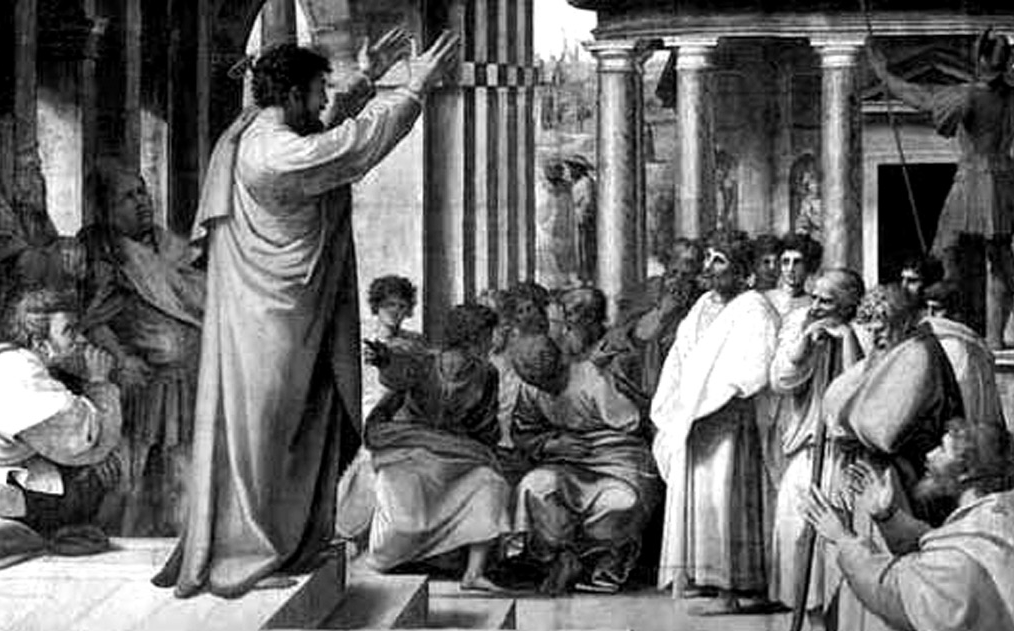
Steven’s Defense before the Council
Jacob bought his land with a hundred of something, possibly lambs, but we cannot say it was with silver. So, in Acts 7:16 Stephen is referring to two different sepulchers; one bought by Abraham with silver and the other bought by Jacob with possibly lambs.
Jacob bought land in Shechem, later used for burial, but Jacob himself was buried with Abraham in Hebron, as seen in Genesis 49:28-32. “All these are the twelve tribes of Israel … their father [Jacob] spake unto them, and … he charged them … bury me with my fathers in the cave that is in the field of Ephron the Hittite, In the cave that is in the field of Machpelah, which is before Mamre, in the land of Canaan, which Abraham bought with the field of Ephron the Hittite for a possession of a burying place. There they buried Abraham and Sarah his wife; there they buried Isaac and Rebekah his wife; and there I buried Leah. The purchase of the field and of the cave that is therein was from the children of Heth.”
With all this Old Testament background, it is evident that Stephen was talking about two different burial places, one bought by Abraham and one bought by Jacob.
In Acts 7:14-16, Stephen used a pattern to help express this point while abbreviating the history he referred to. This pattern demonstrates that he was speaking about two different burial places; Jacob’s and the fathers’ (the kindred). “Then sent Joseph, and called his father Jacob to him, and all his kindred, 75 souls. (15) And Jacob went down into Egypt, and died, he, and our fathers, (16) And were carried over into Sychem, and laid in the sepulcher that Abraham bought for a sum of money of the sons of Emmor the father of Sychem” (Acts 7:14-16).
Jacob is mentioned first and then the fathers, who are the kindred, that went into Egypt. This pattern flows into verse 15, Jacob is mentioned first and then the fathers. In order to continue his point Stephen carries this pattern into verse 16. Knowing that punctuation was not in the original Greek, the phrase “were carried over into Sychem” should be the ending of verse 15. Verse 16 begins with the burial place of Jacob (as well as Abraham and Isaac in Hebron, Genesis 49:29-33), the sepulcher that Abraham bought. Then the second part of verse 16 refers to the burial place of the fathers, the sepulcher bought by Jacob from the sons of Hamor. In order for Stephen to condense his thought, he mentioned Jacob’s burial place first then the fathers’. Stephen began his pattern in verse 14 and carried it through to verse 16, clearly making his point.
THREE WORDS
This is verified in the use of the Greek found in Acts 7:15,16. There are three words “and,” “that,” and “of” that are the key.
The word “and” is Strongs 2532, the Greek kai. Greek Lexicons state that kai is a coordinating conjunction with the sense varying to its circumstances. It is used to join words or sentences, to show sameness or likeness, or to influence single words or clauses. When looking through any Lexicon you will see that this word is used in various ways depending on its context. So how does Stephen use this word?
Acts 7:15,16 (King James translation). “So Jacob went down into Egypt, and died, he, and our fathers, 16 And were carried over into Sychem, and laid in the sepulcher that Abraham bought for a sum of money of the sons of Emmor the father of Sychem.”
The Greek word kai can be better interpreted in the following way in Acts 7:15, 16.
Acts 7:15,16, “So Jacob went down into Egypt; and died, he and but also our fathers; 16 And And so [they, Joseph and the later fathers] were carried over into Sychem, and both laid in the sepulcher (or tomb or grave).
Stephen said that Jacob and the fathers died in Egypt, and the fathers were carried into Shechem to be buried. The reason he does not tell where Jacob was buried in verse 16 is because it is already known that Jacob’s sons had previously buried him with Abraham in Hebron (Genesis 50:7,8,12,13). Remember that Stephen is condensing history.
Next the word “that” found in verse 16 is Strongs 3739, the Greek hos. Greek Lexicons state that hos is a demonstrative pronoun with the antecedent unexpressed which is translated “the one who” or “that one.” The unexpressed antecedent here is Jacob and the fathers who are mentioned in the previous verse. So the Greek reads “that one” Abraham bought for a sum of money.
Lastly, the word “of,” found in verse 16, is Strongs 3844, the Greek para. This word is used to show comparison and means “beside.” So the Greek reads “beside” the sons of Emmor of Sychem. [Editor’s note: and is so translated in McReynolds’ diaglott.]
So verse 16 is translated “that one Abraham bought for a sum of money, beside the sons of Emmor of Sychem. Stephen is telling the council that Jacob who died first was laid in the sepulcher that Abraham bought in Hebron. Then the fathers, who died afterward, were laid in the sepulcher that Jacob bought in Shechem. This harmonizes perfectly with the Old Testament.
SUMMARY
In Stephen’s use of the pattern of mentioning Jacob first and then the fathers, and the uses of the three Greek words “and,” “that,” and “of,” one can properly translate and harmonize Acts 7:14-16 with the Old Testament. Using Stephen’s pattern and his use of those words, Acts 7:14-16 should read as follows.
“Then sent Joseph, and called his father Jacob to him, and all his kindred, threescore and fifteen souls. (15) So Jacob went down into Egypt, and died, he, but also our fathers; And so were carried over into Sychem. (16) Both laid in the sepulcher, that one Abraham bought for a sum of money, beside [the one bought from] the sons of Emmor of Sychem.
To see how Stephen condensed the historical accounts Acts 7:14-16 would read as follows. “Then sent Joseph, and called his father Jacob to him, and all his kindred [the fathers], threescore and fifteen souls, (15) So Jacob went down into Egypt, and died, he [himself] but also our fathers; And so [they, the fathers] were carried over into Sychem [Jacob had already died and been laid in Hebron by his sons]. (16) Both [Jacob and the fathers were] laid in the sepulcher (or tomb, grave), that one [Jacob is buried in the sepulcher of] Abraham [in Hebron] bought for a sum of money [silver], beside [that one which the Jacob bought from] the sons of Emmor of Sychem.
— Br. Rick Evans