
Harmonizing Habakkuk 3:9
“Thy bow was made quite naked, according to the oaths of the tribes, even thy word. Selah …” (Habakkuk 3:9, AV)
Considered by most translators and commentators as an obscure and difficult to translate passage, Habakkuk 3:9 has confounded interpreters for centuries. The United Bible Societies Bible Translator Handbook states that “with so many possibilities to be found in reputable translations (and many other suggestions in scholarly writings), how are translators to decide what to do?” The Commentator Delitzsch said this was possibly the most difficult passage to translate in all of prophecy.1 F. C. Cook’s Commentary says “the ablest critics admit that no very satisfactory explanation of the text, as it stands, is given” and Henry Cowles Commentary on the Minor Prophets states that this “has perplexed commentators, and scattered their opinions more than almost any other passage in the Bible.”
Following are twenty-six variant translations of this verse; but one scholar claims “upwards of one hundred different interpretations have been proposed.”2
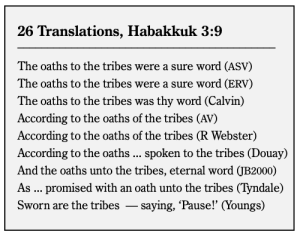
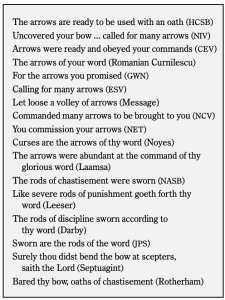
THREE GENERAL TRANSLATIONS
The most common concepts of the rendering listed above can be summarized as follows:
(1) Arrows were ready
(2) Oaths unto the tribes
(3) Rods of punishment
“In this line the three Hebrew words of the traditional text are a serious problem. The first two words have different possible meanings, but no combination of the various possibilities makes much sense or shows much connection with the context.” 3
“ARROWS WERE READY”
This translation might fit the context, but we are led to doubt this construction since the relevant Hebrew word is not translated “arrow” anywhere in scripture. “The word has nowhere the signification of arrow, which would suit excellently the bow, and which is held by some interpreters … It can at the most, as in 2 Samuel 14:17, signify spears …” 4
The versions which translate the word “arrows” assume “… that the third Hebrew word is different from the one in the traditional text, but it does give a meaning which fits the context. This possibility is accepted by some modern versions: NAB has ‘filled with arrows is your quiver,’ and NEB ‘charge thy quiver with shafts.’ “5
“OATHS UNTO THE TRIBES”
“According to the oath of (to) the tribes, ‘the oath which He swore unto our father Abraham,’ which oath He often renewed to Abraham, Isaac and Jacob, and again to David (See the end of Micah, Psalm 89:3, 132:11.) This oath, the word and promise of God, was the pledge of the deliverance of His people, that they ‘should be saved from their enemies, and from the hand of all that hate them.’ “6
If “oaths of the tribes” is the better translation, then it would call to mind the promises God made to Israel to protect them. “Selah” would be an admonition to pause and consider the promises to Israel, that God would curse those who curse them and bless those who bless them. “May peoples serve you, and nations bow down to you; be master of your brothers, and may your mother’s sons bow down to you. Cursed be those who curse you, and blessed be those who bless you” (Genesis 27:29). Contextually we see Habakkuk 3:13 states that the LORD went “forth for the salvation of thy people.”
While this is a possible translation, and “a rendering accepted as on the whole presenting least difficulty,” it is “a construction which, if grammatically defensible, is harsh, and scarcely intelligible.”7 “(It) cannot signify oaths, is determined by the circumstance that ‘the oaths of the tribes,’ the rendering of our common version, affords no tolerable sense as here introduced, whether we regard the tribes as the persons swearing, or as those to whom oaths are sworn.”8 “Of the two meanings which may be given to mattooth, viz., branches, rods, or staffs, and tribes of the people of Israel, the latter can hardly be thought of here, since mattooth would certainly have been defined by either a suffix or some determining clause, if the tribes of Israel were intended.” 9
There are other alternatives.
“BOWS” OR “RODS OF PUNISHMENTS”
“Rods of punishment” or “chastisement” is a thought completely opposite that of the previous concept of oaths. If this is correct, perhaps selah is used here to warn Israel to pause and consider their punishments, or perhaps to consider the punishments against nations who were against them. The exact meaning is difficult to grasp from the context.
Most of the translations use “bow” instead of “rods,” and “some of the moderns have explained [this bow to be] … the rainbow, than which nothing can be conceived more incongruously out of place in a passage containing a sublime poetical description of warlike operations.” 10 In the Authorized Version, Strong 4294 is translated tribe 182 times, rod 52 times, staff 15 times, and staves 1 time.
“Though Habakkuk 3:9a has been subjected to numerous interpretations, there is general agreement that qesheth (Strong 7198) refers to the Lord’s bow. There are numerous verses in the Hebrew Bible that use the term qesheth, but few of these refer specifically to the Lord’s bow. The Lord’s bow is only referred to in Genesis 9:13-14,16, Ezekiel 39:9, Habakkuk 3:9, Lamentations 2:4 and 3:12.” 11
Though this seems a more plausible rendering, it is not the most common translation used in our common English translations. But there is yet another possibility.
AN ALTERNATE POSSIBILITY
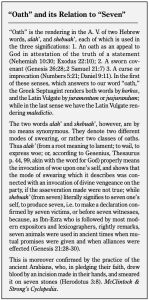
The solution may be found in the root meaning of the Hebrew words translated here, especially the first word which “may be a noun in the sense of oaths, possibly sevens, or a participle, meaning sworn. The second is a noun, meaning originally a rod, something stretched out; then a shoot or twig; but in use most often, the tribes of Israel.” 12 “The first word may be rendered ‘seventh’ (related to Sabbath)” 13
A quick view at the McClintock & Strong reference to “Oath” in the box at the top of the following page, will show its interesting relation to the word “seven.”
A possible translation suggested by F. C. Cook’s Commentary is “Sevens of chastisements are the decree.” When this word is used in Leviticus 26, it is translated “seven times.” With this approach, the passage could be rendered “seven times of chastisements are decreed.”
If this is the meaning, then who are the chastisements against? Are the seven times against Babylon? The context suggests this thought since most of the chapter is about God’s anger against the enemy of Israel.
The New American Standard translation expresses this in the past tense, “The rods of chastisement were sworn.”
Inserting “seven times” for “rods,” this could be translated “seven times of chastisement were sworn” or “seven times of chastisement were decreed,” looking at the completion of the “seven times” from the end. In this case, perhaps the prophecy considers the “seven times” against Israel as completed, and now shows what else was to happen to the nation.
If the word “chastisement” is not a correct translation, it could bear the meaning of “seven times for the tribes.” This would answer the question of who the “seven times” would be applicable to in a direct manner and make the passage a bit clearer.
These possible translations may explain the selah placed after this phrase. Selah, pause and consider, the “sevens” or the “seven times” for Israel.
“SEVEN TIMES”
Keil & Delitzsch’s Commentary says “Ewald’s rendering, ‘sevenfold darts of the word,’ is precluded by the combination of ideas, ‘darts of the word’ … is quite foreign to the context.” 14 But this comment does not show that the word should not be translated “seven,” but rather that the phrase, “darts of the word” is foreign to the context. Most translators and commentators would not translate the word “seven” in this verse since they do not understand the meaning of the “seven times” in prophecy in Leviticus or Daniel either.
Can the case be made to translate “seven” as “seven times” here, when the Hebrew word for “times” is not used anywhere in the verse? It is also not used in Leviticus 26 where the word “seven” is used. The passage in Leviticus does add the word “more” as a qualifier in verses 18 and 21. But in verses 20 and 32 we have only the word “seven,” and the translators still express the thought as “seven times.”
That the word “seven” is used in both Habakkuk and Leviticus, does not necessarily mean that the two passages refer to the same thing. But there appears to be a cause and effect in these verses. In Leviticus we see the cause or reason for punishing Israel “seven times” was disobedience to the Lord and not upholding the covenant, and Habakkuk describes the actual fulfillment of the punishment threatened in Leviticus.
Some of the similarities can be seen as follows:
“I will also break down your pride of power … you shall be delivered into enemy hands … I will scatter among the nations and will draw out a sword after you, as your land becomes desolate and your cities become waste” (Leviticus 26:19, 25, 33).
Babylon’s Pride of Power: “They are a feared and dreaded people; they are a law to themselves and promote their own honour” (Habakkuk 1:7 NIV).
Enemy Hands: “[The Chaldeans] bring all of them up with a hook, drag them away with their net, and gather them together in their fishing net. Therefore, they rejoice and are glad” (Habakkuk 1:15 NASB).
Scattering Israel: “They stormed in to scatter us; Their exultation was like those Who devour the oppressed in secret” (Habakkuk 3:14 NASB).
Drawing a Sword after them and Desolation of Land: “For the violence done to Lebanon shall cover you, and the destruction of the animals terrified you, because of men’s blood and violence done to the land, to the city, and to all that dwell in it” (Habakkuk 2:17, Dead Sea Scrolls translation).
Space does not allow for many of the similarities between Habakkuk’s prophecy and Leviticus 26 to be outlined here. But we encourage each student of the scriptures to take time to research this.
Israel was to be removed from their lands and delivered into enemy hands for “seven times” at the beginning of this period in 607 BC, and after the period is completed (2520 years to 1914) we should see the completion of the “seven times” for Israel in the context. Leviticus warns of the threat. The “seven times” of Daniel 4:16, 23, 25, 32 and Habakkuk refer to beginning the fulfillment of that threat.
HABAKKUK 3
“You came out to save your people, to save your chosen one. You crushed the leader of the wicked ones and took everything he had, from head to toe. Selah. With the enemy’s own spear you stabbed the leader of his army. His soldiers rushed out like a storm to scatter us. They were happy as they were robbing the poor people in secret” (Habakkuk 3:13-14, New Century Version).
Here at last we have an answer to the questions Habakkuk asked previously in the book (see especially Habakkuk 1:1-4). The prophet reviews what he has seen. Verse 3 seems to describe the beginning of the second advent when it refers to the Lord coming “from Teman.” The word “God” in this verse is singular in Hebrew, Eloah. It is not used in any of the other minor prophets, Jeremiah, or Ezekiel. It is used in Isaiah, Daniel, Job, and Deuteronomy. Generally the word used in Scripture for God is Elohim, the plural of the word Eloah found in this verse. When it says “God” comes in this verse, it could refer to Messiah, Christ, as Hebrews refers to when citing Habakkuk in Hebrews 10:37.
In Habakkuk 3:13, the word “salvation” is repeated twice. Perhaps the prophet repeats the words to call attention to this point; however he used the word Selah elsewhere in this chapter to do just that. It is more likely that the “Salvation of thy people” refers to Israel, and the “Salvation of your anointed” refers to the Church. Some commentators interpret the “anointed” here as Christ, but this seems far fetched. Several of the Hebrew manuscripts, and also the Septuagint, translates this “thy anointed ones,” i.e., God’s Christs, God’s Messiahs, God’s anointed, God’s saints. The Hebrew for “anointed” here is plural, a collective of anointed ones.
This is the same time period we read of in Obadiah 21, “Saviors shall come up on mount Zion to judge the mount of Esau; and the kingdom shall be the LORD’s.” These anointed ones will deliver the world from the oppression of Antichrist’s false doctrines, superstitions, idolatry, and from sin and death.
Regarding Israel after 1914, the nation was saved from two millennia of non-existence as a nation. They have been regathered from being scattered all over the earth, but we have not yet seen their full and complete salvation when God will pour out His spirit on that nation and they will recognize Messiah (Zechariah 12:10). There are still more blessings to come for God’s chosen people.
Wounding the head of the house of the wicked one reminds us of the promise to Eve in Genesis 3:15. This seed, Christ and his anointed ones, will destroy Satan, not only by crushing the serpent’s head, but as the verse here says, “destroying all from head to toe,” and piercing the head of the warrior. “The God of peace shall crush Satan under your feet shortly” (Romans 16:20).
But as this leader is pierced, his warriors storm in to scatter the anointed ones, like a whirlwind. This verb also is in the future tense. As Babylon waged war like wild beasts on Israel in Nebuchadnezzar’s day, this is also the character of mystical Babylon. Both rejoiced in swallowing up Israel, natural and spiritual. Mystical Babylon will share the same fate and destiny as literal Babylon did.
Not only is the restoration of Israel anticipated, but also the entire world. “For the earth shall be filled with the knowledge of the glory of the LORD, as the waters cover the sea” (Habakkuk 2:14).
Habakkuk ends his prayer with the words, “I will wait patiently, for the day of disaster that will come to the people who attack us … The Lord God is my strength. He makes me like a deer that does not stumble so I can walk on the steep mountains” (Habakkuk 3:16-19, NCV).
These verses anticipate restoration. Once more Israel will rejoice in the mountains of Judea, in the mountains of the Lord. Habakkuk here trusts that the Lord will protect him, guide him, and his people, just as a deer can maneuver in difficult terrain in high places without injury.
SUMMARY
Habakkuk 3:9 and its context has been an enigma to scholars for centuries. The diversity of renderings suggests the difficulty translators have with the text.
We propose a rendering like this: “seven times of chastisement were sworn” or “seven times of chastisement were decreed.”
Viewing the passage with the thought of “seven times” has three advantages. (1) It makes sense in context, (2) it provides another testimony to the “seven times” of Leviticus 26 and Daniel 4, and (3) it provides an enhanced understanding of the rest of the chapter.
– Jeff Mezera
(1) Aron Pinkner, Biblica, 84 (2003) pp. 417-420
(2) E. Henderson, The Book of the Twelve Minor Prophets
(3) Old Testament Handbook Series, United Bible Society, Copyright 1978-2004
(4) Lange’s Commentary on Habakkuk 3:9
(5) UBS Old Testament Handbook Series. Copyright 1978-2004 by United Bible Societies
(6) Commentary in Barnes Notes on Habakkuk 3:9
(7) Commentary by F. C. Cook
(8) E. Henderson, The Book of the Twelve Minor Prophets
(9) Keil, C. F., & F. Delitzsch, Commentary on the Old Testament, (10:422), Hendrickson, Peabody, MA (2002)
(10) E. Henderson, op.cit.
(11) Aron Pinkner, op.cit.
(12) Henry Cowles, op.cit.
(13) Commentary by Walvoord and Zuck
(14) Keil and Delitsch, op. cit.