
Queen Esther (continued)
“Esther obtained favour in the sight of all them that looked upon her” (Esther 2:15) (Continued from the September, 2014 issue).
The first part of this article suggested that Queen Esther, renowned for her beauty, is a picture of the Church class, which will be renown for beauty of character. That Xerxes, the king, was a picture of our Lord Jesus.
That the 127 provinces of the king’s domain remind us of the 127 years of Sarah’s lifespan, connecting Sarah, a picture of the spiritual part of the Abrahamic Covenant, to the development of the Bride class.1
That the 180 day feast that opens the Book of Esther represents in various ways the preparation for the Gospel Age calling of the saints. The subsequent Grecian campaign of King Xerxes represents the advance of our King Jesus, gathering disciples from the Gentile world. Following is the continuation and conclusion.
VASHTI
Esther chapter one, verses 9 and forward, recount the experience with Vashti, predecessor in the office Esther would later hold. The king while merry with wine called for her in order to display her beauty to his gathered hosts. Perhaps we can sympathize with Vashti in the situation. Her modesty was at peril, in a literal sense. However, the spiritual picture is the essence for us. We suggest that Vashti represents the nation of Israel, called upon to show the beauty of character that should have been developed. But at the necessary moment, Israel failed to display this beauty. Vashti was deposed, as Israel was deposed from the chief honor, and the calling went out kingdom wide for all who wished to try for the position. This shows how the high calling went out worldwide to constitute the heavenly companion for our Lord Jesus.
All of this occurred in the third2 year of Ahasuerus (Esther 1:3). But queen Esther did not come into the presence of the king until his seventh year (Esther 2:16). The four years intervening was the period of Xerxes’ abortive conquest of Greece. In picture, these four years represent the period of trial, testing, and development of the Church. Elsewhere the Gospel Age is represented as 40 years (the wilderness wandering), or as 400 years (the affliction of Abraham’s seed, Genesis 15:13).
Coming into the presence of the king in his seventh year perhaps indicates that members of the Church class enter the presence of the king during the seventh “year,” or stage, of the Gospel Age, the period we often refer to as Laodicea. The 10th month of the 7th year reflects the same numbers in this picture of the end of the Gospel Age, as appears in Ezekiel 40:1, when a vision of the Millennial Kingdom was given to Ezekiel, namely the 10th day of the 7th month.
PREPARATION
Esther was being prepared for a full year (Esther 2:12). This reminds us that the Gospel Age, its teachings, and accoutrements, is represented by the sun (Revelation 12:1, Matthew 13:43), and one year is the period of the solar circuit. This was separated into six months of treatment with “oil of myrrh” and six months with “sweet odours” (Esther 2:12). These six months reminds us that our development is still within the period of sin and death abroad in the world. The oil of myrrh represents the holy Spirit, whose work with us in this age involves suffering and sacrifice (thus myrrh). The perfumes represent the sweet graces of the spirit that should accompany us everywhere we go.
On occasion we observe even brethren disposed to a surly, sour, critical, complaining disposition. No doubt these human weaknesses are traceable to elements of the fallen nature, and Jesus is understanding. But this is not the Christian spirit. We often wonder how this is considered at all compatible with the “sweet odours” that we are intended to reflect to others. Possibly some consider the Christian faith to call upon them to earnestly content, and this is misconstrued to being earnestly contentious, or earnestly opposing whatever they may not deem a proper view, or a proper person. However, this is inappropriate and deleterious. It is very different than the sweet odours apparent in the ministry of our master.
GIFTS
Esther 2:18 says that upon the selection of Esther, “the king made a great feast unto all his princes and his servants, even Esther’s feast.” We suggest that the princes here indicate that when the church is complete the Ancient Worthies will be honored by a resurrection. The servants may picture the Great Company. If this is correct, then it may support a common view, but one we have long wondered about, namely that Revelation 19:9, “Blessed are they which are called unto the marriage supper of the Lamb,” may refer to the Great Company class. Esther 2:18 continues, “and he [the king] made a release to the provinces.” Evidently this refers to releasing the world from the curse as the Kingdom opens.
MORDECAI, HEGAI, BIGTHAN, AND TERESH
Mordecai was an older cousin of Esther, sufficiently older to have raised Esther, who was otherwise without parents in her growing years (Esther 2:7). Mordecai seems to us to represent the Ancient Worthies, our older cousin whose testimonies help shape our life of faith, even though we are called to a superior position, as was Esther.
Hegai, keeper of the women who provided for their needs and refinements, seems to us to represent the holy Spirit (Esther 2:8,15).
Esther 2:19 then speaks of a gathering of virgins “the second time.” The first gathering was in search for the queen of the harem, and Esther secured that place. The second gathering, after Esther has been ushered into the presence of the king, perhaps represents the final gathering of the Great Company. About this time the Ancient Worthies will be raised. They are mentioned also, symbolically, in verse 19, “Mordecai sat in the king’s gate.”
The following four verses speak of a sedition by two of the king’s chamberlains, Bigthan and Teresh. These should have been on the side of the king, but instead they were found to be opposers of the king. When they were seen for what they were, they were summarily executed, and Mordecai was involved in their undoing.
At about this time Revelation shows us that there will be a final judgment of two systems that are ostensibly on the side of our great King. They are “Christian” institutions in name, but in fact they are not working in concert with the program of Christ to establish his Kingdom. These systems are represented by the Beast and False Prophet of Revelation — Papacy, and the Church of England with her protestant allies. Revelation 19:20 tells us that they are summarily executed as systems. “The beast was taken, and with him the false prophet … these both were cast alive into a lake of fire.”
That leaves one major foe to deal with — the Dragon. Revelation chapter 20 shows what becomes of him. He is shrouded in the darkness of the pit, and then disposed of as an enemy of the people of God. Haman represents the dragon, Satan, in his plot to thwart the establishment of Christ’s kingdom at Israel. Haman plotted to destroy Mordecai together with the Israelites. That narrative is recorded in chapters 3 through 9. Ultimately Haman was shrouded in darkness (Esther 7:8), and subsequently disposed of (Esther 7:10). The dragon of Revelation has 10 horns, and Haman had 10 sons, all disposed of (Esther 9:10).
THE CLOSING CHAPTER
Esther 10:1 says that then “the king Ahasuerus laid a tribute upon the land, and upon the isles of the sea.” So Jesus will receive the tribute of the entire world during the Millennium. “Mordecai the Jew was next unto king Ahasuerus, and great among the Jews, and accepted of the multitude of his brethren, seeking the wealth of his people, and speaking peace to all his seed.” The Ancient Worthies will be covered with honor as the early representatives of the Great King. Peace and fortune will attend all.
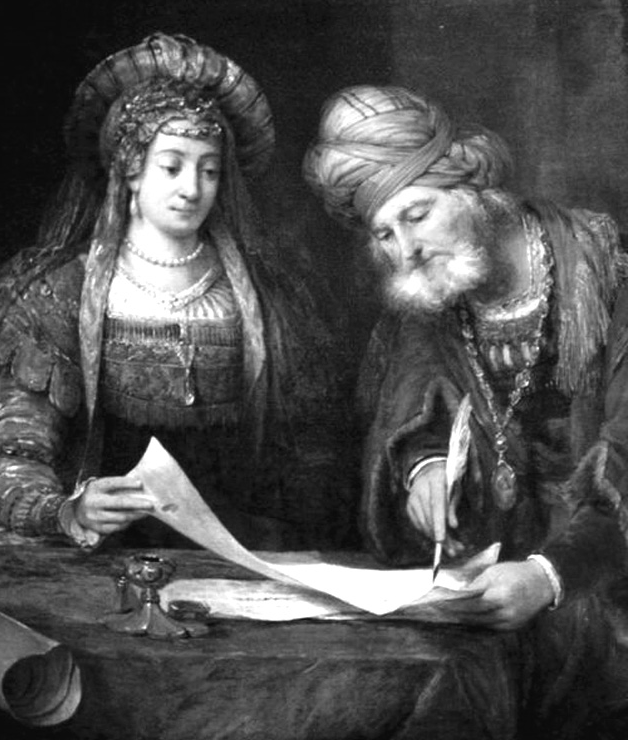
Esther and Mordecai
— Br. David Rice
(1) 127 is also the sum of 100 and 27. Both of these numbers are exponentials. 100 is frequently taken to be the number of Jesus — it is also 10 squared. 27 is equal to 3 cubed. Putting it together as a further symbol of the high calling: Jesus (100) is the source of our redemption (3), yet redemption to not merely eternal life, but the very highest form of life, namely a divine nature of immortality (27, 3 cubed). Thus 27 is an emphasis of the pinnacle of redemption all based upon Jesus and following his footsteps — 27 + 100 = 127. (Editor).
(2) Jesus was three days in the grave, his price was 30 pieces of silver, Mary anointed him with 300 pence of oil, at Pentecost the church swelled to 3000. All these “three” numbers, of whatever magnitude, pertain to redemption. Perhaps this is because there are three parties involved in the work of atonement — God, man, and Jesus the reconciler in between.