
The Nazarite Vow
Particulars of the Nazarite vow are found in Numbers chapter six. This vow was taken voluntarily, either man or woman, in respect to their faith and devotion to Jehovah. For the period of their vow the Nazarite would (1) abstain from wine or any product of the vine, even down to seeds or leaves, (2) let his hair grow uncut, (3) avoid contact with dead bodies (Numbers 6:1-8). The vow is also mentioned in Lamentations 4:7 and Amos 2:11. Both texts suggest a goodly number of persons took this vow from time to time, so that it continued a common part of Jewish culture even when the nation wandered from God. Probably it was this vow that Paul observed (Acts 18:18), and four other Jewish Christian men in his time (Acts 21:23).
The Nazarite vow represents the vow of consecration we make to God as we enter into his fold. Abstaining from wine shows that we abstain from the intoxicating spirit of this world and all of its influences, so that we would wish not to imbibe so much as a “seed” or “leaf” of sin if possible. “Abstain from all appearance of evil” (1 Thessalonians 5:22). The uncut hair is a symbol of faithfulness to our vows, and the flowing locks of hair “as a flock of goats” elsewhere symbolize a feature of great beauty in the Bride of Christ (Song of Solomon 4:1). Avoiding contact with dead ones represents that we, as justified members of the body of Christ, wish to remain cleansed from Adamic sin as far as possible.
IN CASE OF DEFILEMENT
Numbers 6:9-12 describes how to cleanse a Nazarite from unintentional contact with death. He was to shave his head on the seventh day of a purifying period, and on the eighth day bring two birds for his cleansing and a lamb for a trespass offering. This is very similar to the procedure for cleansing lepers in Leviticus 14 — the leper brings two birds for his cleansing, shaves his head on the seventh day, and on the eighth day brings animals for sacrifice which include a lamb for a trespass offering (verses 1-12). The cleansing of lepers represents the cleansing of mankind from the leprosy of Adamic sin. Thus the similarity of the offerings for both lepers and the unintentionally defiled Nazarites.
CONCLUSION OF THE VOW
Numbers 6:13-21 describes the conclusion of the period of one’s vow, representing the time when our consecration unto death is complete. The particulars described bear a marked similarity to the offerings described in Leviticus chapter eight concerning the consecration of the priesthood. But there are some noticeable differences. These differences symbolically distinguish the completion of our vows, collectively at the end of the Gospel Age, from the sacrificing and laboring of the Church during the Gospel Age. Here are some specifics.
(1) Both accounts include a ram for a peace offering, parts of which were waved before the Lord. In Leviticus 8:22-30 this ram of consecration was waved with three items from a basket of unleavened bread: (a) one unleavened cake, (b) one cake of oiled bread, and (c) one wafer. These represent justification, sanctification, and the hope of glorification (Tabernacle Shadows, page 46). But in Numbers 6:15 the basket of unleavened bread contained only two kinds, “cakes … mingled with oil, and wafers.” Why the missing element, the simple unleavened cake not mingled with oil? Because that represents the justification of our flesh, and at the end of the narrow way we no longer require our flesh. We still retain the influence of the holy spirit (oil), and realize the promised glorification (wafer), so these are present.
(2) In both passages the right shoulder of the ram is waved, representing the fullness of our service to the divine cause (Leviticus 8:25, Numbers 6:19). But in Leviticus 8 the right shoulder was burnt on the altar, whereas in Numbers 6 it was not (Levitucus 8:28, Numbers 6:20). Why this missing element? Because during the Gospel Age our labors are expended in sacrifice, but in glory above our service, still joyfully rendered by us and accepted by God, will not be spent in sacrifice.
(3) In Leviticus 8:25 the fat, liver and kidneys were waved and then consumed. In Numbers 6 these items are omitted. Why? Because the liver and kidneys, purifying organs, no longer pertain when our fleshly sacrifice is complete, and our zeal and devotion is no longer consumed in sacrifice.
(4) In Leviticus 8:23, 24, ram’s blood is applied to the right ear, thumb and big toe of the priests. In Numbers 6 the blood is nowhere mentioned. Why? Because there is no need of redemption when the saints finish their earthly course.
(5) In Leviticus 8:27 the priests being consecrated wave the offering, showing how we now wave our offering during the days of our consecration until it is removed from our hands. In Numbers 6:20 the offering is waved on behalf of the Nazarite. Why this difference? Because when our service here is complete we no longer “wave” our offering. It is presented on our behalf, and God accepts it, but our labors will have ended.
At the end of the sacrificing of the Gospel Age Jesus will bless the people, represented by Aaron blessing the people in Leviticus 9:22. What blessing did Aaron speak to the people? He used the words given in Numbers 6:24-26, “The Lord bless thee, and keep thee: the Lord make his face shine upon thee, and be gracious unto thee, The Lord lift up his countenance upon thee, and give thee peace.” That is the blessing which will come to the world when the Nazarites of the Gospel Age have completed their vows. Thus the location of these words following a description of the Nazarite Vow is appropriate.
OLD TESTAMENT NAZARITES
Only two Nazarites in the Old Testament are recorded by name, and the record concerning each of them is remarkable. They were Samson and Samuel. Both were Nazarites from the womb, destined in advance for their life of devotion and service. Both were children of promise. Samson was promised by the angel to Manoah and his wife (Judges 13:6-21). Samuel was promised by Eli in response to Hannah’s desperate prayer (1 Samuel 1:9-20).
Even more striking, both men were contemporaries and employed by God to accomplish the same work, namely the deliverance of Israel from the Philistine bondage which would endure forty long years. Samson was born during that oppression and died just before it was completed. He was destined to “begin to deliver Israel out of the hand of the Philistines” (Judges 13:1, 5). Under Samuel, God would complete the victory so triumphantly that “the Philistines were subdued, and they came no more into the coast of Israel” (1 Samuel 7:13).
The connection between these men is obscured to the casual reader because three narratives intervene between the two accounts. (1) Judges 17, 18 describe how the tribe of Dan went into continued idolatry. (2) Judges 19, 20 describe how the tribe of Benjamin was nearly exterminated. (3) The Book of Ruth describes the ancestral parentage of King David. These three narratives were deferred by the compiler of Judges because they do not pertain to any particular judge. But having occurred during the period of Judges, they had to be included before moving onto the period of Kings which is introduced through the career of Samuel.
These episodes actually occurred much earlier, in the generation following the conquest under Joshua. (See Judges 18:30 in the NASB or NIV, Judges 20:28, and Ruth 4:21.) Without this intrusion, the story of Samson would be immediately followed with the story of Samuel, his younger contemporary. The engagement of both of these men in the same deliverance, one a precursor the other a finisher, begins a pattern (and a picture) continued in another pair of Nazarites which appear much later in the sacred record: John the Baptist and Jesus.
JOHN THE BAPTIST AND JESUS
That John the Baptist was a Nazarite from the womb is implied in Luke 1:15, “For he shall be great in the sight of the Lord, and shall drink neither wine nor strong drink: and he shall be filled with the holy Spirit, even from his mother’s womb.” Jesus, of couse, was not literally a Nazarite, for he drank wine frequently. But he was the fulfillment of the Nazarite, the antitype of what the Nazarite vow was all about.
Jesus was raised in the city of Nazareth and thus “fulfilled which was spoken by the prophets, He shall be called a Nazarene” (Matthew 2:23). The similarity of the words “Nazarite” and “Nazarene” are probably not coincidental. The prophecies said that Jesus would be a “branch” or shoot, and the name of the city Nazareth evidently comes from the Hebrew word netzer, “branch” (Isaiah 11:1), which describes a shoot separated from the main stem. The word “Nazarite” means “separated.”
John and Jesus were contemporaries, John about six months the elder. As Samson completed his life before the deliverance of Israel was complete through Samuel, so John the Baptist completed his life before the deliverance through Christ was effected. Samson was a little older than Samuel; John was a little older than Jesus. Samson and Samuel had distinct ministries, but to the same end — delivering Israel. John and Jesus had distinct ministries, but to the same end — gathering the “Israelites indeed” to God. Samson and Samuel were both destined from the womb. John and Jesus were both destined from the womb.
BRO. MILLER AND BRO. RUSSELL
This tandem at the first advent has a parallel at the second advent in Bro. Miller (1781-1849) and Bro. Russell (1852- 1916), two antitypical Nazarites. Bro. Russell, as the seventh star in the hand of our Lord Jesus (Revelation 1:20), represents our Lord in the havest work at the second advent. John preceded our Lord’s ministry; Bro. Miller preceded the Harvest movement. Men mused in their hearts whether John was Messiah (Luke 3:15); many mused whether the Miller Movement would bring in Messiah. John’s work was introductory; Miller’s work was introductory.
John, though thoroughly devoted, consecrated and faithful, was nevertheless not of the new movement brought in by Christ. “He that hath the bride is the bridegroom: but the friend of the bridegroom, which standeth and heareth him, rejoiceth greatly because of the bridegroom’s voice: this my joy therefore is fulfilled” (John 3:29). Bro. Miller, though thoroughly devoted, consecrated and faithful, did not embrace the clearer views respecting trinity, immortal soul, and greater hope for the world, which began to circulate within the Adventist movement. He was a precusor to the Truth Movement, as John was a precusor to the Gospel Movement. Had Bro. Miller embraced the clearer views, and been vocal concerning them, it probably would have diminished the breadth of his service as herald to the Christian world to rouse them for the second advent.
APOSTLE PAUL AND BRO. RUSSELL
After Jesus died, rose and ascended, his work continued through the apostles. Added to them was the newly con- verted Paul, a “chosen vessel” to bear the Gospel to the Gentiles. Peter was granted the honor of using the “keys of heaven” to introduce faith in Christ to the Gentile Cornelius, which assisted other Jewish Christians to recognize God was broadening the blessed call beyond only Israelites. But Paul, more than any other, grasped from the Old Testament types and prophecies the magnitude of the dispensational change. Evidently Paul was the first messenger to the church.
Thus the work of Jesus extended through the first messenger, Paul, following the first advent. Similarly the work of Jesus at his return proceded through the seventh messenger, Bro. Russell; in neither case exclusively, but in both cases grandly.
FROM THE WOMB?
Samson, Samuel, John the Baptist and Jesus were destined for their service from the womb. Was it so with these two also? Paul writes of himself, “It pleased God, who separated me from my mother’s womb, and called me by his grace, To reveal his Son in me” (Galatians 1:15, 16). Perhaps Paul was speaking on a spiritual level of the Law as his “mother’s womb.” But this still gives us a connection in symbol with the Old Testament Nazarites who were also called from the womb. Even literally, it is apparent that God was preparing Paul for his position from his early years as a student of Gamaliel, one of the finest teachers of the Law.
How about with Bro. Russell? Probably with him and all of the messengers to the Church, there was a foreknowledge and preparation of affairs from years before, possibly from the womb. How much of such divine foresight may apply to others of the New Creation, who can tell? Cannot many of the dear friends testify of experiences in their childhood, in which they can later trace the leadings of providence?
Respecting the seventh messenger in particular, a hint may be gleaned from the book of Daniel. Chapter 5 records the cryptic handwriting on the wall, “Mene, Mene, Tekel, Upharsin” (verse 25). Literally this means “numbered, numbered, weighed, divided.” Some commentators and brethren note that this phrase is very close to expressing units of monetary value, “mena, mena, shekel, division.” The Babylonian mena was 50 shekels, and a shekel is 20 gerahs (Exodus 30:13). Thus “mena, mena, shekel, division” suggests the amounts of 1000, 1000, 20 and 500 gerahs respectively. These sum to 2520, the same number as the years of Gentile dominion commencing with Babylon. Thus this judgment on ancient Babylon points to the judgment concluding the 2520 years, which brings us to 1914.
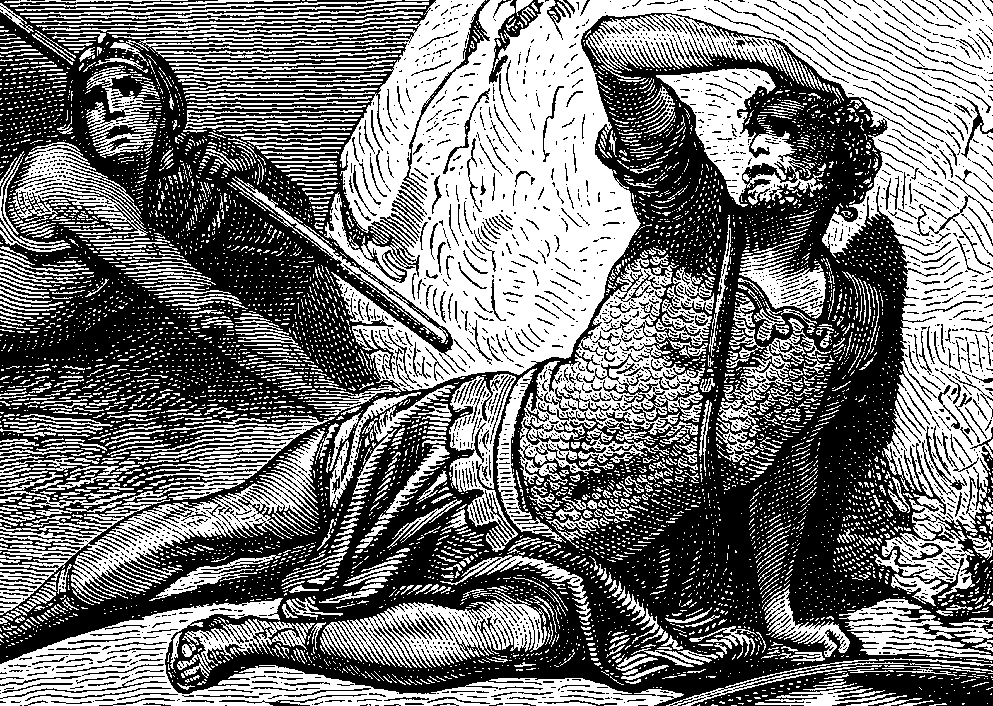
The Conversion of Saul
Belshazzar was slain, and Darius the Mede took the kingdom at the age of 62 years (Daniel 5:30, 31). Who is this Darius? Some scholars who support the integrity of the scriptural record hold that Darius the Mede was the same person as Cyrus the Persian. Cyrus blended both kingdoms into one, his mother being Median and his father Persian. Daniel 6:28 appears to affirm this, if the word “and” is translated “even.” (See 1 Chronicles 5:26, NASB or NIV, where the same construction equates Pul with Tilgath-pilneser — two names for the same person.) If Darius is Cyrus, then Darius is a picture of Christ (Isaiah 45:1, 2).
Now to the point. Darius was 62 years old — prophetically, Christ in 1914 would be 62 years old. Does this make any sense? It may, if we recognize that Christ was represented at his return by the seventh of those seven stars in his right hand. In 1914, Bro. Russell was in fact 62 years old. If this age was foreknown, then his birth year was foreknown; he was called from the womb.
THE JEREMIAH CONNECTION
Thinking of these consecrated servants being called from the womb, we note a prophet in the Old Testament who was also destined from the outset. God said to Jeremiah, “Before thou camest forth out of the womb I sanctified thee, and I ordained thee a prophet unto the nations” (Jeremiah 1:5).
Jeremiah represented our Lord. Jeremiah was anointed a prophet 40 years before the Babylonians burned the temple; Jesus was anointed at Jordan 40 years before the Romans burned the temple. Jeremiah was beset by the rulers, priests and people, but God promised he would be finally victorious (Jeremiah 1:18). Jesus was beset by the rulers, priests and people, but was finally victorious. Jeremiah was put into a pit but raised out of it; Jesus was put into a tomb but raised out of it. A link between the two is also made in Matthew 16:14, “some say thou art … Jeremias.”
Since Jesus is represented by the first and seventh messengers following the two advents, it is noteworthy that four dates prominent during Jeremiah’s ministry are paralleled by prominent dates following each of the two advents of Christ — first carried through Paul, later through Bro. Russell. Here, in chart form, is the comparison.
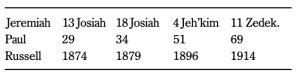
Jeremiah entered his prophetic office in the 13th year of Josiah (Jeremiah 1:2) and continued forty years “unto the carrying away of Jerusalem captive in the fifth month” of the 11th year of Zedekiah (Jeremiah 1:3). Five years after his call began a great religious reformation in the 18th year of Josiah, sparked by finding the book of the Law in the Temple (2 Kings 22:3, 8; 2 Chronicles 34:8, 14). Seventeen years later the first of the predicted judgments fell upon Judah with an invasion by Nebuchadnezzar in the fourth year of Jehoiakim (2 Kings 24:1; 2 Chronicles 36:6; Jeremiah 46:2, 25:1; Daniel 1:1 accession year reckoning). Eighteen years later Zedekiah’s kingdom fell (Jeremiah 1:3).
The anointing of Jeremiah parallels the anointing of Jesus in 29 AD. Five years later Paul was converted in 34 AD. Through him a great religious reformation was initiated. Seventeen years later in 51 AD the disciples convened a council at Jerusalem to resolve the Jewish question, namely, to what extent the Gentiles coming to Christ should be obliged to the Law. Eighteen years later the 40 years of probation expired in 69 AD, the last year the atonement offerings could be observed before the temple was destroyed the following spring.
The corresponding dates at the second advent would be 1874, 1879, 1896, 1914. In 1874 Christ returned, and Bro. Russell’s ministry as a messenger to the Church of Laodicea commenced. (According to a testimony of Bro. Russell’s sister, Sr. Margaret Land, in the Convention Reports from 1907, this may also have been the year of Bro. Russell’s immersion.) In 1879 the first edition of the Watchtower was published, beginning a great religious reformation. In 1896 the Jewish question came to the fore with the publication of “The Jewish State” by Theodore Herzl, beginning the Zionist movement. In 1914, 40 years of probation for Christendom expired, leading to World War I.
Each date focuses on a different aspect of the Harvest work. Jeremiah had a message for three distinct classes — the faithful who would heed his words, the nation which would receive the punishments predicted, and also “the nations” (Jeremiah 1:10). After the beginning of the harvest in 1874, the threes date following, namely 1879, 1896, 1914, high- light a work for each of these classes. (1) The faith class received the truth through the Watchtower begun in 1879. (2) Israel responded to the Zionist movement begun in 1896. (3) The nations fell to the war opening in 1914.
DATES OF PAUL’S MINISTRY
When the parallels presented above began to take form, we were uncertain of the dates of Paul’s ministry. The following are helpful facts relative to two rulers who intersect with Paul’s experiences. (1) Aretas was king over Damascus when Paul escaped the city by being lowered over the wall in a basket. This was three years after Paul’s conversion (Acts 9:19-28, 2 Corinthians 11:32, Galatians 1:15-18).
(2) Gallio was proconsul of Achaia when Paul appeared before him during his second missionary journey. This was about two years after the council at Jerusalem (Acts 15), allowing six months for various journeys (Acts 16 through 18:10) and 18 months at Corinth (Acts 18:11) until his appearance before Gallio (Acts 18:12). The Jerusalem council was 14 years after Paul’s first visit to Jerusalem at his escape from Damascus (Galatians 2:1). Thus between Paul’s escape from Aretas and his appearance before Gallio were 16 years.
Current historical information suggests the earliest date feasible for Aretas’ control of Damascus is 37 AD. The latest date feasible for Gallio as deputy (“proconsul” in NASB) of Achaia is 53 AD. The span between these dates is 16 years, which matches the 16 years between these episodes from scripture. Thus these 16 years cannot begin earlier, or end later, than 37 AD and 53 AD respectively.
Therefore Paul’s conversion was in 34 AD, three years before his escape from Damascus in 37 AD. The council at Jerusalem was in 51 AD, 14 years after his first visit to Jerusalem.
SUMMARY
The Nazarite Vow represents the consecration vows of our Lord Jesus and his saints. The two named Nazarites of the Old Testament, Samson and Samuel, were chosen for their service from the womb, and engaged in two phases of the same work. Their work finds a parallel in the spiritual work of two New Testament Nazarites, John the Baptist and Jesus (an antitypical Nazarite). They were chosen for their service from the womb and engaged in two phases of the same work. Centuries later another tandem emerged. Bro. Miller and Bro. Russell, two antitypical Nazarites, engaged in two phases of the latter day gathering of the saints.
Jeremiah, also chosen from the womb for his service, represents our Lord Jesus, whose ministry after both advents was carried on largely through the first and seventh messengers to the Church, Bro. Paul and Bro. Russell. Four prominent dates in Jeremiah’s ministry are paralleled in four prominent dates respecting the ministry of Paul, and four others respecting the ministry of Bro. Russell.
— Bro. David Rice