
The Twenty-Four Elders
“Surrounding the throne were twenty-four other thrones, and seated on them were twenty-four elders.” (Revelation 4:4, NIV).
Various thoughts have been expressed about the meaning of these twenty-four elders. At first sight, we may believe that the elders represent the Church of Christ, because they were sitting on thrones and had crowns of gold on their heads. Moreover, this concept seems to be supported by Revelation 5:9, 10: “The four and twenty elders … sung a new song, saying, Thou art worthy to take the book, and to open the seals thereof: for thou wast slain, and hast redeemed us to God by thy blood out of every kindred, and tongue, and people, and nation; and hast made us unto our God kings and priests: and we shall reign on the earth” (Authorized version).
The revised version and several contemporary versions render these verses differently. We quote the revised version: “The four and twenty elders … sing a new song, saying, Worthy art thou to take the book, and to open the seals thereof: for thou wast slain, and didst purchase unto God with thy blood men of every tribe, and tongue, and people, and nation, and madest them to be unto our God a kingdom and priests; and they reign upon the earth.”
In the notes of Prof. C. Tischendorf we learn that the word us in the ninth verse is omitted by the Alexandrian manuscript, whereas the words us and we in the tenth verse are omitted by the Sinaitic manuscript and should be replaced by them and they (Spurious Passages of the New Testament, page 12).
We must not forget that the vision of John is symbolical. There are not elders with beards in heaven; the elders personify something. Likewise the thrones and the crowns are symbolical and represent something. The old age of these personages seems also to stand for something.
In the case of the elders, they are not the portrayal of anything which pertains to the time of the Lord’s second presence, because they are present when the Lamb takes the scroll from the right hand of God.
In our opinion, the elders do not represent the Church of Christ; they do not symbolize her for several reasons. (1) In Revelation 5:5 one of the elders said to John: “Do not weep! See, the Lion of the tribe of Judah, the Root of David, has triumphed. He is able to open the scroll and its seven Seals.” At that time, the Church was not yet either in heaven or on earth. The Church of Christ, as new creatures, came into existence at Pentecost, when the holy Spirit came upon the disciples, ten days after the Lord’s ascension, after the Lamb took the scroll from the right hand of Him who sat on the throne.
(2) From verse 8 of the same chapter, we learn that when the Lamb had taken the scroll the twenty-four elders fell down before Him. We believe that the Lord took the scroll from the right hand of his Father after his resurrection, and specially after presenting the merit of his sacrifice to the Father. The Church could not then exist.
(3) Besides, the Church is not raised up before the second coming of our Master, as it is written: “For the Lord himself will come down from heaven, with a loud command, with the voice of the archangel and with the trumpet call of God, and the dead in Christ will rise first” (1 Thess. 4:16). The Church could not be in heaven beforehand.
(4) In Revelation 14:4, John writes that he saw the Lamb standing on Mount Zion, and with him 144,000 who had his name and his Father’s name written on their foreheads. And they sang a new song before the throne and before the elders. The members of the Church are represented by the 144,000 singing a new song. They were singing before the elders. It follows that the elders do not typify the Church.
Someone might say that these twenty-four elders, on account of their old age, represent the Prophets of the Old Testament, the ancient worthies. According to this statement, their resurrection should have taken place before the ascension of our Lord, before the presentation of the ransom price to Divine Justice. We know that Christ had first to enter heaven to appear for us in God’s presence. He was to come a second time to bring salvation to the Church, the ancient worthies and the world of mankind (Hebrews 9:24, 28; Revelation 11:18). Therefore, the elders do not represent the Prophets.
The elders cannot symbolize angels either, for in that case they would not be symbolical and they would represent nothing. Yet we know that the vision is symbolic.
OLD TESTAMENT PROPHECIES
In the present light of the Truth, we perceive that the elders are the personification of some of God’s teachings, predictions or prophecies of the Old Testament, as the two Witnesses, mentioned in the eleventh chapter, are the personification of the Word of God, of the Old and the New Testaments. In both cases the Word of God is illustrated by living beings. The two Witnesses stand before the Lord of the earth, they have mouths and prophesy, they give a testimony, they have feet and are exalted to heaven. The fact that the elders were well on in years denotes the ancientness of the prophecies which they personify. Their old age gives us to understand that these prophecies were written long ago, before the Lamb had triumphed. (Revelation 5:4, 5)
If the elders personify some predictions or prophecies emanated from God in the Old Testament, their utterances should be found more or less distinctly in the Law and the Prophets.
The first utterances of the elders is: “You are worthy, our Lord and God, to receive glory and honor and power, for you created all things, and by your will they were created and have their being” (4:11). This is the first teaching of the Old Testament: “In the beginning God created the heavens and the earth” (Genesis 1:1). “This is the account of the heavens and the earth when they were created” (Genesis 2:4). This first utterance of the elders is found in the Old Testament in many places, under different forms. David said: “Shout for joy to the Lord, all the earth. Worship the Lord with gladness; come before him with joyful songs. Know that the Lord is God. It is he who made us, and we are his; we are his people, the sheep of his pasture” (Psalm 100:1-3). Isaiah, reminding the Israelites of the power of God, said to them, among other things: “To whom will you compare me? Or who is my equal? says the Holy One. Lift your eyes and look to the heavens: Who created all these? He who brings out the starry host one by one, and calls them each by name” (40:25, 26). “Do you not know? Have you not heard? The Lord is the everlasting God, the Creator of the ends of the earth” (40:28).
Then one of the elders said to John: “Do not weep! See, the Lion of the tribe of Judah, the Root of David, has triumphed. He is able to open the scroll and its seven seals” (Revelation 5:5). The elder undoubtedly quoted words of the Old Testament, when he spoke of the Lion of the tribe of Judah and the Root of David. In the prophecy of Jacob we read: “You are a lion’s cub, O Judah; you return from the prey, my son. Like a lion he crouches and lies down, like a lioness-who dares to rouse him? The sceptre will not depart from Judah, nor the ruler’s staff from between his feet, until Shiloh comes and the obedience of the nations is his” (Genesis 49:9, 10). This prophecy already predicts the triumph of Shiloh, of the Messiah, because all nations will obey Him. The elder, who spoke to John, also mentioned this prophecy of Isaiah, when he called the Lamb a Root of David: “A shoot will come up from the stump of Jesse; from his roots a Branch will bear fruit” (11:1). And concerning the opening of the scroll, David said: “The secret of the Lord have they who fear Him, and He will show them His covenant” (Psalm 25:14, Amplified Bible). There are other similar testimonies in the Old Testament, but we only quote these ones.
In Revelation 5:9, 10, we learn that the twenty-four elders, along with the four living creatures, fell down before the Lamb and sang a new song. They said: “You are worthy to take the scroll and to open its seals, because you were slain, and with your blood you purchased men for God from every tribe and language and people and nation. You have made them to be a kingdom and priests to serve our God, and they will reign on the earth” The elders were visibly singing the song of Moses. In the Old Testament we find plenty of statements, types, figurations, images fortelling what the elders said, singing.
We will mention only a few excerpts: “But you, Daniel, close up and seal the words of the scroll until the time of the end” (Daniel 12:4, 9). “In my vision at night I looked, and there before me was one like a son of man, coming with the clouds of heaven. He approached the Ancient of Days and was led into his presence. He was given authority, glory and sovereign power; all peoples, nations and men of every language worshipped him” (Daniel 7:13,14). “Yet it was the Lord’s will to crush him and cause him to suffer, and though the Lord makes his life a guilt offering, he will see his offspring and prolong his days … by his knowledge my righteous servant will justify many”(Isaiah 53:10, 11). “I will also appoint him my firstborn, the most exalted of the kings of the earth” (Psalm 89:27). “You will be for me a kingdom of priests and a holy nation” (Exodus 19:6). The elders revealed to John what the Old Testament shows in shadows (Hebrews 10:1).
Further on, in the seventh chapter, we still read: “Then one of the elders asked me, ‘These in white robes -who are they, and where did they come from?’ I answered, ‘Sir, you know.’ And he said, ‘These are they who have come out of the great tribulation; they have washed their robes and made them white in the blood of the Lamb. Therefore, they are before the throne of God and serve him day and night in his temple; and he who sits on the throne will spread his tent over them. Never again will they hunger; never again will they thirst. The sun will not beat upon them, nor any scorching heat. For the Lamb at the center of the throne will be their shepherd; he will lead them to springs of living water. And God will wipe away every tear from their eyes’ “ (Revelation 7:13- 17).
We do not intend to explain each verse of this Scriptural passage, but we only want to call attention to the fact that in each utterance of the elders we find references to the Old Testament. In verse 14, the elder is teaching John, who particularly represents the last members of the Body of Christ. The elder refers to a class who came out of tribulation, out of pains, as Isaiah said: “Yet no sooner is Zion in labor than she gives birth to her children” (66:8). Then he mentioned the words of Daniel who predicted the great tribulation: “There will be a time of distress such as has not happened from the beginning of nations until then” (12:1). Afterwards he spoke of a washing of robes in the blood and might refer to this prophecy of Jacob: “He will wash his garments in wine, his robes in the blood of grapes”(Genesis 49:11). Indirectly he hinted to the Levites, who typify the Great Multitude after the Gospel age, and who did not serve in the Tabernacle, but before the Tabernacle, that is in the Court (Hebrews 9:6, Numbers 3:6, 7). Verse16 may concern the prophecy of Isaiah, where it is written: “They will neither hunger nor thirst, nor will the desert heat or the sun beat upon them. He who has compassion on them will guide them and lead them beside springs of water” (49:10). Verse 17 contains words similar to those of the prophet Jeremiah, when he said that the spring of living water was the Lord. “They have forsaken the Lord, the spring of living water” (2:13, 17:13).
One more utterance is found in Revelation 11:17, 18. On this occasion, all the elders are speaking. In verse 18we find the evidence that the elders represent neither any servants of God, nor the prophets of the Old Testament, nor the saints of this Gospel age, nor any class of persons fearing God’s name, because they do not identify themselves with them. We quote the whole utterance:
“We give thanks to you, Lord God Almighty, the One who is and who was, because you have taken your great power and have begun to reign. The nations were angry; and your wrath has come. The time has come for judging the dead, and for rewarding your servants the prophets and your saints and those who reverence your name, both small and great -and for destroying those who destroy the earth ‘ “ We see here the portrayal of the time of the Lord’s second presence and the work of the entire Millennial age. Our Lord Jesus Christ, as a representative of His Father, who gave Him all authority in heaven and on earth and all judgment (Matthew 28:18; John 5:22), will accomplish this work. Indeed, He has already begun it, inasmuch as, being present a second time, He is rewarding His saints (1 Thess. 4:16).
The elders’ utterance, aforementioned, is connected with Peter’s proclamation to the Jews: “When the times of refreshing shall come from the presence of the Lord; and he shall send Jesus Christ, which before was preached unto you: whom the heaven must receive until the times of restitution of all things, which God hath spoken by the mouth of all his holy prophets since the world began” (Acts 3:19-21, KJV). Which texts of the Old Testament did the elders use in their utterance now under consideration? We think that the elders often summarized the statements or predictions of the prophets. Consequently, we cannot always expect to find texts which would be word for word parallel to the utterances of the elders. Nevertheless, we can always find similar texts. We will quote some of them briefly: “He was given authority, glory and sovereign power; all peoples, nations and men of every language worshipped him.”(Daniel 7:14). “The Lord reigns; He is clothed with majesty; the Lord is robed, He has girded Himself with strength and power” (Psalm 93:1, Ampl. Bible). “Why do the nations conspire and the peoples plot in vain? … The One enthroned in heaven laughs; the Lord scoffs at them. Then he rebukes them in his anger and terrifies them in his wrath, saying, I have installed my King on Zion, my holy hill” (Psalm 2:1, 4- 6). “Multitudes who sleep in the dust of the earth will awake: some to everlasting life, others to shame and everlasting contempt. Those who are wise will shine like the brightness of the heavens” (Daniel 12:2,3). “He will bless those who fear the Lord-small and great alike” (Psalm 115:13). “Surely the day is coming; it will burn like a furnace. All the arrogant and every evil-doer will be stubble, and that day that is coming will set them on fire. Not a root or a branch will be left to them” (Malachi 4:1).
FOUR LIVING CREATURES
It is interesting to notice that the elders, in many places, and even almost everywhere, are mentioned in the book of Revelation in conjunction with the four living creatures who symbolize the four attributes of God, Justice, Power, Love and Wisdom. The Scriptural passages where we can notice this close connection between the ones and the others are these: Rev. 4:9, 10; 5:6, 8, 11, 14; 7:11; 14:3; 19:4.
We see two reasons why the elders and the living creatures are often mentioned together. The first reason is that all the teachings of God as well as all the prophetical testimonies are in accordance or in harmony with God’s attributes and they reflect God’s character. The second reason is that if the living creatures, who are living beings, symbolize not God, but His attributes, then the elders, who are also living beings, symbolize not the Prophets, but their predictions or utterances, that is to say the teachings or oracles of God.
– Antoine Papajak, France
(The following comments, extracted from the book The Keys of Revelation, are harmonious with and supplementary to the above. Please see the article Two Treatises Available, later in this issue, for details regarding this book.)
In preparation for the Solomonic Temple services, David established twenty-four courses or time periods throughout the ecclesiastical year, in which portions of the priesthood would take turns at full-time employment in Temple work. This plan ingeniously afforded an opportunity for all the priestly family, which had grown to considerable numbers since the initial establishment of the priesthood five centuries earlier, to actively participate in the Temple ceremonies. It also helped to minimize jealousy, partiality, and contention within the priestly family itself.
Since the twenty-four thrones do call to mind this former priestly arrangement of the courses, it is natural to infer that the twenty-four elders of Revelation are somehow associated with the priesthood and that, therefore, they actually represent the Church or priesthood of the Gospel Age. However, this conclusion is inaccurate and fails to satisfy all the requirements everywhere the expression “four and twenty elders” is found in the Apocalypse.
It is important to reiterate that Revelation is a book of symbols, replete with imaginative language; sometimes the descriptions employed are seemingly of personalities or beings, whereas the internal theme of the vision indicates otherwise. Thus, correctly reasoned, the twenty-four elders personify the canon of Scripture. More specifically, the number “twenty-four” indicates the twenty-four books of the Hebrew Testament. The term “elders” is associated not with the prophets but with the prophecies or books of the Old Testament; the “white raiment” alludes to the Holy Scriptures; the “golden crowns” point to the divine authority of the Word of God; and the “thrones” provide assurance of infallibility or surety of fulfillment.
However, it is important to state that a deliberate association is intended between the twenty-four elders of Revelation and the twenty-four courses of David. The lesson is that the Word of God itself performs a priestly function in connection with the Temple, that is, on behalf of the true Church or Temple class.
The twenty-four elders are personified abstractions of the Word of God in their component parts in the books of the Old Testament. The accepted Jewish canon is divided into three parts comprising the following books: (a) five in the Pentateuch, (b) eight in the Prophets, and (c) eleven in the Holy Writings. Thus the sacred canon consists of twenty four rolls in all. The following title page is submitted as substantive evidence:
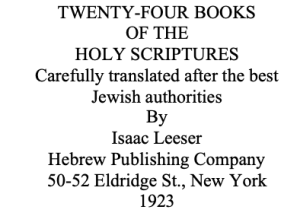
Since at the First Advent there was no New Testament, the twenty-four elders were emblematic of the whole Word of God . The prophetic utterances of the Bible concerning the Kingdom, particularly those of the Old Testament, which contains the bulk of prophetic testimony, will culminate and/or be fulfilled at the time the kingdoms of the world become those of Jehovah and His Anointed. It is then, when these prophecies are fulfilled, that the twenty four elders will bow down and give homage to their Author and Sponsor, the Lord God Almighty.