
A Psalm for Solomon
“Give the king thy judgments, O God, and thy righteousness unto the king’s son” (Psalms 72:1).
Psalm 72 is unique. Apparently it was one of the last psalms composed by David, near the end of his long reign of 40 years, for this Psalm expresses a prayer to God by David for the blessing of the new king Solomon, who was appointed by David in his declining days to be his heir and successor to the throne. The closing verse of this psalm says merely “The prayers of David the son of Jesse are ended” (verse 20).
Saul, David, and Solomon, each reigned for 40 years, and are widely seen by brethren as representing the Jewish, Gospel, and Messianic ages, respectively. In this progression Solomon represents the jurisdiction of Christ to be manifest during the Millennial age blessing of the world. With this thought in the backdrop of our minds, as we read the Psalm, many points seem to fit nicely. Here are some suggestions from a recent study by brethren in India.
THE KING’S SON: SOLOMON
Verse one is a request that Solomon, “the king’s son,” be imbued with godly judgment and righteousness in his administration — as Christ Jesus, and his administration of the Kingdom, will be. “He shall judge thy people with righteousness, and thy poor with judgment” — just as Jesus will do, raising the poor of earth to wonderful blessings.
Verses 3, 4 — the mountains perhaps represent the chief administration, Christ and the Church from above, and the “little hills” perhaps the Ancient Worthies, bringing peace and righteousness to the people, delivering the needy and breaking oppression.
Verse 5 — “They shall fear thee as long as the sun and moon endure, throughout all generations.” In Matthew 13:43 the sun represents the saints that shine forth in the Kingdom, the moon perhaps represents the reflecting light of the Ancient Worthies who will lead Israel, and all, in the Kingdom.
AS RAIN UPON THE MOWN GRASS
Verse 6 — “He shall come down like rain upon the mown grass, as showers that water the earth.” In Isaiah 40:7 and elsewhere “the people is grass.” Perhaps here the “mown” grass depicts mankind having passed through the time of trouble initiating the Kingdom, or perhaps “mown” indicates the grooming disciplines of the Kingdom. In either case, the refreshing showers of blessing will be gratefully received. “I will cause the shower to come down in his season; there shall be showers of blessing” (Ezekiel 34:26).
Verse 7 affirms that “in his days shall the righteous flourish” (as also in Psalms 92:12), and there will be “abundance of peace.” Indeed, 1 Kings 4:24 says of Solomon, “He had dominion over all the region … and he had peace on all sides round about him.” The end of verse seven says “so long as the moon endures,” perhaps meaning until the work of the Ancient Worthies is complete.
EXPANSIVE DOMINION
“He shall have dominion also from sea to sea, and from the river unto the ends of the earth” (verse 8). Zechariah 9:10 says the same thing, perhaps lifting the words from this text. Zechariah 14:8 also affirms that “living waters” from Jerusalem will go “half of them toward the former sea (the Mediterranean) and half of them toward the hinder sea (the Dead Sea), refreshing both the living formerly laboring under the curse, and the dead who will be raised again for blessing. This will continue throughout the Millennium, as Zechariah says, “in summer and in winter shall it be.”
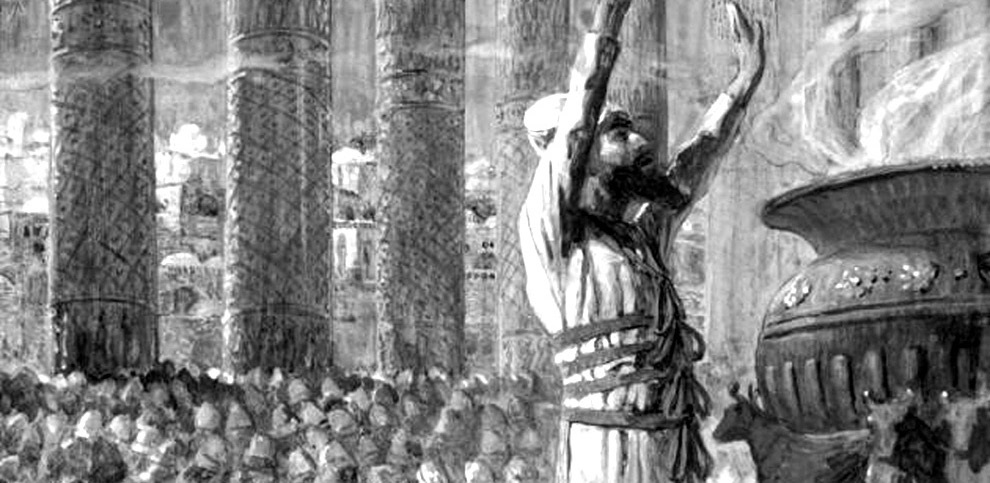
King Solomon, leading Israel in worship
Verse 9 — Those who have been in wilderness surroundings will appreciate the benefits of Jesus’ rule and “bow before him.” Even “his enemies” shall be subdued.
Verse 10 refers to presents for Solomon from “the Kings of Tarshish … the kings of Sheba and Seba.” The three kings here remind us of three gifts given Jesus at his birth, but here the donors are from even more widespread areas. These three names, Tarshish, Sheba, and Seba, are drawn respectively from Japheth, Shem, and Ham (Genesis 10:4-5, 28, 7), thus representing the entire world population in it scope. “Yea, all kings shall fall down before him: all nations shall serve him” (verse 11). Ultimately “every tongue” will “confess that Jesus Christ is Lord, to the glory of God the Father” (Philippians 2:11).
Verses 12, 13, 14, 15 — Jesus will deliver the needy, the poor, “and him that has no helper. He will redeem them from deceit and violence of every kind, and their lives will be “precious … in his sight.” They in turn will offer “prayer … for him continually … daily shall he be praised.”
Verse 16 — “upon the top of the mountains,” restored Israel (Isaiah 2:2, Micah 4:1), shall appear “an handful of corn in the earth,” perhaps representing the bread of life, the benefit of redemption in Christ, emanating from Israel. There will be an abundance of “fruit.” As Revelation 22:2 depicts it, 12 kinds of fruit, bearing monthly, for a thousand years. “And they of the city [the world of mankind] shall flourish like grass of the earth” — all mankind.
Verse 17 — “His name shall endure for ever: his name shall be continued as long as the sun: and men shall be blessed in him: all nations shall call him blessed. (18) Blessed be Jehovah God, the God of Israel, who only doeth wondrous things. (19) And blessed be his glorious name for ever: and let the whole earth be filled with his glory; Amen, and Amen.”
— Gleaned from a presentation by Br. Lawrence Pradeep