
The Resurrection Body of Jesus
It is the view of most in Christendom that the body with which Jesus was resurrected from the dead was some kind of glorified flesh. Though extremely popular, this view presents a number of scriptural questions. Very few Christians would deny that Jesus gave his life as a ransom, that is, because of the penalty of death pronounced upon Adam (and his progeny) for his sin, we required a ransomer to pay the penalty for us. The payment was the life of a perfect man. Since none of the human race qualified, help had to come from some other source. Here God’s love stepped in and offered his only begotten son as payment. So Jesus came to earth and became something he was not before, a human being. His death was accepted by justice (the hands of God) as payment for Adam’s sin. Adam and his race were thereby purchased by Jesus and he is now in a position to offer life to the world. Notice Jesus’ own expression of this in John 6:51:
“I am the living bread which came down from heaven: if any man eat of this bread, he shall live for ever: and the bread that I will give is my flesh, which I will give for the life of the world.” Jesus says he would “give” his flesh. If this is so, then the idea that Jesus would somehow get his flesh back again seems to invalidate the satisfaction of justice. The ransom is truly a transaction where one thing is exchanged for another. The first thing is given up permanently! We have the expression that someone would ‘give their right arm’ for one thing or another. If you really did give your right arm for something and got that something, would you expect to get your right arm back? No, of course not. The expression shows how much you value one thing or another, that you would be willing to pay a very high price for it. But it would be ludicrous to expect to get the price back after you have obtained the thing you are seeking. No less so with Jesus. His human flesh was given. Justice accepted. It cannot be regained without invalidating the satisfaction of justice.How, then, could he be raised from the dead? He would be raised, not as a fleshly human being, but rather as a spirit. Peter says this in 1 Peter 3:18:
“For Christ also hath once suffered for sins, the just for the unjust, that he might bring us to God, being put to death in the flesh, but quickened by the Spirit.”
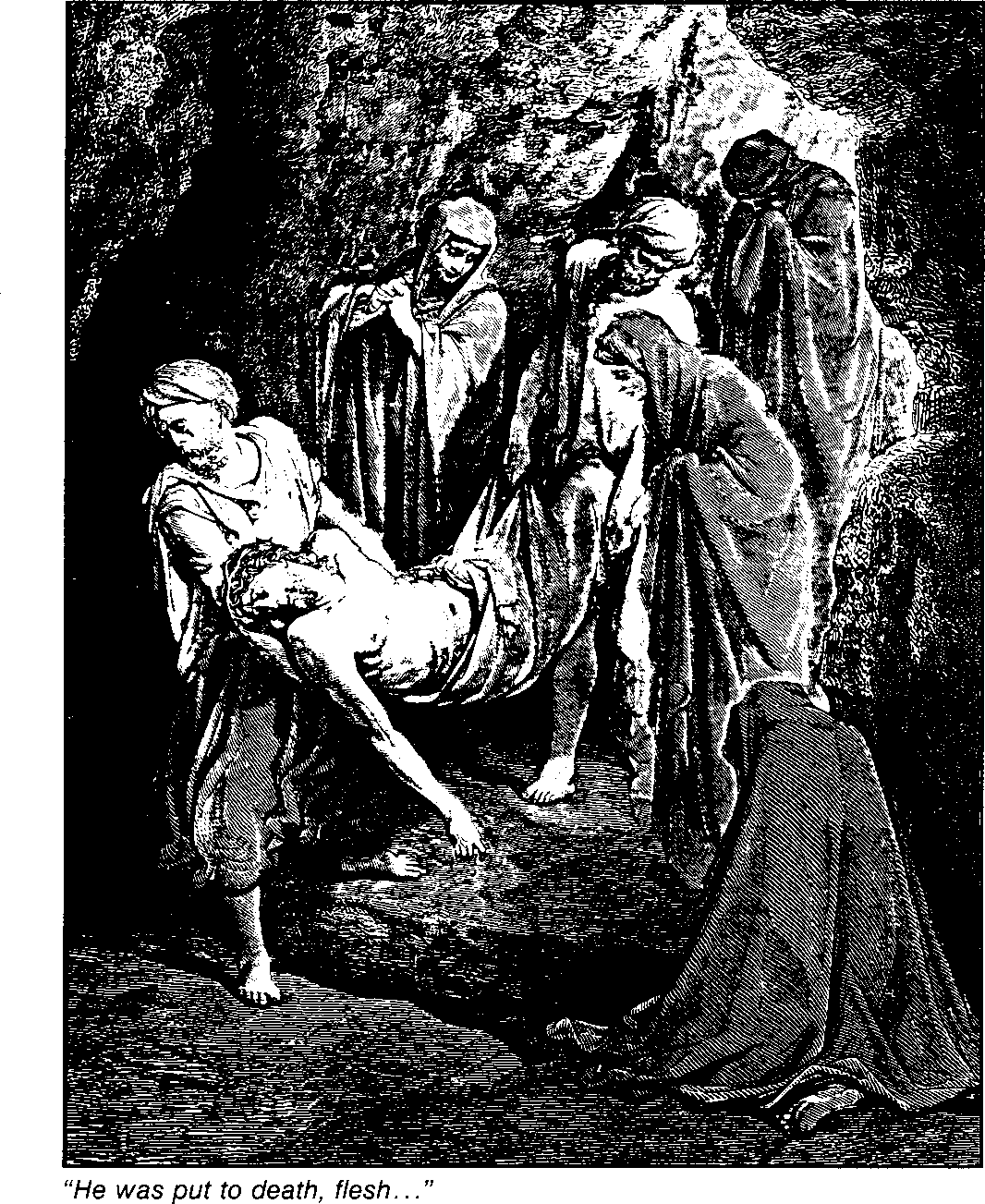
It should be noted in this text that the Greek says “put to death flesh, raised spirit.” The parallel here is clear: What he was when he rose from the grave was not what he was when he went down to the grave. He is now a mighty spirit, just like his heavenly Father! The heavenly Father is not flesh! The Apostle John very distinctly says:”… the true worshippers shall worship the Father in spirit and in truth: for the Father seeketh such to worship him. God is a Spirit: and they that worship him must worship him in spirit and in truth.”
It is inconceivable that God could be any kind of fleshly being. Flesh is incompatible with spirit. It cannot understand spirit life, it cannot see spirit life. The Apostle Paul wanted to make sure that the early Christians understood this. He wrote in I Cor. 15:50: “Now this I say, brethren, that flesh and blood cannot inherit the kingdom of God; neither doth corruption inherit incorruption ”
So Jesus was not raised flesh and blood, but rather he was raised a divine spirit in the “express image of God” (Heb. 1:3), “Who being the brightness of his glory, and the express image of his person.”
“IT IS I MYSELF”
However, an objection to this view is raised with respect to Jesus’ words in Luke 24:39, where Jesus, after his resurrection, said to the disciples:
“Behold my hands and my feet, that it is I myself: handle me, and see; for a spirit hath not flesh and bones, as ye see me have.”
The objection contends that Jesus very clearly showed to his disciples his post-resurrection body, stating “it is I myself “Furthermore, Jesus states that they are not seeing a spirit but a true manifestation of himself. How do we harmonize this with the concept of a spiritual and invisible resurrection?
The first question we may ask is did these eyewitnesses of Jesus’ resurrection believe that what they were seeing was an illustration of what was promised to them? We don’t think so. One of the eyewitnesses in that room was the Apostle John. But John states the he had not yet seen what it is to live on the resurrected plane of the divine nature! In 1 John 3:2 he testified that he had not yet seen what it is to be a spirit:
“Beloved, now are we the sons of God, and it doth not yet appear what we shall be; but we know that, when he shall appear, we shall be like him; for we shall see him as he is.”
John had not yet, when he wrote that, seen Jesus as he actually was. But he had the hope that he would, because he knew the promise that what Jesus had received in his resurrection, the divine nature, would be what his faithful followers would also receive. Then, as a spirit creature, not as a creature of flesh and blood, John would behold Jesus as he actually was. The Apostle Paul also taught the same thing. Of Jesus in his present spiritual condition we read in 1 Timothy 6:16: “Who only hath immortality, dwelling in the light which no man can approach unto; whom no man hath seen, nor can see: …”1
Notice in this verse once again that man, who is flesh and blood, cannot approach this condition and cannot even see it! If the body that was seen of the Apostles and others was in fact the spirit body of Jesus, this text could not be true. But the body that Jesus’ followers saw following his resurrection was not what Jesus really was. It was a body that Jesus materialized to communicate with his disciples and assure them that he had been resurrected. Since they could not see his real spirit self, he had to use what they could perceive.
After Jesus was resurrected, he appeared on multiple occasions to various ones to let them be certain of his raising. Some of these appearings were in forms not recognizable by his disciples. That is to say, he did not appear in a body that looked like he had before he died. This is an important concept. Spirit creatures have the ability to materialize human bodies. These bodies are used only to communicate, except in the case of the wicked angels before the Flood. (Genesis 6:2, Jude 6) There are numerous examples where angels did this very thing in the capacity of messengers from God. Jesus’ post-resurrection appearances seem to be the same thing.
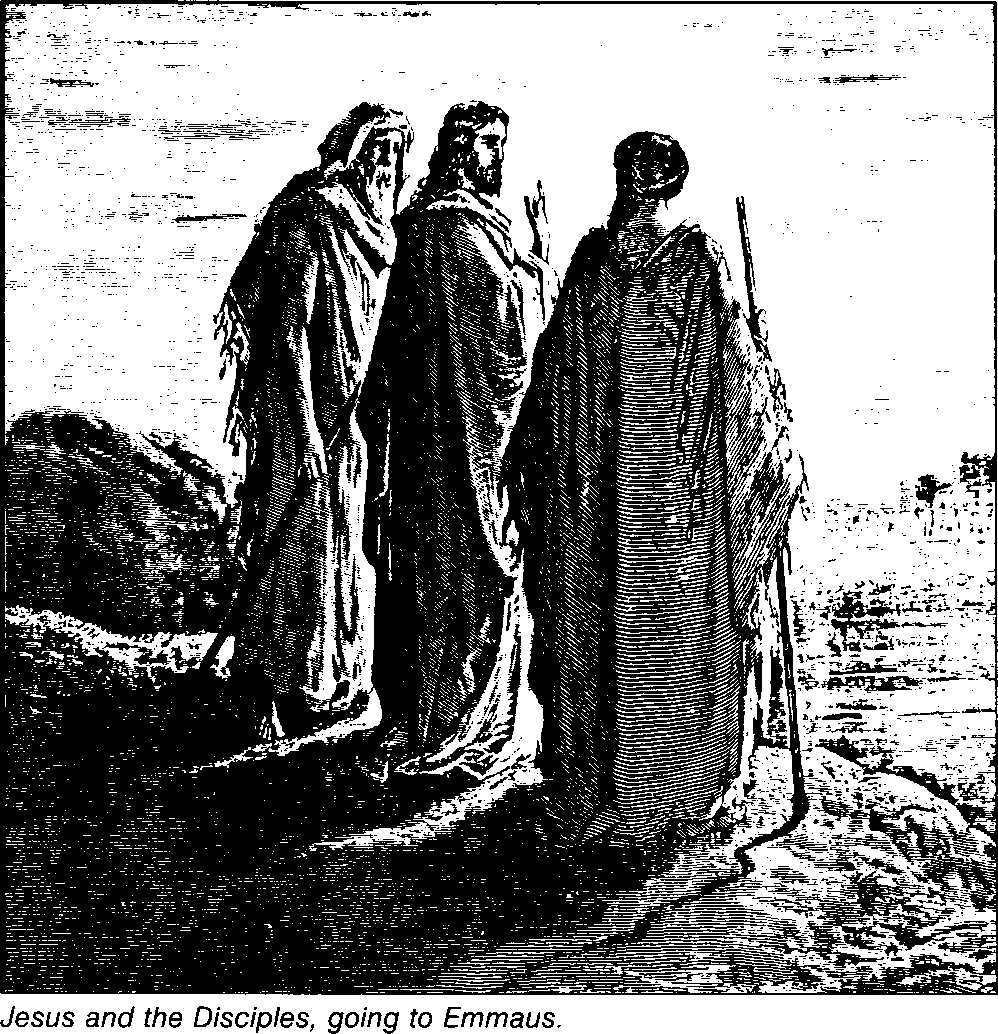
The first example of this is the wonderful experience had by two of the disciples recorded in Luke 24:13-33 on the road to Emmaus. These walked and talked with Jesus but did not recognize him. We are told “their eyes were holden that they should not know him” What does this mean? The Gospel of Mark tells us in Mark 16:12 that “… he appeared in another form unto two of them. ” Being able to appear in another form is within the capacity of a spirit creature. Clearly the “form” Jesus appeared in was not his fleshly body that he gave for the world, but a convenience form he used to communicate and encourage.
Spirits are not restricted by physical obstructions as are we humans. They have supernatural power like the single angel who killed186,000 Assyrians camped outside of Jerusalem during Hezekiah’s reign in one night. These creatures can come and go as they please, like the disembodied hand which suddenly appeared and wrote words of judgment on the wall of King Belshazzar’s palace, only to disappear just as abruptly. It is this ability by which we understand the sudden appearance of Jesus to his disciples in a closed room as recorded in Luke 24:36. The fact that the body Jesus used had the same wounds as those inflicted upon him as a dying human, is pointed out as proof that the flesh itself was raised. However, we observe that no such wounds were noticed by his disciples when he appeared in other forms. Returning to our text in Luke 24:39, we note that Jesus himself points out that what they were seeing was not spirit. His words again in Luke 24:39:
“Behold my hands and my feet, that it is I myself: handle me, and see; for a spirit hath not flesh and bones, as ye see me have.”
 Jesus’ own testimony lends further support to our concept of separation of spirit and fleshly natures. A spirit cannot be handled the way Jesus’ body was at this appearance.
A point is sometimes made with respect to Jesus’ words here that he was “flesh and bone” as opposed to “flesh and blood.” Is there anything significant here? We believe that there is. The expression “flesh and blood” conveys to us the idea of living flesh. The fact that Jesus left out the word “blood” and substituted the word “bone” may reinforce the idea of a spiritual resurrection. In the Old Testament, blood is associated with life. In Genesis 9:4 we read:
“But flesh with the life thereof, which is the blood thereof, shall ye not eat.”
This identification of life with the blood helps us to understand the concept of sacrifice unto death, which is central to the theme of Christianity during the Gospel Age. All of those who will follow Jesus must render a sacrifice unto death even as their Master did. Their “blood” must be poured out as was their Lord’s. So when Jesus omitted the word “blood” in the expression “flesh and bone”‘ he was teaching two things. First, the fact that his sacrifice was complete, his blood had been poured out unto death. Secondly, the body that he materialized was not living in the sense that the disciples were living. Blood is not indicated. It was animated, rather than alive, and controlled by the real spirit being unseen and unseeable to them, Jesus the Divine. This conclusion is in harmony with all of the other testimony we have already considered.
AN ILLUSTRATION FROM THE TABERNACLE
There is a beautiful type of this resurrection truth which appears in Numbers chapter 4, where the coverings of the tabernacle furniture are described. The Levites and Priests are given specific instructions for moving each item within the tabernacle and courtyard. Only the copper Laver is moved to the next camp without having some kind of covering.
The coverings of the Ark of the Covenant appear to be special in illustrating the resurrection hopes of Jesus and his church. The description of the coverings is found in Numbers 4:5, 6, which read:
“And when the camp setteth forward, Aaron shall come, and his sons, and they shall take down the covering veil, and cover the ark of testimony with it: And shall put thereon the covering of badgerS’2 skins, and shall spread over it a cloth wholly of blue, and shall put in the staves thereof.”
This elaborate covering ritual was intended by the Father to teach us lessons. So what is the lesson?
Sealskin covering is not a particularly attractive covering, being black and unsightly. As such it well represents the view the unchristian world has of sacrificial Christians. They see only the flesh. They perceive nothing beautiful about our commitment to the Father and our labors in His service.
The veil between the Holy and the Most Holy represents the demarcation between spirit begettal (in the flesh) and spirit birth, in other words, the death of the flesh.
Finally, the color blue represents faithfulness. So a cloth of blue would betoken the faithfulness of those so clothed. The Ark of the Covenant was unique in being the only item which had an outer covering of blue. All of the other pieces(with the exception of the Laver) had sealskin as their outer covering. This difference is significant.
The Most Holy compartment of the tabernacle represented the condition of glorification. The Holy represented the condition of spirit begettal while still in the flesh. The veil between the Holy and the Most Holy represented the demarcation between flesh and spirit. The articles within each of these areas corresponded to the conditions represented by the areas. So the Ark of the Covenant represents the church born on the divine plane partaking of the divine nature.
1There is some question about whether this verse is speaking about Jehovah or his son Jesus. While we have no contention with those who prefer to see the Father here, we incline to believe that it is Jesus about whom Paul is referring. One compelling reason is that in the previous verse this one “dwelling in the light” is also described as “the King of kings, and Lord of Lords,” an expression which Revelation 17:14 clearly ascribes to Jesus.
2The word “badgers”‘ is mistranslated in the KJV. The correct translation should be “sealskin.”
So the question is, what kind of resurrection body will the church have in the divine glory? The fact that the Ark had an exterior covering of blue instead of sealskin teaches that mankind in the Kingdom will perceive the faith of the church. But since the sealskin is not visible, it means the world will not see the flesh of the church! So will the flesh be glorified and brought to heaven as often taught? No! Look again at the type. The sealskin does not touch the Ark! It remains separated from the golden Ark by the veil of demarcation. The flesh does not go beyond the veil! This is another beautiful confirmation of the truth seen elsewhere, that Jesus and his church die as fleshly creatures, and are raised as divine spirits.
– David Stein