
Joshua, Jericho, and the Gospel Age
It was 1575 BC when Joshua led more than a million Israelites out of the wilderness to an encampment point a mile or so outside the high walls of Jericho. Archaeologists say those walls were approximately 20 feet high on three sides; a steep natural cliff dropping off toward the Jordan River protected its eastern side. This was the twentieth city to be constructed there. Each previous city had been destroyed, only to be followed by the building of a new one on the ruins. People built cities where there was water and this place had a perennial spring of water. The ruins of so many previous cities beneath it raised the Jericho of Joshua’s day to about 50 feet above the surrounding plain.
Several thousand people lived in Jericho and it had abundant supplies of both food and water. If a foreign invader took the usual approach and tried to starve the city’s inhabitants, he would have a very long siege indeed. Even though the city gates were tightly barred, no one felt safe. These “foreigners” were different. They had a God who dried up the Jordan when they wanted to cross! How could anyone defend themselves against such a God as this?
The details of this battle are in Joshua chapter 6. Following the instruction of an angel who told him what to do, Joshua arranged to have the army, the priests carrying the ark, and the people march once around the city. This would be a distance of about a mile and they would, of course, stay well away from the range of the defenders’ weapons. The priests sounded trumpets, the march took place, but no one said a word. Only the trumpets “spoke.”
The second day was like the first. Likewise the third through the sixth days. The priests blew the trumpets, the people marched, but no one said a word. Early at the dawn of the seventh day, everyone arose. The seventh-day trumpet sounded, then sounded again and again as they marched around the city seven times. At the end of the seventh and last circuit, the trumpets sounded long and the people shouted with one voice. They probably shouted something like, “The kingdom of Jericho has become our Lord’s!”
At that moment, possibly as a result of a great earthquake, the city’s main defensive wall swayed and fell down, taking with it some of the city’s most valiant defenders.
The wall fell outward, filling a nine-foot deep trench and so provided easy access into the city. In later battles Israel was permitted to take a spoil, but this battle was different. Only the metals and iron were to be taken and they were to go into the Lord’s treasury. Everyone who lived in the city was killed except Rahab and her family who lived on the northwest wall that did not collapse. The houses with their contents were completely destroyed by fire, one of the few times Joshua burned a city.
Jericho’s final indignity occurred when Joshua pronounced a curse upon anyone who would rebuild it. Six or seven centuries later, in the days of Ahab, this curse was fulfilled on Hiel from Bethel, whose firstborn died when the foundation was laid and whose lastborn died when the gates were finished. – 1 Kings 16:34

THE GOSPEL AGE
This first battle under the leadership of Joshua pictures the Gospel Age. The Greek form of the name Joshua is Jesus, and means “Jehovah is salvation.” On the first day of march we read that “Joshua rose early in the morning and the priests took up the ark of Jehovah ‘ “ Jesus’ resurrection “early in the morning” began the Gospel Age for the church. Shortly thereafter at Pentecost the spirit came upon the church and they “shouldered the cause of the Lord .”
“Ye shall not shout, nor let your voice be heard, neither shall any word proceed out of your mouth, until the day I bid you shout:’ said Joshua. This tells us that the church is not to promote her own ideas. We are to let the trumpets of God do all the talking.
The seven priests blew seven trumpets on seven days (representing the entire Gospel Age period). This has the same meaning and covers the same period as the seven angels who blow seven trumpets (Rev. 8:6 through 11:19) and the seven angels of the seven churches (Rev. 2:1 through 3:22). On the last day, when seven priests circled Jericho seven times, we have a picture of the end phase of the Gospel Age where seven angels pour out the seven last plagues (Rev. 16:1-21).
Jericho typifies the kingdom of this world and particularly its capital. During the Gospel Age literal Rome fulfils this role. Each day the army of the Lord circled Jericho. They did this for six days, picturing six periods of church history where apparently little happened to threaten that great city. But everything changed during the seventh period, the period of our Lord’s second presence. The activities of the seventh day of the Jericho siege picture activities at the end of the Gospel Age. We read, “They rose early at the dawning of the day” (Joshua 6:15). The resurrection of the sleeping saints began the harvest of the Gospel Age on earth and the dawning of the Messianic Age in heaven. “The dead in Christ shall rise first.”- 1 Thess. 4:16 It is instructive to compare the events during the final siege of Jericho in Joshua 6:15-20 with the events of 1 Thess. 4:16:
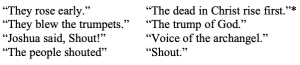 At the end of the seventh and last circuit around Jericho, there was a long blast from the trumpets. Joshua told the people to shout and the main defensive wall fell to the ground. And so at the end of this Gospel Age, at the right moment, the defenses of the kingdom of this world will collapse. We can see how easy it would be for God. Thermonuclear, economic, or religious war could so easily frighten all earth’s people to the point of revolution (a symbolic “earthquake”). “Babylon the great was remembered in the sight of God, to give unto her the cup of the wine of the fierceness of his wrath.” Revelation 16:19
Although all of Jericho was destroyed, Rahab and her family were saved because she had shown kindness to the Israelite spies. So today there are those who are sympathetic to the Lord in antitypical Jericho and we should be compassionate to them.
AFTER THE FALL
There is little in the Jericho picture describing the events of the thousand year kingdom of Christ that follows the destruction of the kingdom of this world. The salvaging of the gold, silver, copper, and iron suggest the return of earth’s peoples (of varying nobility) to the Lord. The ancient worthies are resurrected to positions of prominence, particularly Abraham because he died before receiving the land God promised to give him (see Acts 7:2-5; Luke 20:37-40). Even Sodom, Tyre, and Sidon, which would have repented had they seen the works of Christ, will return to their former estate in the resurrection. (Matt. 11:21-24; Ezek. 16:55)
The curse placed upon any rebuilder of the city suggests the loosing of Satan at the end of the thousand years, followed by a little season of rebellion. In effect this is a final examination for the reformed families of the earth, and the ultimate destruction of the rebels for all eternity. (Rev.
20:3,7-10,14,15)
– James B. Parkinson
*The order in Thessalonians is reversed compared to the Jericho siege because Paul’s main topic is the resurrection of the sleeping saints.