
Zechariah’s Horses
“I saw by night, and behold a man riding upon a red horse, and he stood among the myrtle trees that were in the bottom; and behind him were there red horses, speckled, and white. Then said I, 0 my lord, what are these? And the angel that talked with me said unto me, I will show thee what these be. And the man that stood among the myrtle trees answered and said, These are they whom the LORD hath sent to walk to and fro through the earth. And they answered the angel of the LORD that stood among the myrtle trees, and said, We have walked to and fro through the earth, and, behold, all the earth sitteth still, and is at rest. Then the angel of the LORD answered and said, 0 LORD of hosts, how long wilt thou not have mercy on Jerusalem and on the cities of Judah, against which thou hast had indignation these threescore and ten years? And the LORD answered the angel that talked with me with good words and comfortable words.” (Zechariah 1:8-13)
A disquieting vision of a fertile brush land in which a mounted cavalry is on night patrol opens Zechariah’s prophecy (1:8-11). While it is not unusual to find a prophet stunned by the power of prophetic image (Isaiah 6:5; Eze 3:15; Da 7:15; Re 22:8) it is unprecedented to find one of the Lord’s angels needing comfort after participating in a prophetic vision: ‘And the LORD answered the angel that talked with me with good words and comfortable words’. (Zechariah 1:13)
Here we gain insight into the emotional commitment of the holy angels as they observe the ‘theater’ of our fallen state. (1 Corinthians 4:9) Yet, the questions arises, ‘Why was the angel so disturbed by this vision?’ The first characteristic drawn to our attention is that this cavalry rides horses of various colors. There are direct links to Chapter Six of Zechariah where we meet a related but distinctly different set of colored horses harnessed to chariots. What are these horses, their colors, their different uses, and the relation of Chapters One and Six?
MANKIND’S INNER MOTIVATING ENERGY
When the subject of horses was treated in the broadest sense, an earlier article suggested ‘Horses seem to be an image for mankind’s inner motivating energy’ (‘Horses Ready for Battle,’ Beauties of the Truth, August 1997). Hence, this horsepower is a psychological energy. It is that special portion of the general physical energy that mankind draws on for motivation. Such horsepower can be directed for good or for harm, as doctrine true or false can be directed for good or harm. For harm, this horsepower can motivate us to literally pick fights, or aggressively and blindly pursue false religion, ill-gotten wealth, licentiousness, sinful pleasure, or ‘unbridled’ power. Indeed, the survival of this metaphor ‘unbridled power’ in English suggests the general sense of the interpretation of horses as a metaphor for our inner motivating energy.
This motivating energy may be religious doctrine, and it may be broader than doctrine. Clearly, horses cannot always picture doctrine. In Isaiah 30 we find that the Lord asks us to visualize a herd of horses desperately swimming through floods of waters with their bridles of error barely holding their jaws above these floods. Here we learn this serves as a direct image of the Assyrians and other nations against whom the Lord of Hosts has indignation. ‘Behold, the name of the LORD cometh from far, burning with his anger, and the burden thereof is heavy: his lips are full of indignation, and his tongue as a devouring fire: And his breath, as an overflowing stream, shall reach to the midst of the neck, to sift the nations with the sieve of vanity: and there shall be a bridle in the jaws of the people, causing them to err’. (Isaiah 30:27-28)
On the other hand, exercised positively, ‘horsepower’ opens our hearts to the good things of the Lord. ‘Horsepower’ revitalizes us to go to an evening ecclesia meeting even after a day where we have missed deadlines, listened through the petty arguments of our co-workers, interceded for our children at school, had our hands full as our toddler’s fever kept us up through the night. For the Christian, horses are the driving power of our consecrated living. They picture the Holy Spirit in action.
ZECHARIAH ONE
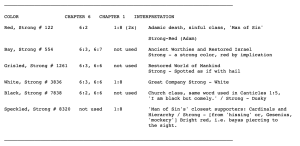
The table included in this study presents the general outline for the suggested interpretations of these horses, offering some guidance for interpretation of the horses’ colors in Zechariah 1:8-17 that reconciles these colors with Zechariah 6:1-8. Several aspects of the first chapter suggest that this scene in Zechariah Chapter One focuses on the sad period of papal domination that arrested progress in Europe. During these ‘Dark Ages,’ the seeds of reformation germinated unseen below the soil of culture.
First, let us consider an alternate interpretation of the vision in Chapter One. One line of interpretation holds that this chapter deals with the promised blessings of the kingdom. From this perspective:
- The leader of this cavalry band, a rider on a red or Adam-colored horse, announces that this cavalry was sent to do the Lord’s bidding; these are they whom the LORD hath sent to walk to and fro through the earth. He reports that the whole earth is at rest. (Zechariah 1:11) If these words of the rider are truthful, kingdom blessings are surely intended. However, both the ‘eyes of the LORD’ (Zechariah 4:10) and Satan (Job 1:7) pass ‘to and fro’ through the earth. The act of patrolling the earth provides no clue as to the true character or mission of the red cavalry rider. However, this claim of operating at the Lord’s command seems to close any further argument as to authority.
- Seemingly this setting in the kingdom gains strength from the linkage of ‘red’ to the ancient worthies, Abraham, Isaac, Jacob, Moses, Daniel and other heroes of faith. These are foreshadowed in the tabernacle under the image of a ‘red’ or ‘Adam-colored’ heifer picturing sin. (Numbers 19:2)
- Myrtle trees suggest kingdom blessings. (Isaiah 41:19,55:13)
Let us note that when the angel invites the prophet to see what will transpire, (Zechariah 1:9) we need to be cautious about believing everything we hear. However appealing this interpretation is, it creates a number of difficulties:
- This is a vision of the night; (Zechariah 1:8) the kingdom is a period of light.
- The angel now needs comfort. Something in this picture clearly upsets the angel. Why is this so if this truly is a picture of kingdom blessings under the stewardship of the ancient worthies? Is it possible that the angel was startled to hear the boast from the rider on the red horse? Rather, the words of the rider, ‘behold all the earth sitteth still and is at rest’ (Zechariah 1:11) need to be weighed carefully as to their truth or falsehood. They may be a false boast similar to that found in Revelation 12:10-11. Indeed, they may be false boasts produced by the same propaganda machine of the medieval papacy we meet in Revelation 12.
- To these concerns is added the weight of the Lord’s pronouncement that, ‘I am very sore displeased with the heathen that are at ease: for I was but a little displeased, and they helped forward the affliction’. (Zechariah 1:15) The Lord promises a rebuilding. (Zechariah 1:16-17)
- Myrtle, as contrasted with the brier, is a picture of blessing. (Isaiah 55:13) But myrtle suggests blessings in unimproved soils or abandoned soils as in a devastated city. On unimproved soils it is preferable that the soil be held in place by the myrtle, whose sap perfumes the very axe that cuts it, rather than the thorny brier.
- Direct reference is made to the 70 years of desolation. (Zechariah 1:12) Why is this, if Chapter One pictures the kingdom? If, on the other hand, this really is a vision of the 70 years of desolation, we can see the reason that the vision of the four carpenters is next presented. (Zechariah 1:18-21) This is the Lord’s promise of rebuilding.
If this vision presents the boasts of the papacy during the middle ages, the following becomes reasonable:
- The night (Zechariah 1:8) directly links to the 70 years of desolation (Zechariah 1:12) when the church was in captivity in mystic Babylon.
- The man on the red horse is the ‘Man of Sin.’ He is supported by a long descent of papal pronouncements – the other red horses.
- The ‘speckled’ horses are the ‘Man of Sin’s’ closest supporters, particularly the Cardinals and hierarchy. Of special interest, this word ‘speckled’ is defined by Strong’s as being from ‘hissing,’ to which Gesenius adds ‘mockery.’ The translators suggest bright red, i.e., bay, as piercing to the sight. Literally this suggests the piercing red garments of the cardinals in the hierarchy. What this bright red mocks is the drab subdued color of true blood red.
- White horses picture the Great Company. This class falls to stay separate from Babylon. We note in Chapter Six that they nevertheless maintain faith in Jesus and receive the reward of a place in the North Country – the heavenly phase of the kingdom. However, if Chapter One presents a kingdom picture, how do the white horses get from the heavenly realm, to a patrol in the earthly realm?
- Black horses, clearly the favored horses of Chapter Six, are nowhere to be found in this vision – they have maintained themselves separate from Babylon. In all likelihood, they are the ‘troublemakers’ the night patrol is guarding against.
- Now the myrtle becomes significant, this patrol is watching the promising ground that is producing myrtles. Their intent: to maintain the ‘status quo’ and suppress the promise of nascent reform suggested by the myrtle.
- Hence, we should view Zechariah One as taking place during the ‘bottom’ (Zechariah 1:8) of the church’s 70 year captivity (Zechariah 1:12) when the heathen, led by the ‘red’ man of sin, are at ease. (Zechariah 1:15)
ZECHARIAH SIX
The interpretation of Chapter Six will strengthen this interpretation of the horses.
‘(1) And I turned, and lifted up mine eyes, and looked, and, behold, there came four chariots out from between two mountains; and the mountains were mountains of brass. (2) In the first chariot were red horses; and in the second chariot black horses; (3) And in the third chariot white horses; and in the fourth chariot grisled and bay horses. (4) Then I answered and said unto the angel that talked with me, What are these, my lord? (5) And the angel answered and said unto me, These are the four spirits of the heavens, which go forth from standing before the Lord of all the earth. (6) The black horses which are therein go forth into the north country; and the white go forth after them; and the grisled go forth toward the south country. (7) And the bay went forth, and sought to go that they might walk to and fro through the earth: and he said, Get you hence, walk to and fro through the earth. So they walked to and fro through the earth. (8) Then cried he upon me, and spake unto me, saying, Behold, these that go toward the north country have quieted my spirit in the north country’. (Zechariah 6:1-8)
- Let us consider how the chariots of Zechariah 6 match one for one with the planes on the Chart of the Ages during the Messianic Age as presented in the ‘Divine Plan of the Ages.’ The two mountains of brass suggest the two kingdoms of perfect humanity, the first, the paradise lost by Adam, the second, the paradise restored through Christ.
- In the valley (of sin) between these kingdoms the red or ‘Adam-colored’ horses drawing a chariot appear prominently as in Chapter One. They are described as the ‘first chariot.’ They have an unusual distinction. Let us presume the chariots are traveling from east to west as do both the High Priest entering the tabernacle and the (apparent) path of the sun. Every other chariot passing through the valley goes to a destination either north (turning right) or South (turning left). However this chariot has no destination. How well this pictures that once these chariots pass through the valley of sin, there is no destination for the ‘Adamcolored’ horses. Neither Adamic sin nor the ‘sin unto death’ – the ‘second death’ – have a home beyond this valley. They simply go into oblivion.
- Black horses are clearly the favored horses of Chapter Six. We should give pause and consider that they ‘quiet’ the spirit of the Lord himself. (Zechariah 6:8) They constitute the ‘second chariot.’ Black is the same word used in Canticles 1:5 for ‘I am black but comely.’ Canticles also likens the beloved woman to the horses of Pharaoh’s chariots, picturing the church class (Canticles 1:9). Linking these two verses together, we might expect a team of black horses harnessed to this chariot. Their destination is the north country or spiritual realms.
- The ‘third chariot’ is harnessed to white horses. This suggests the overcoming righteousness of the Great Company, a class clothed in white. (Revelation 7:9) They are shown as victors and appropriately they follow their black companions to the same destination in the spiritual realms. (Psalms 45:14)
- For the fourth chariot, the correspondence with the Chart of the Ages holds right down to the detail of two horses – Israel ‘grisled’ and the world ‘bay’ harnessed together in their journey to the ‘south’ country, or the ‘restored world of mankind.’ Neither of these colors appears in Chapter One. Both these colors are appropriate only to classes that have undergone restitution experiences.
FINAL THOUGHTS – PROPHETIC IMAGES, CODE OR AUTHORITY?
Here I would like to suggest a broad approach to prophetic image. Although ‘suggested interpretations’ are offered, I strongly believe the final authority for understanding prophetic image should return our vision to the image. When interpreting prophetic image sometimes we approach the Lord’s word as if it is a secret code to be broken. That is, if we, through the Holy Spirit, can discern the one word that should be substituted for the image, all is well. Horns for power, and mountains for kingdoms are two images that fit this approach well enough. Our Lord’s interpretation of parables, such as those found in Matthew 13, seemingly adds all the authority needed for this code-breaking approach.
However, the code-breaking approach runs into complications if we seek the single word for the image of horses. One such complication occurs when comparing horse in Isaiah 30:27-28 where it means erring people and horse six verses later Isaiah 31:1 where the sense of doctrines fits well enough. Rather than simply resigning to the conclusion that horse is being used in two different ways in these texts, I suggest reflecting on the image, walking around it, and trying to see it in three dimensions. When the image is studied topically, consider all the additional lessons the image suggests. Consider the dynamics of the image. Is the horse carrying a rider, hitched to a chariot, or swimming in a flooding stream? Each of these suggests a distinctly different aspect of the horse image. For ‘horse,’ the broad sense of motivation emerges from such an approach. But this should only serve as our earliest working definition. There are riches yet to be mined from this image as we return to it. Our Lord Jesus in interpreting his own parables has served as the guide for this essay. The interpretations offered are a point of entry into the parable, not an ending point.
Rather than breaking the code and reading the text with the one word we find, or developing a well-meant ‘interpretive translation,’ let us take a different approach. In this equally prayerful approach, we should reflect on the meanings that constellate around prophetic images such as ‘horse,’ ‘horn,’ or ‘mountain.’ In the end, let us resolve to soberly and cautiously return to the image with ever more depthful eyes of understanding to see if additional insights emerge with time. These images should point to universal truths. The image, and not our interpretation, should always retain the final authority. Search we may for many years, still some new rich gem appears.
– Richard Doctor