
Love Your Enemies
Probably no admonition of Jesus has been more difficult to follow than the command to “love your enemies” (Matthew 5:44). Some men have sincerely felt that its actual practice is not possible. “It is easy,” they say, “to love those who love you, but how can one love those who openly and insidiously seek to defeat you?” Others contend that Jesus’ exhortation to love one’s enemies is testimony to the fact that the Christian ethic is designed for the weak and cowardly and not for the strong and courageous. “Jesus,” they say, “was an impractical idealist.” In spite of these insistent questions and persistent objections, this command of Jesus challenges us with new urgency. Upheaval after upheaval has reminded us that modem man is traveling along a road called hate, in a journey that will bring this present order to destruction and judgment. Far from being the pious injunction of a utopian dreamer, this command to love one’s enemy is an absolute necessity for the survival of the meek in the day of the Lord’s vengeance (Zephaniah 2:3).
Jesus is not an impractical idealist; he is the practical realist. We can be certain that Jesus understood the difficulty inherent in the act of loving one’s enemy. He realized that every genuine expression of love grows out of a consistent and total surrender to God. So when Jesus said “Love your enemy,” he was not unmindful of its stringent qualities. Yet he meant every word of it. Our responsibility as Christians is to seek passionately to live it out in our daily lives and to preach it in a world that needs to learn of God’s gracious love.
FORGIVENESS AND RELATIONSHIPS
Let us be practical and ask the question, “How do we love our enemies?” First, we must develop and maintain the capacity to forgive. He who is devoid of the power to forgive is devoid of the power to love. It is impossible even to begin the act of loving one’s enemies without the prior acceptance of the necessity, over and over again, of forgiving those who inflict evil and injury upon us. It is also necessary to realize that the forgiving act must always be initiated by the person who has been wronged, the victim of some great hurt, the recipient of some tortuous injustice, the absorber of some terrible act of oppression.
The wrongdoer may request forgiveness. He may come to himself and, like the prodigal son, move up some dusty road, his heart palpitating with the desire for forgiveness. But only the injured neighbor, the loving father back home, can really pour out the warm waters of forgiveness. Forgiveness does not mean ignoring what has been done or putting a false label on an evil act. It means, rather, that the evil act no longer remains as a barrier to the relationship. Forgiveness is a catalyst creating the atmosphere necessary for a fresh start and a new beginning. It is the lifting of a burden or the canceling of a debt. The words “I will for give you, but I’ll never forget what you’ve done,” never explain the real nature of forgiveness. Certainly one can never forget, if that means erasing it totally from his mind, but we understand the mind of God when the Psalmist sings, “as far as the east is from the west, so far hath he removed our transgressions from us” (Psalm 103:12).
But when we forgive, we forget in the sense that the evil deed is no longer a mental block impeding a new relation ship. Likewise, we can never say “I will forgive you, but I won’t have anything further to do with you.” Forgiveness means reconciliation, a coming together again. Without this, no man can love his enemies. The degree to which we are able to forgive determines the degree to which we are able to love our enemies.
SEEING THE GOOD
Second, we must recognize that the evil deed of the enemy-neighbor, the thing that hurts, never quite expresses all that he is. An element of goodness may be found even in our worst enemy. A persistent civil war rages within all of our lives. Something within us causes us to lament with the Apostle Paul, “The good that I would I do not: but the evil which I would not, that I do” (Romans 7:19). This simply means that there is some good in the worst of us and some evil in the best of us. When we discover this, we are less prone to hate our enemies. When we look beneath the surface, beneath the impulsive evil deed, we see within our enemy-neighbor a measure of goodness and know that the viciousness of his acts is not quite representative of all that he is. We see him in a new light. We recognize that his hate grows out of fear, pride, ignorance, prejudice, or misunderstanding, but in spite of this, we know God’s image is ineffably etched in his being – this image is not beyond the gracious provisions of God for mankind in the kingdom. In a practical way, we love our enemies by realizing that they are not totally bad and that they are not beyond the reach of God’s redemptive love.
BUILDING UNDERSTANDING
We must not seek to defeat or humiliate the enemy but to win his friendship and understanding. At times we may be tempted to humiliate our worst enemy. Inevitably, his weak moments come and we are able to take advantage of this. But this we must not do. Every word and deed must contribute to building understanding with the enemy and to release those vast reservoirs of goodwill which have been blocked by impenetrable walls of hate.
The meaning of love is not to be confused with some sentimental outpouring. Love is something much deeper than emotion. Perhaps the Greek language can clear our confusion at this point. In Greek there are three words for love. The word eras is a sort of aesthetic or romantic love; it is used for physical love. In the Platonic dialogues eras is a yearning of the soul for the realm of the divine. The word eras is not used in the New Testament. The second word is philia, a reciprocal love and the intimate affection and friend ship between friends. This word is used in the New Testa ment. We love those whom we like and we love because we are loved. The third word, also used in the New Testament, is agape, understanding and creative, redemptive goodwill for all men. This is an overflowing love which seeks nothing in return. Agape is the love of God operating in the human heart.
At this level we love men not because their ways appeal to us, nor even because they possess some type of divine spark; we love every man because God loves him. At this level we love the person who does an evil deed although we hate the deed that he does. Now we can see what Jesus meant when he said “Love your enemies.” When Jesus bids us to love our enemies, he is speaking neither of eras nor Philia; he is speaking of agape, understanding and creative, redemptive goodwill for all men. Only by following this way and responding with this type of love are we able to be children of our Father who is in heaven.
FROM DARKNESS TO LIGHT
Let us move now from the practical how to the theoretical why: Why should we love our enemies? The first reason is fairly obvious. Returning hate for hate multiplies hate, adding deeper darkness to a night already devoid of stars. Darkness cannot drive out darkness; only light can do that. Hate cannot drive out hate; only love can do that. Hate multiplies hate, violence multiplies violence, and toughness multiplies toughness in a descending spiral of destruction. So when Jesus says “Love your enemies,” he is setting forth a profound and ultimately inescapable admonition.
Has not the modern world come to such an impasse that there is more urgency than ever to love one’s enemies or else? The chain reaction of evil – hate begetting hate, wars producing more wars – will remain unbroken until these urgent words of Christ are heard. Left to itself, this cycle will lead mankind to plunge into the dark abyss of annihilation.
Another reason why we all must love our enemies is that hate scars the soul and distorts the personality. Mindful that hate is an evil and dangerous force, we too often think of what it does to the person hated. This is understandable, for hate brings irreparable damage to its victims. We have seen its ugly consequences in the ignominious deaths brought to six million Jews by a hate-obsessed madman named Hitler and in the dark horrors of war and internal violence of “every one against his neighbor” (Isaiah 19:2).
HATE INJURES THE HATER
But there is another side which we must never overlook. Hate is just as injurious to the person who hates. Like an unchecked cancer, hate corrodes the personality and eats away its vital unity. Hate destroys a man’s sense of values and his objectivity. It causes him to describe the beautiful as ugly and the ugly as beautiful, and to confuse the true with the false and the false with the true.
Prejudice includes documented examples of communities where people are normal, amiable, and congenial in their day-to-day relationships with their own kind. But when they are challenged to think of other communities separated by race, language, or religion as having rights and deserving of justice they react with unbelievable irrationality and an abnormal unbalance. This happens when hate lingers in our minds. Many of our inner conflicts are rooted in hate, hence the saying “Love or perish.” This modern restatement recognizes what Jesus taught centuries ago: hate divides the personality and love in an amazing and inexorable way unites it.
Yet another reason why we should love our enemies is that love is the only force capable of transforming an enemy into a friend. We never get rid of an enemy by meeting hate with hate; we get rid of an enemy by getting rid of enmity.
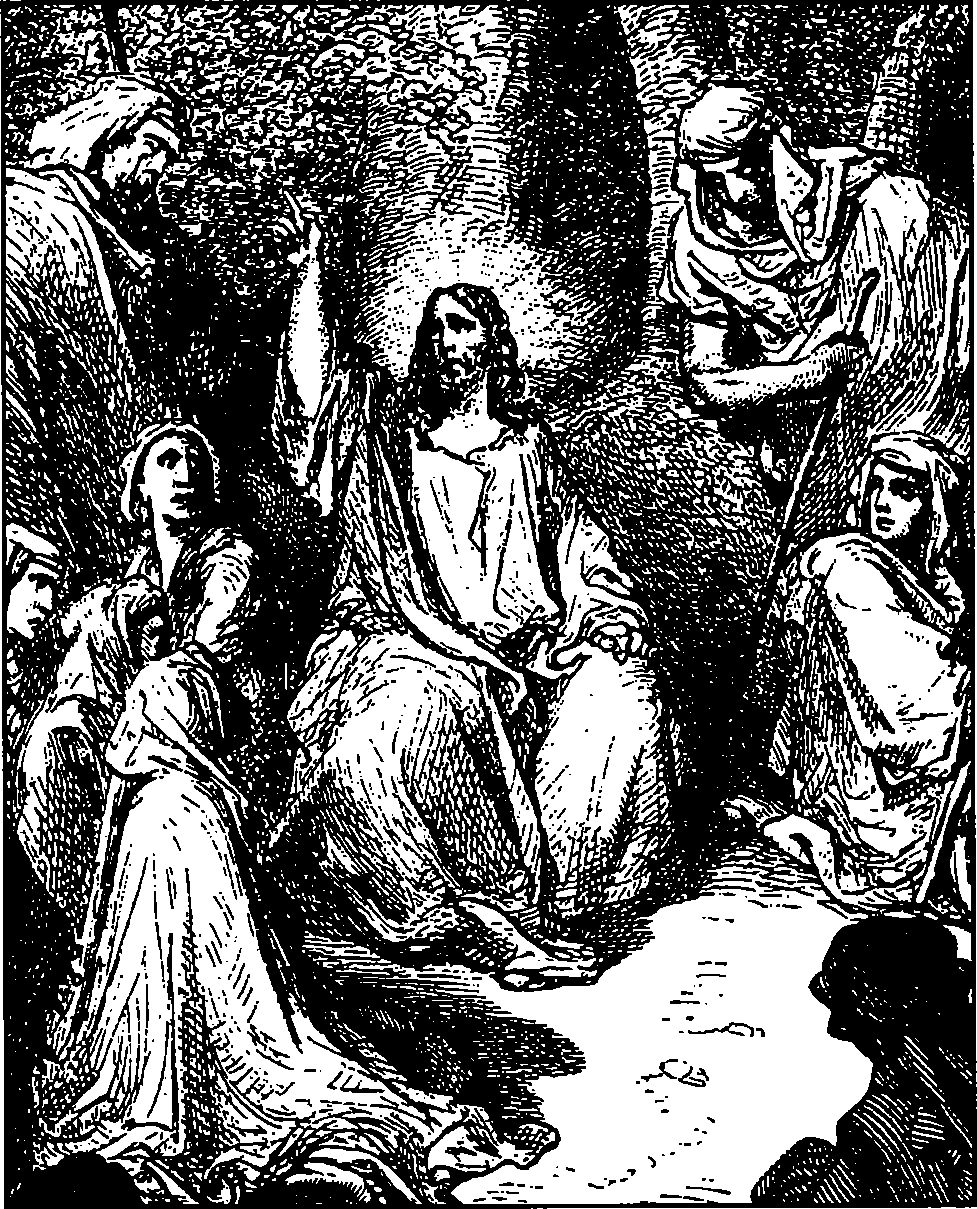
The Sermon on the Mount
By its very nature hate destroys and tears down; by its very nature love creates and builds up. Love transforms with redemptive power.
PRESIDENT LINCOLN’S VIEW
In U.S. history, it was this same attitude that made it possible for President Abraham Lincoln to speak a kind word about the South during the Civil War when feeling was most bitter. Asked by a shocked bystander how he could do this, Lincoln said, “Madam, do I not destroy my enemies when I make them my friends?” This gracious answer we must hasten to say is not the ultimate reason why we should love our enemies. An even more basic reason why we are commanded to love is expressed explicitly in Jesus’ words, “Love your enemies … that ye may be children of your Father which is in heaven.” We are called to this difficult task in order to realize a unique relationship with God. We are potential sons of God. Through love that potentiality becomes actuality. We must love our enemies; because only by loving them can we know God and experience the beauty of his holiness.
The relevance of Christ’s command should be readily apparent to the crisis of our day. There will be no permanent solution to the issues of hate facing the world until men develop the capacity to love their enemies. For a blessed meek few who may be hidden (Zephaniah 2:3), the lesson may be learned now – for many the lesson will need to wait until the Lord speaks to them in a pure language after the troublous times that will close out this present evil world (Zephaniah 3:8, Galatians 1:4).
Millions have been battered by the iron rod of oppression, frustrated by day and bewildered by night by unbearable injustice, and burdened with the ugly weight of hate. Forced to live with these shameful conditions, anyone would be tempted to become bitter and to retaliate with a corresponding hate. But if this happens, the new order the op pressed ones seek will be little more than a duplicate of the old order. Perhaps the overthrow of the repressive Czarist order in Russia and its replacement with the oppressive Soviet Union is the best object lesson of recent history. And sadly, this is not at all an isolated example.
THE URGENCY OF LOVE
The Lord’s people must urge the strength and humility of meeting hate with love. Of course, our old man will say this is not practical. Life is a matter of getting even, of hitting back, of “dog eat dog.” Nor do we wish to set aside the needful lessons of mankind reaping what they have sown. Are the Lord’s people to urge that Jesus commands us to love those who hurt and oppress us and our neighbors? Are we to sound this idealistic and impractical? “Maybe in the kingdom this command of Jesus will work, but not in the hard, cold world in which we live.” Surely we can say, “Satan will not be so moved. Nor will terrorists of all stripes. We are missing the element of force, exhibited by God’s quality of power. Only force will overcome some of the evil elements spawned by Satan.” And here we have much scriptural support as it is written, “It shall come to pass in that day, that I will seek to destroy all the nations that come against Jerusalem” (Zechariah 12:9). It will not simply be kindness.
At the same time there is an urgency for mankind – for men have followed the so-called practical way for too long a time now, and it has led inexorably to deeper confusion and chaos. Time is cluttered with the wreckage of societies which surrendered to hatred and violence. For the salvation of our neighbors we must follow another way. This does not mean that we abandon our righteous efforts, nor look with faith towards that time when God’s perfect character shall render recompense for evil.
Yet now, with every ounce of our energy, we must continue to live as Christ lived and show by example how to rid the world of hate. We must never relinquish our privilege and our obligation to love. While abhorring every hateful evil, we shall love our enemies. This is the only way to follow Christ’s command. Love is the most durable power in the world. This creative force, so beautifully exemplified in the life of our Christ, is the most potent instrument avail able in mankind’s quest for peace and security. Napoleon Bonaparte, the great military genius, looking back over his years of conquest, is reported to have said: “Alexander, Caesar, Charlemagne and I have built great empires. But upon what did they depend? They depended on force. But centuries ago Jesus started an empire that was built on love, and even to this day millions will die for him.”
Who can doubt the veracity of these words? The great military leaders of the past have gone, and their empires have crumbled and burned to ashes. But the empire of Jesus, built solidly and majestically on the foundation of love, endures. It started with a small group of dedicated men who, through the inspiration of the Holy Spirit, were able to break down the gates of the Roman Empire and carry the gospel into the entire world. May we solemnly realize that we shall never be true sons of our Heavenly Father until we love our enemies and pray for those who persecute us.

Christ Taching in the Synagogue
– Richard Doctor