
Understanding John 1:1, “Towards God”
“In the Beginning was the Logos, and the Logos was towards [in the service of] God, and the Logos was a god” (John 1:1, literal translation).
The opening verses of John’s Gospel, John 1:1-2, are familiar. But they have been misunderstood.1
(1) The translation “with God,” as appears in most Bibles, is inaccurate.
(2) The correct translation is “unto God,” or, “towards God.” The correct understanding of this idiom is that it means “pertaining to God,” or, “in the service of God.”
(3) The use of Bible study helps such as the Wilson Emphatic Diaglott and more modern Diaglotts greatly aid our understanding.
(4) The Logos had a special privilege of office in the creation of both the visible and invisible universe.
The beloved Apostle John was so intent that we focus on a single Greek phrase, pronounced pros ton theon, that he used it twice in the first two verses of his Gospel. This is equivalent to underlining and highlighting an important concept on a written page. For this reason, understanding the sense of this phrase should engage our attention.
The Marshall Diaglott (1968 original), one the best Diaglotts available, also uses “with – God” for the interlinear in John 1.2 The comparably excellent McReynolds Diaglott uses “towards God.” 3
The Wilson Emphatic Diaglott, a ground-breaking scholarly work from the time of the American Civil War, treats this text the same way.4 Reading John 1:1 from King James and other translations, the phrasing may not seem confusing at all. It seems perfectly normal that the “Logos,” or “Word” should be “with” God. After all, individuals are “with” one another. This is a natural state of affairs.
What is confusing is that a straightforward reading of the Greek does not support this thought. First, the preposition pros (Strong’s 4314) has not been properly rendered. Strong writes that pros is “a preposition of direction; forward to, i.e. toward.” It appears 710 times in the New Testament, translated as “unto” or “to” a total of 544 times. John uses this very preposition again in John 1:29, “The next day, John seeth Jesus coming towards him.” Of the 99 uses of “pros” in John’s Gospel, it is translated “unto” or “to” 86 times, but not again even a single time as “with.”
A completely different Greek word is usually rendered “with.” An example is John 15:27, “You have been with me from the beginning.” This is the Greek word meta (Strong’s 3326) which means accompanying, being in the midst of a group. This same word, meta, is used a little later in the account of our Lord’s last discourse on the road to the Garden. John 17:12. “While I was with them in the world, I kept them in thy name.”
Pros Rarely Means “With”
Aside from the confused rendering of John 1:1-2, the preposition pros is seldom used in the sense of “with.” One of the strongest supporting scriptures for the translation “with” is 2 Corinthians 5:8, “Willing rather to be absent from the body, and to be present with the Lord.” J.C. Sunderlin (R180) asks whether Paul refers to the body of the church, rather than his physical body. If so, this text harmonizes with the other idiomatic uses of the phrase.
There are additional examples where pros should be rendered “with,” and lacking further examination, this might be sufficient proof for an accurate reading of John 1:1, 2. Matthew 13:56 and its parallel Mark 6:3, respecting Jesus’ family, says “And his sisters, are they not all with us?” All our Lord’s siblings were not necessarily present, but they were well known in the community. Luke 9:41 illustrates a point, “O faithless and perverse generation, how long shall I be with you, and suffer you?” Other examples: Mark 9:10, 16, 19, 11:31, 14:4 (“within”), Luke 9:41, 18:11, 20:5, Acts 15:2, 17:17, 1 Corinthians 2:3, 13:2, 16:6, 7, 10, 2 Corinthians 11:9, Galatians 1:18, 2:5, 1 Thessalonians 3:4, 2 Thessalonians 2:5, 3:1, 10, Philemon 5, 13.
The “comforter,” parakletos, is at our side, not “towards” us. But pros is the preposition for opposition in the following texts. Acts 24:19, “ought against me,” 2 Corinthians 6:14, 15, “What communion hath light with darkness? … Christ with Belial?” It is used in this formal sense, but with the thought of reconciliation in Hebrews 10:16, “This is the covenant that I will make with them after those days.”
PROS MEANING “DIALOGUE”
The preposition seems to have particular use respecting a reasoning dialogue. Matthew 26:55, “I sat daily with you teaching in the temple, and ye laid no hold on me.” Often, teachers do sit facing, pros, “towards,” their students, so this is a harmless, but unwarranted rendering. Mark 9:10, 16, 19 “They kept that saying with themselves, questioning one with another what the rising from the dead should mean.” This discussion occupies verses 10-19 and appears also in Mark 11:31, “And they reasoned with themselves.” An unhappy internal dialogue is meant in Mark 14:4, “Some … had indignation within themselves, and said, Why was this waste of the ointment made?” Other renderings of this type are in Luke 18:11, “the Pharisee prayed with (towards) himself,” also in Luke 20:5, Acts 15:2, and Acts 17:17.
IDIOMATIC USE
To correctly understand this phrase “towards the God” where pros means “towards” and ton theon means “the God,” we need to recognize that it is an idiom used by Hebrew speakers of Greek. Aside from the two uses in John 1:1, 2, the only place the phrase appears in the four Gospels, John uses the phrase three additional times in his first epistle. In 1 John 1:1, 2:1 the variation is “towards the father.” Here the translators have rendered it “with,” however, when the phrase appears in 1 John 3:21 it is “If our heart condemn us not, then have we confidence toward God.”
To get a sense for the idiom we can examine Hebrews 2:17 which uses pros ton theon: “Wherefore in all things it behoved him to be like unto his brethren that he might be a merciful and faithful high priest in things pertaining to God, to make reconciliation for the people” (King James).
The Rotherham translation is nearly identical: “that he might become a merciful and faithful high Priest in the things pertaining unto God.”
This casts a different light on John 1:1-2. “Towards God” actually means “in the things pertaining to God” or “in the service of God.” The High Priest was pros ton theon, in the service of God. Literally, he did the service on the Great Day of Atonement facing towards the mercy seat. It would not be correct to say that he was “with” God. Let us see how some translators have worked with this problem.
Hebrews 2:17 uses the identical phrase as in John 1:1 but in the Marshall Diaglott the Greek phrase is there rendered “in regard to – God.” The Wilson Diaglott says “as to the God.” Wilson makes sense out the grammar and sets Hebrews 2:17 this way: “That he might be a merciful and faithful High Priest as to the things relating to God, in order to expiate the sins of the people.”
The testimony of Hebrews 2:17 is sufficient enough reason to rework our reading of John 1:1, 2. The High Priest was in the service of God and the Logos was in the service of God. However, the evidence for this is even stronger when we examine other New Testament usages. With only one exception (Romans 5:1), the King James translators kept reaching for different phrases to explain the idiom.
1 Thessalonians 1:8, 9, is a strong supporting text. It employs pros ton theon twice: “From you sounded out the word of the Lord … your faith to God-ward is spread abroad … how ye turned to God from idols.” Paul adds the definite article “the” before “to God-ward” that is usually left untranslated. But it clearly indicates that he used the phrase as a noun. Hence, following Wilson on Hebrews 2:17, this commendation should read: “in every place your faith as to the things relating to God is spread abroad.” Further, this turning is “towards God” from idolatry. Elsewhere we find:
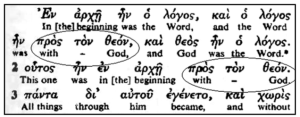
Hebrews 2:17, Marshall Interlinear
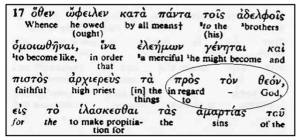
John 1:1, 2, Marshall Interlinear
Acts 24:16 “I exercise myself to have always a conscience void of offence toward God.” Paul means in the service of God, as he does when he uses this phrase in Romans:
“Being justified by faith, we have peace with God” (Romans 5:1). Clear our peace is in respect to God, not that we are “with” him in his physical presence.
Romans 15:17, “I may glory through Jesus Christ in those things which pertain to God.” (Also Revelation 12:5, 13:6) 2 Corinthians 3:4, “And such trust have we through Christ to God-ward.” A variation using “Lord” rather than “God” appears in 2 Corinthians 5:8 and is commented on above.
FLAVIUS JOSEPHUS
In the disastrous war that destroyed Jerusalem and the temple in 70 AD, a defeated Jewish general, Flavius Josephus, became an historian defending the record of his people. Josephus was contemporary with the writing of John’s Gospel and epistles, and he uses this phrase over eighteen times. Josephus always uses pros ton theon in the sense of “in the things pertaining to God,” or, “towards God.” He never uses it in the sense of “with God.”
In “Antiquities” (9.11.2) he writes that righteous King Jotham was pious “in the things pertaining to God.” Here he uses the identical phrase we find in John 1:1-2, and Hebrews 2:17. He uses this again when King David upon his death bed charged Solomon to be “just to your subjects, and pious towards God.” (Steven Mason, Flavius Josephus on the Pharisees, Brill Academic Publishers (2001), page 87.) The sense is clear. This phrase is idiomatic. To be “towards the God” has the sense of “being in the service of God.” The Logos was in the service of God, even as the High Priest was in the service of God.

Josephus
JEROME – THE LATIN VULGATE
How did confusion in the translation of John occur? What is the tradition that almost everyone follows? How did we get the current accepted but inaccurate reading?
Rebellions in Israel, followed by crushing defeats, reinforced the Christian belief that God’s judgment was upon that unworthy people. Thus, though the writings of Josephus were copied and preserved for their historical interest, they were not widely read in early Christian Churches. Thus the correct interpretation of this idiomatic phrase was not maintained.
But a greater problem for maintaining the correct understanding was a war in “Heaven.” After a tolerant reign of nearly 20 years, Emperor Diocletian issued edicts in 303 to re-establish imperial values and exterminate Christianity.
Diocletian’s name is forever sullied by permitting some of the severest, most inhuman persecutions in history. Failing health forced him to retire in 305. But despite a reversal of the edict in 311, his policies continued in force until 313.
When Constantine became the leading contender for the throne, a startling reversal of state policy ensued. Constantine was not a baptized Christian, but he claimed to have two visions setting a course for Christianity to become dominant. First was a vision of the sun emblazoned with the formerly despised Christian cross, reading in Greek, “By this sign shall you conquer.” This reportedly was followed by a vision the following night of Christ himself.
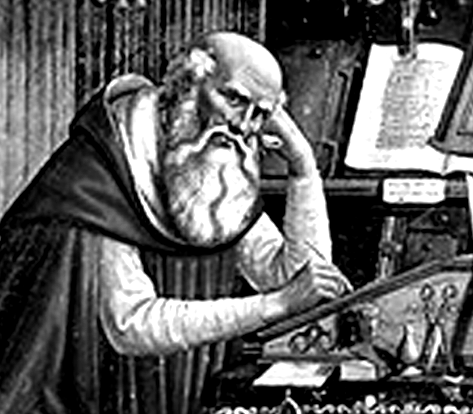
Jerome, laboring on the Vulgate
On this dubious authority, the armies of Constantine marched into battle with a stylized cross on their shields. They were victorious on October 28, 312. The ascension of Constantine heralded a new challenge for Christianity, with unprecedented trials. For with the Emperor involved in the working of the Church, corruption rapidly increased.
Constantine stopped the persecution of Christians by issuing an Edict of Milan in 313, closing ten years of cruelty. This edict supplemented and reaffirmed the Edict of Toleration by Galerius in 311, which had not stopped the persecution. But had the character of the beast really change?
Sadly, no. What did change were the tactics. All of this relates to the reading that would be adopted for John 1:1.
The future of the Empire did not rest in defending the troubled European frontier. Europe could not feed itself and was pressured by raids and frontier wars from southward migrations of the Vandals, Goths, and others, partially due to a cooling climate. The future did not lay with old, decadent Rome, that had been a rival to Constantine’s power base. Nor did the future of a diverse empire lie with insisting on Rome’s traditional pagan religion.
Constantine saw Christianity as a unifying force. He wanted a Christian empire, at a new capital, Constantinople, on the border between Asia and Europe. Then came a new orthodoxy, a version of Trinitarian doctrine, and the Empire was set to enforce it. This was crippling, setting civilization on the wrong course.
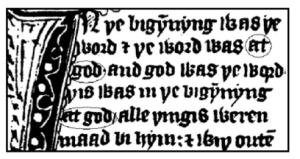
Wycliffe version, giving “at God,” twice
THE LATIN VULGATE
Eusebius Sophronius Hieronymus, better known as St. Jerome, was born in 347 and died in 420. He lived a generation after Christianity was tolerated in the Roman empire.
The Western Roman empire spoke Latin, rather than Greek, as they had in the days that Paul wrote to the Romans in Greek. There was a very real need for a translation of the Gospels into the common dialect – Latin. Jerome undertook to translate the Greek into Latin because earlier attempts at translation were poor.
Thus Jerome was doing a good thing. Because this translation was in the “common” or “vulgar” language, we call it the Latin “Vulgate.” Jerome made more than a few mistakes, but it was a great advancement in Bible translation. But one of the mistakes he made was to include the Trinitarian thought that the Logos was “with” God.
English versions (including King James and even the Wilson Emphatic Diaglott) followed in step with the Latin Vulgate’s incorrect affirmation of Trinitarian belief. Any other preposition but “with” creates difficulties for Trinitarians. Following the Vulgate, John 1:1, 2 undeservedly became a Trinitarian support text. The correct rendering, to be “towards,” means “being ready for service” or “in the things pertaining unto.” If you did not know this idiomatic phrase, staying with Jerome might seem reasonable.
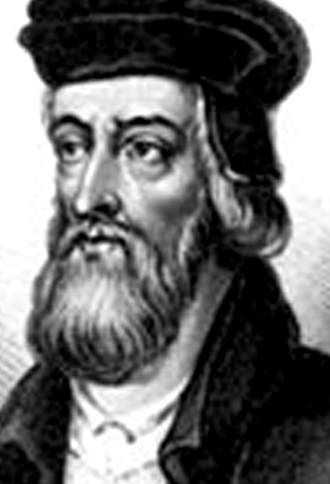
John Wycliffe
HOW DOES “IN THE THINGS PERTAINING UNTO” APPLY TO THE LOGOS?
The Logos, or “Word,” was the father’s agent in every act of creation. The creation work in Genesis 1 moved forward when God spoke the Word. The Logos or the Word is how Creation came about. This is what verses 1-3 of John 1 focus on for us. We can read about the Logos, who is called Wisdom, in Proverbs 8.
One of the blessed aspects of holiness comes into our hearts from continually beholding the glory of God. We can continually reflect on God’s Love, Power, Justice, and Wisdom. As we reflect on these attributes shown in Divine Plan of the Ages, how can we also not wish to serve him?
– Bro. Richard Doctor
(1) This expands on a brief article in Beauties of the Truth, May 2008.
(2) Marshall, Alfred, Interlinear KJV-NIV Parallel New Testament in Greek and English, Zondervan, 1991.
(3) McReynolds, Paul R., Word Study Greek-English New Testament, Tyndale House Publishers, Inc., 1999.
(4) An account of the translation work of Benjamin Wilson, written by his nephew W.H. Wilson, appears in “Early Pioneers of the Truth,” Herald of Christ’s Kingdom, January/February 1962 (reprinted from an article in 1951). The Wilson Diaglott uses the Griesbach Greek recension, that represents scholarship from 1755 (with footnoted emendations based on the Codex Vaticanus 1209). It does not include major textual studies, including the Sinaiticus Codex (4th century), and earlier papyrus manuscripts discovered in the 20th century.