
Bible Words for “Ransom”
“The Son of man came … to give his life a ransom” (Matthew 20:28).
There are three Hebrew root words and two Greek words that are translated “ransom” in the KJV. They are listed in the following chart. Included are the three Greek words used in the Septuagint translation of the Old Testament, and some examples of texts in which these words appear.
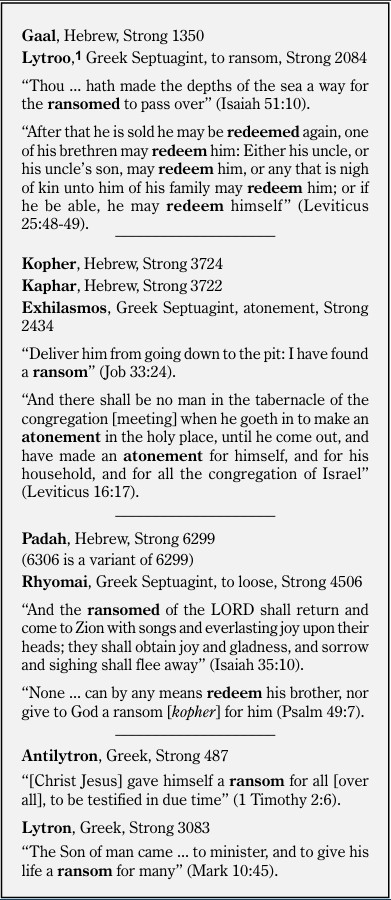
The translations of the three Hebrew words into the Greek Septuagint are inconsistent, even as in English they are inconsistent with both the Hebrew Massoretic and Greek Septuagint texts. The word gaal means primarily to “redeem by paying value for” (Hebrew Students Manual).
The word padah means “to loose (primarily by cutting); hence (1) to redeem by paying a price … (2) to let go, as a priest (a firstling) … (3) to set free, e.g. from servitude …” (Gesenius).
The word kopher (cognate “cover”) means primarily “price of expiation or redemption … or, atonement” (New Wilson’s Old Testament Word Studies). In the plural, kopher becomes kippurim, from which is derived “Yom Kippur,” or “Day of Atonement” (literally, “Day of Atonements” in the Hebrew Old Testament).
NEW TESTAMENT
In the New Testament, lytron means “literally, a means of loosing (from luo, to loose), occurs frequently in the Septuagint, where it is always used to signify equivalence” (W.E. Vine, An Expository Dictionary of New Testament Words). Hence, “ransom” is a good translation of it.
Of the other word, antilytron, Vine says, “The change of preposition in 1 Timothy 2:6, where the word antilutron, a substitutionary ransom, is used, is significant. There the preposition is huper, on behalf of, and the statement is made that he “gave himself a ransom for all,” indicating that the ransom was provisionally universal, while being of a vicarious character.”
All scriptures using lytron, lytroo, and related forms of the word can well be translated by the word “ransom.” Specifically:
- “The Son of man came not to be ministered unto, but to minister, and to give his soul a ransom for many” (Matthew 20:28, Mark 10:45).
- “Blessed be the Lord, the God of Israel; For he hath looked upon and made a ransom for his people” (Luke 1:68).
- “[Anna] gave thanks unto God, and spake of him to all them that were awaiting the ransom in [or, of ] Jerusalem (Luke 2:38).
- “We hoped that it is to be he who should ransom Israel” (Luke 24:21).
- “Moses … hath God sent to be both a ruler and a ransomer with the hand of the angel” (Acts 7:35). (Only here is lytrotees used; “redeemer” might be substituted.)
- “[Jesus] gave himself for us, that he might ransom us from all iniquity” (Titus 2:14).
- “Nor yet through the blood of goats and of calves, but through his own blood entered in once for all into the Holies, having obtained an eternal ransom” (Hebrews 9:12).
- “Ye were ransomed, not with … silver or gold, from your vain manner of life handed down from your fathers; but with precious blood, as of a lamb without blemish and without spot, even the blood of Christ” (1 Peter 1:17-19).
- “There is one God, one mediator also between God and men, himself having been a man, Christ Jesus, the one having given himself a ransom for all; the testimony to be borne in its own times” (1 Timothy 2:4-6).

The Cross of Christ
OLD TESTAMENT
Following are selected texts from the Old Testament, using gaal, kopher, kaphar, or padah (or its variant), properly translated.
- “If there be laid on him an atonement [kopher], then he shall give for the loosing [6306, padah variant] of his soul whatsoever is laid upon him” (Exodus 21:30).
- “If the man have no kinsman [gaal, literally ransom, or equivalent] to whom restitution may be made for the guilt, the restitution for guilt … made unto Jehovah shall be the priest’s; besides the ram of the atonements [kippurim], whereby it shall atone [kapher] for him” (Numbers 5:8).
- “God is gracious unto him, and saith, Loose him from going down to the pit, I have found a ransom … He hath loosed my soul from going into the pit” (Job 33:24, 28).
- None of them can by any means loose his brother, nor give to God an atonement for him; (For the loosing of their life is costly, and it faileth for ever)” (Psalm 49:7, 8).
- “Jehovah hath loosed Jacob and ransomed him from the hand of him that was stronger than he” (Jeremiah 31:11).”Draw nigh unto my soul, and ransom it: loose me because of mine enemies” (Psalm 69:18).
- “The ransomed shall walk there: and the loosed of Jehovah shall return, and come with singing unto Zion: and everlasting joy shall be upon their heads” (Isaiah 35:9-10).
- “Thou … madest the depth of the sea a way for the ransomed to pass over … And the loosed of Jehovah shall return, and come with singing unto Zion” (Isaiah 51:10, 11).
- “I will loose them from the power of Sheol; I will ransom them from death: O death, where are thy plagues? O death, where are thy plagues? O Sheol, where is thy destruction? repentance shall be hid from mine eyes” (Hosea 13:14).
In these scriptures “loose” could be replaced with “redeem,” because the loosing is associated with payment of a price. However, “redeem” would not be appropriate in several other scriptures, including several of those below:
- “And I will set a sign of loosing between my people and thy people: by tomorrow shall this sign be” (Exodus 8:23).
- “Jehovah hath … loosed you out of the house of bondage, from the hand of Pharaoh” (Deuteronomy 7:8; see 13:5, 15:15, 24:18).
- “So the people loosed Jonathan, that he died not” (1 Samuel 14:45).
- “He hath loosed my soul in peace from the battle that was against me” (Psalm 55:18).
- “Thus saith Jehovah, who loosed Abraham, concerning the house of Jacob” (Isaiah 29:22).
CONCLUSIONS
As a tentative conclusion, the word “ransom” in the Hebrew Old Testament is properly translated only from the word gaal, which should be so translated everywhere feasible.
Kaphar, kopher and kippurim should consistently be translated “atone” and “atonement(s).”
Padah should be translated “loose” or “redeem” (where shown by context with payment of a price), or equivalent.
OLD TESTAMENT RANSOM TEXTS
Old Testament “ransom” texts (that is, texts using the Hebrew word gaal), include:
- “Bless Jehovah … who ransometh thy life from the pit” (Psalm 103:2, 4).
- “Ransom me: quicken me according to thy word” (Psalm 119:154).
- “I have ransomed thee … thou art mine” (Isaiah 43:1)..
- “I have blotted out, as a thick cloud, thy transgressions, and, as a cloud, thy sins: return unto me; for I have ransomed thee” (Isaiah 44:22).
- “Go ye forth from Babylon … Jehovah hath ransomed his servant Jacob” (Isaiah 48:20)
- “The day of vengeance is in my heart, and the year of my ransomed is come” (Isaiah 63:4, 9).
- “Jehovah hath loosed Jacob, and ransomed him from the hand of him that was stronger than he” (Jeremiah 31:11).
- “Hanamel the son of Shallum thine uncle shall come unto thee, saying, Buy thee my field that is in Anathoth; for the right of ransom is thine to buy it” (Jeremiah 32:7-8).
In Leviticus chapters 25 and 27 the various forms of “redeem” should be the corresponding forms of “ransom” (except only “shall redeem” in 27:27, and “shall be redeemed” in 27:29).
MEANING OF “RANSOM” FROM THE OLD TESTAMENT
The correspondence, or equivalence, implied in the Hebrew word for “ransom” is seen in Numbers 5:8, where “kinsman” is the translation – the only one to whom restitution can be made for the person slain. Similarly, it is so at least a dozen times in Ruth 2:20-4:14.
The prophecy, “I will ransom them from death” (Hosea 13:14), shows that being freed from the grave is to be a result of “ransom.”
When Elihu instructs Job, “Loose him from going down to the pit, I have found a ransom” (Job 33:24), this suggests the ransom is a lawful foundation for not physically dying (at the end of the Adamic age).
ELABORATION ON “RANSOM” IN THE NEW TESTAMENT
Matthew 20:28 and Mark 10:45 say that Jesus was to give his soul a ransom for many, not just for the few. How many? Paul says Jesus has “given himself a ransom for all” (1 Timothy 2:4-6). How can one man die for all? Paul elaborates in Romans 5:18-19. “As through one trespass condemnation cometh unto all men; even so through one act of righteousness justification of life cometh unto all men. For as through the one man’s disobedience the many were made sinners, even so through the obedience of the one shall the many be made righteous.”
1 Corinthians 15:21, 22, reads “By a man cometh death, by a man cometh also a resurrection of the dead. For as in Adam all die, so also in Christ shall all be made alive [or, quickened].” “Quickened” need not imply that all cooperate. But it does suggest that all will have a full opportunity.)
If all were condemned to death through the first man, then Jesus’ sacrifice of his human life for Adam can ultimately release Adam, and hence all who had been condemned under Adam.
The testimony of Jesus Christ’s ransom sacrifice for Adam and his race is testified now in the Gospel Age for the benefit of his faithful church. During Christ’s thousand-year Kingdom, it will be testified for the benefit of the entire rest of the world.
– Br. James Parkinson
(1) Many reference works transliterate this word Lutroo, where the letter “u” is used for the Greek letter upsilon. (Vines Expository Dictionary is one example.) However, some works use the letter “y” for the Greek upsilon. (The Kingdom Interlinear Translation is one example.) The latter form is preferred by the present author and is used in this article for this word and related words.