
Put to Death Flesh, Raised Spirit
“For Christ also hath once suffered for sins, the just for the unjust, that he might bring us to God, being put to death in the flesh, but quickened by the Spirit” (1 Peter 3:18).
All Christians rejoice in the truth of the resurrection of our Lord. But the details of what that resurrection entails, as viewed by most of Christianity, diverges significantly from what is outlined in the Bible. This divergence comes partially from an incomplete understanding of Christ’s ransom for all.
The basis for salvation is the substitutionary atonement provided by the death of Jesus. The Apostle Paul states it succinctly in 1 Corinthian 15:22, “For as in Adam all die, even so in Christ shall all be made alive.”
What could be simpler? It satisfies the claim justice has on the human race and provides an opportunity for salvation to “all.” Jesus is the ransom. His human body paid the price for the sin of Adam. So Jesus died.
Next came the resurrection. But an interesting question arises. If the body of Jesus was the ransom price, how can it be resurrected without also reneging on the ransom payment? If Adam’s death would have been eternal without a ransom, would not the giving of a ransom price likewise mean eternal death for the man Jesus? In the strict exchange demanded by justice, it must be so. Consequently, when Jesus was resurrected, it could not have been a restoration to his human manhood. Rather, it was a new life form on a completely different plane of existence. Jesus was a new creation! He was a divine creation! Something that had never existed before! He became an immortal being like God himself.
This is not the typical view of Christianity. Most Christians believe that Jesus’ resurrection was in the flesh. Or more precisely, they see the resurrected body of Jesus as some kind of glorified flesh. As proof of this they point to Luke 24:40, where Jesus visited his disciples and showed them his wounds. Though this text seems on the surface to provide some foundation for their view, harmonizing it with other scriptures provides a more satisfying picture of the reward that Jesus received from the Heavenly Father for his obedience unto death.
As stated earlier, a ransom cannot be given back. In John 6:51 Jesus makes it clear that his sacrifice is still efficacious and therefore was never taken back. “I am the living bread which came down from heaven: if any man eat of this bread, he shall live for ever: and the bread that I will give is my flesh, which I will give for the life of the world.”
His flesh is given for the life of the world. Divine justice accepted it as a full payment. If it were taken back, the life of the world would be forfeited once again.
The scriptures clearly state that Jesus was given a different life, a new life on the divine plane. Peter described this beautifully in 1 Peter 3:18. “For Christ also hath once suffered1 for sins, the just for the unjust, that he might bring us to God, being put to death in the flesh, but quickened by the Spirit.” He was “put to death in the flesh, but quickened [raised, made alive] in the Spirit.” In the Greek it is even more emphatic:
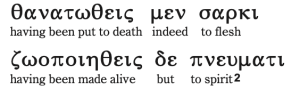
The “μεν … δε” construction conveys the thought “on the one hand … on the other hand.” Thus was Jesus raised a spirit creature on the divine plane. To this time, only the Father possessed the divine nature. Now he shared it with his beloved son.
This spiritual resurrection also helps us to understand what the Apostle Paul wrote in 1 Corinthians 15:50, “Now this I say, brethren, that flesh and blood cannot inherit the kingdom of God; neither doth corruption inherit incorruption.”
As followers of Jesus, we have the same hope of future life. If faithful, we too will be rewarded with the divine nature. “Whereby are given unto us exceeding great and precious promises: that by these ye might be partakers of the divine nature, having escaped the corruption that is in the world through lust” (1 Peter 1:4).
GLORIFIED FLESH?
But what about the concept of a glorified flesh? Did Jesus demonstrate such a glorified flesh to his disciples when he appeared to them in Jerusalem? The account is in Luke 24:36-39. “Jesus himself stood in the midst of them, and saith unto them, Peace be unto you. But they were terrified and affrighted, and supposed that they had seen a spirit. And he said unto them, Why are ye troubled? and why do thoughts arise in your hearts? Behold my hands and my feet, that it is I myself: handle me, and see; for a spirit hath not flesh and bones, as ye see me have.”
Jesus’ sudden appearance in a closed room terrified them! They thought they had seen a “ghost”! This is probably the only place in scripture where the word “ghost” would be an appropriate translation. Jesus wanted to calm their fears. His purpose in appearing to them was to assure them that he had been raised to life again as promised. He wanted them to be assured it was really him. As evidence, he showed them the terrible wounds inflicted by the crucifixion.
The question is: Was this the glorious resurrection body of Jesus? If it were, the prospect of Jesus carrying horrible wounds in his body for the rest of eternity would be troubling. Clearly there must be something wrong with this thought.
But Jesus provided the answer in his own words. He said that they were not seeing a spirit. What they were seeing was a special manifestation provided to convince them that Jesus was alive again. It was really he! They were not seeing his glorious spiritual body. He could not show them his real body without doing them damage. We know this because when Jesus did show a reflection of his glorious spiritual body to Saul on the road to Damascus, Saul was blinded by the sight! (Acts 9:3,4,8,9, 26:13)
But there is something even more compelling than this. The Apostle John was present when Jesus appeared to the apostles. If this appearance was the glorified body of Jesus that he saw, we might have expected him to write about it in glowing terms. But John wrote something entirely different! “Beloved, now are we the sons of God, and it doth not yet appear what we shall be; but we know that, when he shall appear, we shall be like him; for we shall see him as he is” (1 John 3:2).
John here says that he did not know what a glorious spiritual existence was like! But he had the hope that at the future time of Jesus’ return, they would all “see him as he is.” So seeing the beautiful and glorious form of Jesus as a divine being must wait until each of his followers is resurrected from the dead themselves.
When relating his experience in meeting Jesus on the road to Damascus the Apostle Paul says this in 1 Corinthians 15:8, “And last of all he was seen of me also, as of one born out of due time.” This phrase, “as one born out of due time,” is interesting. Paul knew that at the second advent he would see Jesus’ glory. However, his blinding experience at the start of his Christian career was something given early, before the due time.
The point here is that the body that Jesus showed the disciples at Jerusalem was not his spiritual body. Jesus is no longer approachable by man nor can be seen by man! Again, Paul writes in 1 Timothy 6:16, “Who only hath immortality, dwelling in the light which no man can approach unto; whom no man hath seen, nor can see.” 3 So the body in which Jesus appeared after his resurrection was similar to previous angelic materializations. Jesus did so because it was evidently necessary that the disciples be fully assured of his resurrection.
DIFFERENT APPEARANCES
It is also interesting to reflect upon the fact that at other times in Jesus’ post-resurrection appearances he did not assume the same likeness as he had during his earthly ministry. For example, when the disciples walked with Jesus on the road to Emmaus, they did not know who he was (Luke 24:13-33). Neither did he speak in the same voice he had as a man. Had he done so, the disciples would certainly have recognized him. Neither did the two disciples notice wounds in his hands as they walked with Jesus. They would certainly have found that a striking identifier. But in the form that Jesus appeared to them, he did not include the crucifixion wounds.
The ability of spirit creatures to materialize in order to communicate with men is well documented in scripture. So Jesus was using capabilities that were easily within his divine powers.
FLESH AND BONES
There is one more clue in Jesus’ words, when he appeared to the disciples, which suggests that the body Jesus used was not his spiritual body. “Behold my hands and my feet, that it is I myself: handle me, and see; for a spirit hath not flesh and bones, as ye see me have” (Luke 24:39). As mentioned earlier, Jesus told them plainly that they were not seeing a spirit being. But he adds that spirits do not have “flesh and bones.” It is further significant that Jesus did not say “flesh and blood.”
Blood in the Bible is associated with life. In Leviticus 17:11 read, “For the life of the flesh is in the blood: and I have given it to you upon the altar to make an atonement for your souls: for it is the blood that maketh an atonement for the soul.” 4
Jesus’ omission of the word “blood” suggests that this body the disciples were seeing was not live flesh. Indeed the blood of Jesus Christ was given for man’s atonement. “Ye were not redeemed with corruptible things, as silver and gold, from your vain conversation received by tradition from your fathers; But with the precious blood of Christ, as of a lamb without blemish and without spot” (1 Peter 1:18, 19).
When that precious blood was spilled, the man Jesus died. Jesus chose his words carefully to subtly suggest that the materialized body that the disciples saw and handled was no longer a living human, but rather a manifestation, an animated body provided to bolster their faith.
ARK OF THE COVENANT
There is an additional lesson that can be derived from the Old Testament Tabernacle types. The Ark of the Covenant is a type of the divine family of God in future full glory. It was a vitally important part of God’s Plan from before the creation of the world. “Who verily was foreordained before the foundation of the world, but was manifest in these last times for you” (1 Peter 1:20). “According as he hath chosen us in him before the foundation of the world, that we should be holy and without blame before him” (Ephesians 1:4).
Jehovah God was represented in the Shekinah light that shined above the Ark of the Covenant between the two cherubs. Jesus is represented in the mercy seat of pure gold upon which the blood of the typical sacrifices was sprinkled.5 The church, whose head is Christ, is represented by the box of the Ark itself (1 Corinthians 11:3, Ephesian 5:23).
As the Ark was moved from camp to camp, it, along with all of the other components of the entire Tabernacle structure, was packed according to detailed instructions to the Levites recorded in Numbers chapter four. While being moved, the Ark of the Covenant was to be covered with several layers of material. It was the holiest object that Israel possessed and was not to be looked upon or touched except by the authorized Priests and Levites.6
The procedure for preparing the Ark for travel is found in Numbers 4:5,6. “And when the camp setteth forward, Aaron shall come, and his sons, and they shall take down the covering vail, and cover the ark of testimony with it: And shall put thereon the covering of badgers’ skins, and shall spread over it a cloth wholly of blue, and shall put in the staves thereof.”
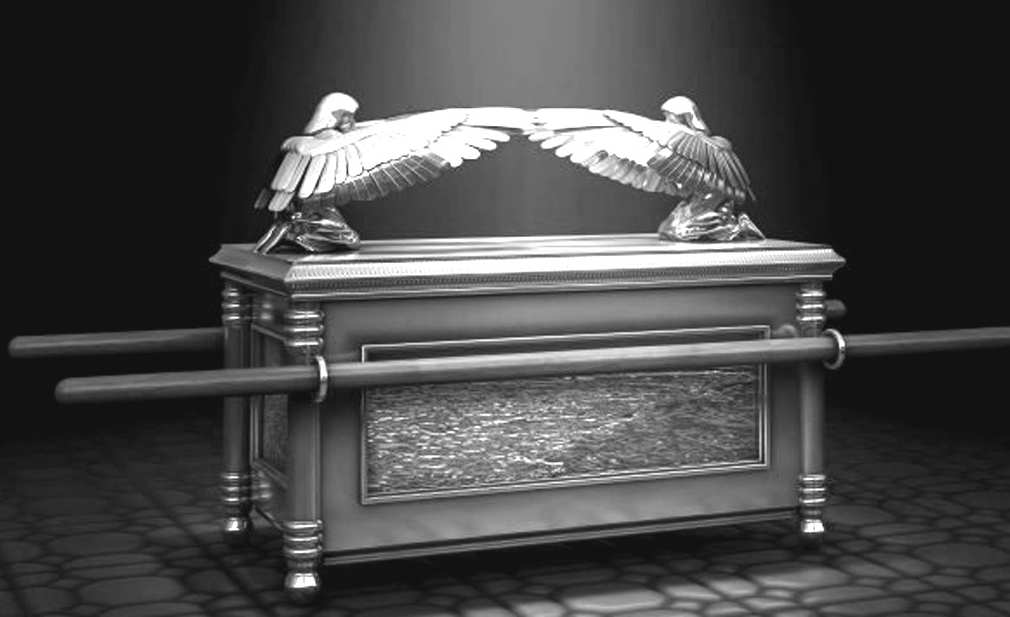
Ark of the Covenant
The innermost covering of the Ark was the veil that normally separated the Holy of the Tabernacle from the Most Holy. As the Holy represented the spirit-begotten condition and the Most Holy represented the spirit-born condition, the veil represents the death of the flesh of those passing through, first Jesus and then all that follow closely in his footsteps. “By a new and living way, which he hath consecrated for us, through the veil, that is to say, his flesh” (Hebrews 10:20).
The next layer that was laid over the veil was a cover of sealskin.7 The aquatic animal from which the skin was taken provided a very practical waterproof covering. Black sealskin is not a particularly attractive covering. Sealskin was also used as the outer covering the Tabernacle itself.
In the Tabernacle, the sealskin represents how the unchristian world views sacrificing Christians. They see only the unsightly flesh and do not know of the beautiful things within — the gold, silver, and broidered curtains. In the case of the Ark, sealskin is not the outermost covering, as it is on the Tabernacle. The sealskin covering the Ark also represents the unattractive flesh, but it is hidden by the final covering, a sheet of blue cloth.
Thus when the Ark was on the move, all that anyone could see was this blue covering. In the Tabernacle types, blue represents faithfulness. In nature, blue is the favored result of the complex interaction (Rayleigh scattering) of the atmosphere with sunlight. This heavenly blue illustrates the faithfulness of God. “For I have said, Mercy shall be built up for ever: thy faithfulness shalt thou establish in the very heavens” (Psalms 89:2).
The Ark was the only piece of Tabernacle furniture that did not have an outermost covering of sealskin (except the Copper Laver that had no coverings at all). This difference is important in understanding the meaning that God intended.
Putting all of the details of this type together, we see that when the church is in glory with Jesus, as shown by the Ark in the Most Holy or on the move, then mankind will recognize that the Kingdom of God is ruling the earth, and Jesus and the church are their kings (Revelation 5:10).
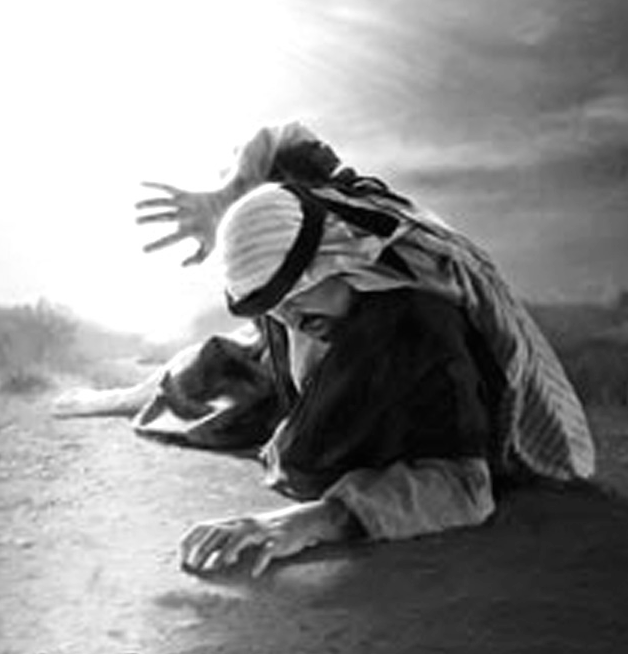
Jesus appearing to Paul
The resurrection of the church, just like the resurrection of their head Jesus, will come as a result of being faithful unto death — the death of the flesh — and the receiving of the divine nature as a gracious reward. The golden Ark represents that divine reward.
But notice carefully — the flesh of the church, represented by the sealskin, does not touch the Ark in any way. No, the second veil, representing the death of the flesh, forever separates the sealskin — the flesh of the church — from the Ark. In other words, the flesh does not go beyond the vail! “Flesh and blood cannot inherit the Kingdom” (1 Corinthians 15:50). This relates back to the discussion of Jesus’ own resurrection. He too passed through death, leaving the flesh behind.
But what of the flesh? It has been sacrificed and is to be seen no longer. Consequently, the covering of blue forever hides the flesh from sight. What is remembered of Jesus and the church is their faithfulness — the cloth of blue. In the Kingdom, the world will remember the earthly walk of Jesus and the church.
They will remember the faithfulness and character of those overcomers. And they will know that these have gone to their reward on the divine plane to be the loving and kind rulers with King Jesus over the world of mankind. “And of Zion it shall be said, This and that man was born in her: and the highest himself shall establish her” (Psalms 87:5).
— Br. David Stein
(1) The manuscript evidence favors “died,” not “suffered.” GNT1 reads “died,” though GNT4 does not.
(2) See word for word translation, The Kingdom Interlinear Translation, Watchtower 1969, or The Emphatic Diaglott, Benjamin Wilson, 1942 edition.
(3) There is some debate about whether this verse is speaking about Jehovah or his son Jesus. Scriptures can be well mustered on both sides of the question. The author inclines to believe that it is Jesus about whom Paul is referring because if it were the Father here, it would not be strictly true that he “only” has immortality since at the time this was written, Jesus also had immortality. One could describe Jesus as the “only” one with immortality inasmuch as the Father is often excepted in such statements. See 1 Corinthians 15:27.
(4) See also Leviticus 17:14, Genesis 9:5, Deuteronomy 12:23.
(5) Romans 3:24, “whom set forth the God a mercy-seat through the faith by the of him blood, for a pointing out of the righteousness of himself, through the passing by of the formerly committed sins in the forbearance of the God” (Wilson Diaglott).
(6) Violation of the holiness of the Ark resulted in immediate judgment from God. See 1 Samuel 6:19,20, 2 Samuel 6:6-8.
(7) The word “badgers” is mistranslated in the KJV. The correct translation should be “sealskin” or “sea-cows.” See Beauties of the Truth, February 2010, “Tabernacle Coverings of Sea-cows.”