
A Bloody Husband
“It came to pass by the way in the inn, that the LORD met him, and sought to kill him. Then Zipporah took a sharp stone, and cut off the foreskin of her son, and cast it at his feet, and said, Surely a bloody husband art thou to me. So he let him go: then she said, A bloody husband thou art, because of the circumcision” (Exodus 4:24-26).
These verses have been the subject of conjecture and uncertainty for centuries. On the surface, they certainly are confusing. Jonathan Kirsch calls it “The single most bizarre passage in all of the Bible.” 1 We will ask a few questions about these texts with a goal of finding some explanation that seems plausible. Here are a few questions to be answered:
- Who was Jehovah threatening to slay?
- Why was Jehovah threatening to slay that one?
- Why was it Zipporah who acted and not Moses?
- Whose feet was the foreskin laid at?
- What is the meaning of the phrase “husband of blood”?
It seems necessary to interpret “Jehovah” as referring to an angel sent by Jehovah.2 The Septuagint version gives the following: “And it came to pass that the angel of the Lord met him by the way in the inn, and sought to slay him.”
So God sent an angel to kill “him.” Who is “him”? It appears that the intended victim was Moses’ son, not Moses himself. The action that resolves the problem is the circumcision of the son. So we conclude that it was the son who is in jeopardy.
That Moses is not the intended victim3 seems conclusive by the fact the God Himself, in the verses immediately preceding (19-23), had sent Moses to deliver Israel from Egypt. It would make no sense to dispatch Moses to deliver Israel, and then slay him on the way. So why was Jehovah seeking to slay Moses’ son? To answer this, we will read those verses (19-23) for a clue.
“And the LORD said unto Moses in Midian, Go, return into Egypt: for all the men are dead which sought thy life. And Moses took his wife and his sons, and set them upon an ass, and he returned to the land of Egypt: and Moses took the rod of God in his hand. And the LORD said unto Moses, When thou goest to return into Egypt, see that thou do all those wonders before Pharaoh, which I have put in thine hand: but I will harden his heart, that he shall not let the people go. And thou shalt say unto Pharaoh, Thus saith the LORD, Israel is my son, even my firstborn: And I say unto thee, Let my son go, that he may serve me: and if thou refuse to let him go, behold, I will slay thy son, even thy firstborn.”
First, Jehovah assured Moses that it was safe to return when he said “all the men are dead which sought thy life.” Again, we take this as evidence that God Himself was not seeking Moses’ life.
Second, Moses now loads up his wife and sons to take them with him.
Third, God told Moses what the threat will be if Pharaoh will not let Israel go. He would forfeit his own firstborn son. Obedience to God is the only thing that would save the firstborn son of Pharaoh.
Now note something important respecting Moses’ obedience. He had not obeyed God by having his own firstborn son circumcised! The clear command of God that was still incumbent upon Moses is in Genesis 17:10-14:
“This is my covenant, which ye shall keep, between me and you and thy seed after thee; Every man child among you shall be circumcised. And ye shall circumcise the flesh of your foreskin; and it shall be a token of the covenant betwixt me and you. And he that is eight days old shall be circumcised among you, every man child in your generations, he that is born in the house, or bought with money of any stranger, which is not of thy seed. He that is born in thy house, and he that is bought with thy money, must needs be circumcised: and my covenant shall be in your flesh for an everlasting covenant. And the uncircumcised man child whose flesh of his foreskin is not circumcised, that soul shall be cut off from his people; he hath broken my covenant.”
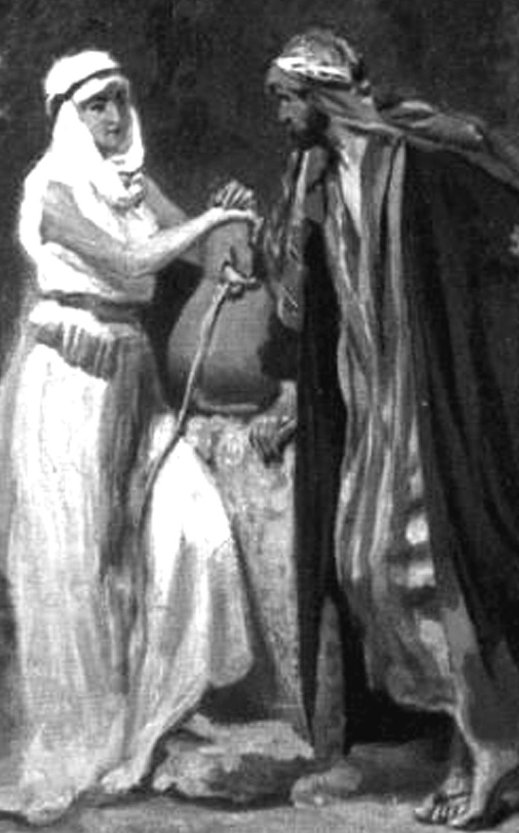
Zipporah meets Moses at a well
Note that this was a command given to Abraham as part of the Abrahamic covenant and that it would apply to his whole family and onto subsequent generations. Also note the severe penalty — a “man child” not circumcised according to this law was to be “cut off from his people.” This was not a mere excommunication. This was to be an execution! Circumcision is very serious business as it relates to the covenant God was making with Abraham!
So we suggest that the son of Moses that was in danger was his firstborn — Gershom. He had not yet been circumcised as required by God according to the Abrahamic covenant. And, since Moses was traveling to Egypt to threaten the firstborn son of Pharaoh if Pharaoh was disobedient, it seems an appropriate time to remind Moses of his failure to obey the requirements of the covenant in regard to his own firstborn son.
FURTHER QUESTIONS
So why did not Moses act in the face of this angel of Jehovah? Why did Zipporah carry out the circumcision?
We do not have a good answer for this. Perhaps Moses was not present at the moment when the angel came.4 If that is so, then perhaps the delay in circumcising Gershom was due to reticence on the part of Zipporah to have her son circumcised. Evidently it was not part of Midianite custom, though as Midian was a descendent of Abraham, circumcision should have been practiced. But the fact that Zipporah knew what to do tells us that Moses had discussed it with her. If Moses was present, it would have been his duty as the father to carry out the circumcision.
We note one other point in this narrative. We are told in verse 24 that the angel sought to kill Moses’ son. How? Evidently the angel had hold of the boy are some point in order to kill him. Note one point in verses 25 and 26: “Then Zipporah took a sharp stone, and cut off the foreskin of her son, and cast it at his feet, and said, Surely a bloody husband art thou to me. So he let him go: then she said, A bloody husband thou art, because of the circumcision.”
“He let him go” — Who let who go? We conclude it was the angel (“he”) who let go of Moses’ son (“him”) now that the circumcision had taken place. If the “he” is in fact the angel of Jehovah, then we surmise that Zipporah was addressing this angel, and that it was this angel at whose feet she cast the foreskin, and whom she called “a bloody husband.” What does this mean? Here are a few other translations of this enigmatic phrase:
- “Surely a bridegroom by rites of blood art thou to me” (Rotherham).
- “Surely a bridegroom of blood art thou to me” (ASV).
- “Surely a bloody relative art thou to me” (Leeser).
- “The blood of the circumcision of my son is staunched” (Septuagint).
- “I have a bloody husband
… You are a bloody husband, because of the circumcision” (Lamsa, Aramaic).
We might understand this by noting that Zipporah is not an Israelite. As we already noted, she was a daughter of Midian. In Numbers 12:1 she is called “an Ethiopian,” evidently as a pejorative.5 She appears to be aware of this fact since by her act of obedience to the requirement of the Abrahamic covenant, she now claims the rights due to Abraham’s descendants. In speaking to the angel, she is claiming relationship now with God himself.
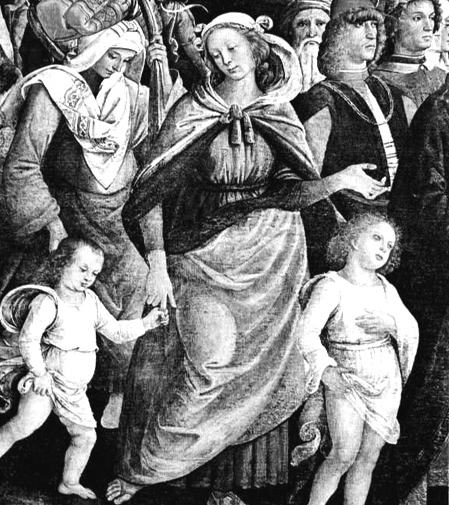
Zipporah with her sons
Her thinking might be illustrated by Jehovah’s comment about his relationship with Israel in Jeremiah 31:32: “Not according to the covenant that I made with their fathers in the day that I took them by the hand to bring them out of the land of Egypt; which my covenant they brake, although I was an husband unto them, saith the LORD.”
The covenant relationship Israel had with God is likened to a marriage. So Zipporah might have thought the same was established by her actions of circumcision. If this be the right view, she is an audacious woman. But she did the right thing at the right time and saved the life of her son.
We hear no more of Zipporah or of Moses’ sons during the whole experience of Moses in Egypt. It is not until Israel left Egypt and began their journey in the wilderness that we see Jethro bringing Moses’ family to him.
“When Jethro, the priest of Midian, Moses’ father in law, heard of all that God had done for Moses … and that the LORD had brought Israel out of Egypt; Then Jethro … took Zipporah, Moses’ wife, after he had sent her back, And her two sons; of which the name of the one was Gershom; for he said, I have been an alien in a strange land: And the name of the other was Eliezer; for the God of my father, said he, was mine help, and delivered me from the sword of Pharaoh: And Jethro, Moses’ father in law, came with his sons and his wife unto Moses into the wilderness, where he encamped at the mount of God: And he said unto Moses, I thy father in law Jethro am come unto thee, and thy wife, and her two sons with her” (Exodus 18:1-6).
Note that at some point Moses had sent her back to Jethro. When did that happen? We don’t know for sure, but it is possible that it occurred right after the circumcision incident. We surmise that this reinforced a reverential fear on the part of Moses as he was about to step into Egypt and perhaps did not want to expose his family to the dangers he knew would be present.
We are still left with an open question: why is this strange incident is included in sacred writ? Might there be some prophetic application of the lesson to the church? We leave this to other thoughtful students of prophecy.
(1) Jonathan Kirsch, Moses: A Life (New York: Ballantine Books, 1998), page 12.
(2) Some might call it The Principle of Agency — God’s agent.
(3) Many commentators believe God was seeking the life of Moses.
(4) Most commentators think Moses was present during this experience. This article suggests that Moses was not present at the time of the incident as an explanation for several details in the narrative.
(5) Some think that Moses had a second wife who was from Ethiopia, and that is who Miriam referred to. Much has been written about this idea, worthy of review, but that is beyond the scope of this article.