
In the Beginning God Created the Heavens
“In the beginning God created the heaven and the earth” (Genesis 1:1). “Thus saith the LORD, who stretcheth forth the heavens, and layeth the foundation of the earth, and formeth the breath of man within him” (Zechariah 12:1).
The Bible asserts the universe had a “beginning” and that it was subsequently “stretched.” The scientific community would not have supported the assertion that the universe had a beginning during the early 20th century. At that time, Albert Einstein, Sir Arthur Eddington, Sir James Jeans, Sir Fred Hoyle, and the rest of the world’s famous cosmologists agreed that the universe could not have had a beginning. Yet while they agreed upon that, as might be expected, they differed considerably over hypotheses and theories to account for the existing universe, let alone the beginning of life.
The idea of action by God did not appeal to many scientists. Yet, the origin of the universe and the origin of life needed some rational explanation. In an article published in Nature in 1931, Eddington replaced God with random motion when he postulated, “[the] way out of the dilemma … [is] … If we have a number of particles moving about at random, they will in the course of time go through every possible configuration, so that even the most orderly, the most non-chance configuration, will occur by chance if only we wait long enough”1
Variations on the Eddington thesis echo down to our day in the polemics of Dr. Richard Dawkins author of “The God Delusion.” Dawkins embraces the concept of an unobservable “multiverse” with an incredible number of variations (10 with 500 zeros following) to explain the “fine tuning” of the physical constants that makes life possible for us. This reasoning seems to remove the need for God in the reasoning of some scientists.
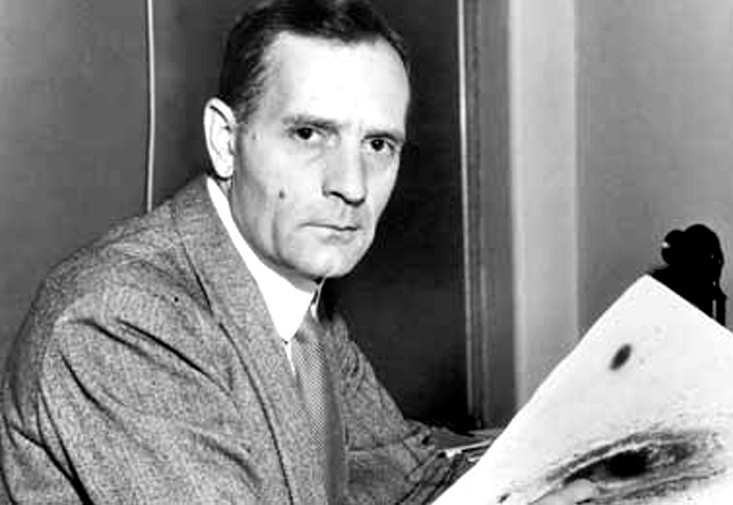
Edwin Hubble, 1889-1953, found that the Universe is expanding.
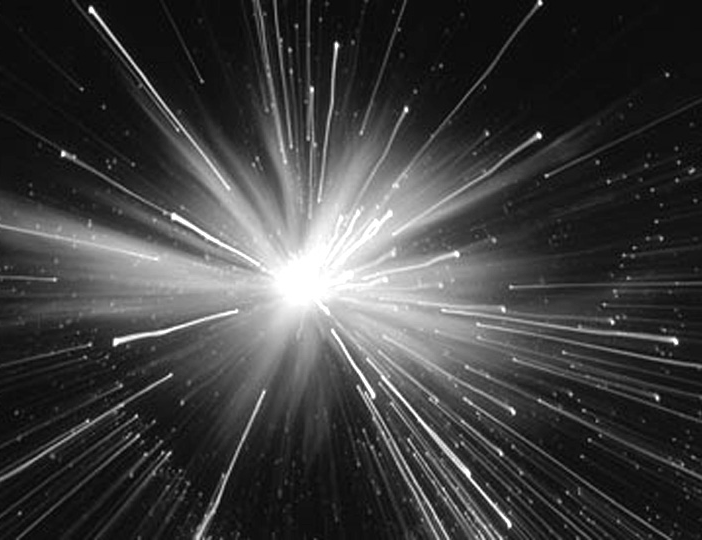
Beginning the Universe
As the 20th century moved forward, one-by-one, Georges Lemaître’s Cosmic Hesitation Model, Eddington’s further hypothesis on it, James Jeans’ Steady-State Cosmology, Fred Hoyle’s C-field, and Willem de Sitter’s Oscillating Universe, all fell progressively before direct astronomical measurements.
By the late 1920s the pioneering work of Edwin Hubble in his observations of galaxies and their associated “red shift” established that the universe was expanding and argued for a “beginning” and a “stretching,” just as the Bible asserts.2 The Bible presents a view of a Creator who stands outside of nature, and creates nature itself.
Not wishing to concede defeat, Hoyle derisively called Hubble’s expanding universe — with a beginning and stretching — the “Big Bang.” The name “Big Bang” stuck, although the term “Cosmic Inflation” is preferred today. Sadly, a portion of the Christian community that asserts a belief in the Bible are as confused as to the implications of the “Big Bang” as they are on other aspects of scripture.
Today, the equations of the theory of general relativity set forward by Albert Einstein have been tested in a multitude of ways and have thus far passed every test. They may therefore be proposed as the description of cosmology: the dynamics of the universe. The combined equation for Einstein’s theory of general relativity may be simply written although solving the combined equation for general relativity is no simple matter.
Nonetheless, from general relativity we can infer both the age and current size of the universe. Today linking theory and observation with direct observation using the Hubble space telescope we know the age of the Universe to a much higher precision than before Hubble: around 13.8 billion years.3,4 As the current Hubble telescope looks out in distance it is sometimes termed a “time machine,” for these distant observations look back in time — the Hubble telescope has now made the direct observation of the early universe a reality.
SO WHAT HAPPENED WITHIN LESS THAN 100 YEARS?
The 20th century began with no cosmologists putting forward a theory that the universe had a beginning. What a contrast to the close of the 20th century where a universe with a “beginning” and “stretching” is now considered the “standard model.” “Cosmic inflation,” i.e. the “Big Bang,” has validated the Bible!
— Br. James B. Parkinson
(1) Eddington, A.S., “The End of the World: from the Standpoint of Mathematical Physics,” Nature, Volume 127, pages 447-453, 1931.
(2) “Red shift” may be explained in simple terms. The three lightest elements, hydrogen, helium, and lithium, have a fixed characteristic emission spectrum at well measured frequencies. When this emission spectrum pattern is observed in galaxies more and more distant, Dr. Edwin Hubble was stunned to see greater shifts towards the “red” end of the spectrum. He realized that the only plausible explanation was that the universe was expanding, or being “stretched” and that the universe had a finite age or “beginning.” The “fixed” stars were not “fixed” at all, but moving away from us at high speed.
(3) www.spacetelescope.org/science/age_size/
(4) Interested readers may contact the “Beauties of the Truth” web- site for a more detailed examination of the differential equations involved and their solution developed by Bro. J. B. Parkinson. Or see the Dawn’s “Creation” booklet, 2nd or 3rd edition.