
Moses, the Reluctant Servant
“I will send thee” (Exodus 3:10).
With good reason, Moses is highly esteemed as the servant of Jehovah. He was the agent God used to free the Israelites from their bondage in Egypt. He then led them for forty years in the wilderness. He is called the meekest, or humblest, man in the earth (Numbers 12:3). So it may be of some surprise to find that just before he was sent to Egypt, he was reluctant to carry out God’s will and had to be persuaded by God himself!
THE BURNING BUSH
About one year before Israel left Egypt, Moses led the peaceful life of a shepherd, watching over the flock of his father-in-law, Jethro. On one particular day[1] he saw something unusual — a burning bush that was not consumed.
Exodus 3:1-3, “Moses was keeping the flock of Jethro his father-in-law, the priest of Midian: and he led the flock to the back of the wilderness, and came to the mountain of God, unto Horeb. And the angel of Jehovah appeared unto him in a flame of fire out of the midst of a bush: and he looked, and, behold, the bush burned with fire, and the bush was not consumed. And Moses said, I will turn aside now, and see this great sight, why the bush is not burnt.”
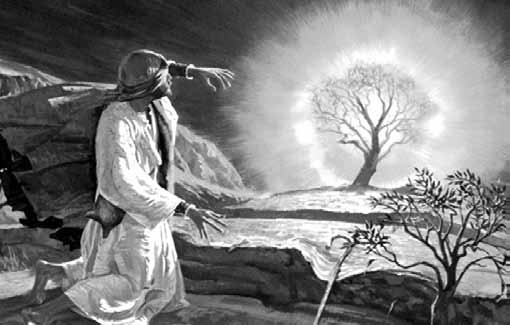
Moses at the burning bush
Jehovah’s angel called out to him, commanding that he remove his shoes because he stood on “holy ground.” Of course, since this was the “mountain of God” it must be a holy place. Moses obeyed and then God introduced himself to Moses and described his intention to free Israel from the taskmasters of Egypt. Furthermore, God intended to use Moses to do that! Exodus 3:10, “Come now therefore, and I will send thee unto Pharaoh, that thou mayest bring forth my people the children of Israel out of Egypt.”
Moses’ response to this is surprising. Instead of being excited at being chosen for this great task he said: Exodus 3:11, “Who am I, that I should go unto Pharaoh, and that I should bring forth the children of Israel out of Egypt?”
Moses basically says to God, “you have the wrong man!” He doesn’t think he is qualified for this job. We cannot get into Moses’ mind, but we wonder if his response contained a bit of fear. As far as he knew, he was wanted for murder and didn’t want to leave the peaceful life of a shepherd to face the authorities in Egypt.
But Jehovah was patient and reassured Moses that he himself would be with him and that the people would serve Jehovah upon this very mountain on which he stood.
THE NAME OF GOD
But Moses pressed the issue and raised a second problem with being selected as God’s spokesman. He said in verse 13: “Behold, when I come unto the children of Israel, and shall say unto them, ‘The God of your fathers hath sent me unto you; and they shall say to me, What is his name? What shall I say unto them?’ ”
Moses perceived this to be a problem. He felt the people of Israel would not recognize him as God’s servant; challenge his claims and reject him.
But God told him what to say if that happens, in verses 14-15: “God said unto Moses, I AM THAT I AM … Thus shalt thou say unto the children of Israel, I AM hath sent me unto you. And God said moreover unto Moses, Thus shalt thou say unto the children of Israel, Jehovah, the God of your fathers, the God of Abraham, the God of Isaac, and the God of Jacob, hath sent me unto you: this is my name forever, and this is my memorial unto all generations.”
Then Jehovah gave him even more detailed information intended for the elders of Israel. It is one thing to speak to the people, but something more to speak to the leadership. This was an appeal to higher authorities amongst the people. They were told prophetically what would happen to affect their release. Egypt would resist their efforts and Jehovah himself would smite them. However, the Egyptians would eventually plead with Israel to leave and they would be given some of the riches of the nation as a spoil, or payment, for all of the work they had done as slaves and for the houses they could not take with them.
MIRACULOUS SIGNS
Moses was still unconvinced. For a third time he drew back and worried that he would not be believed. Exodus 4:1: “And Moses answered and said, But, behold, they will not believe me, nor hearken unto my voice; for they will say, Jehovah hath not appeared unto thee.”
Again, Jehovah showed great patience and gave him some tools to convince the Israelites that God was with him. Three miraculous signs would be unmistakable proof of Moses’ authority as God’s representative.
In Exodus 4:2-9, God provided the proofs for Moses. The first sign was Moses’ rod turning into a serpent. This miracle would certainly capture the attention of the Israelites. The second sign was Moses’ hand becoming leprous and then returning to normal. Again, this would be an unmistakable demonstration of God’s power. And the final sign would be changing water into blood. Clearly, such an exposition of the power of God should sway anyone.
POOR SPEECH
Moses still tried to get out of this assignment. He offered a fourth reason not to carry God’s message to the people. This time his excuse was his poor speech. Verse 10, “Moses said unto Jehovah, Oh, Lord, I am not eloquent, neither heretofore, nor since thou hast spoken unto thy servant; for I am slow of speech, and of a slow tongue.”
We may imagine that Jehovah’s patience was starting to wear thin at this point. He made the obvious point that he is the Creator of the mouth and the ears and the eyes. He knows all about the senses and man’s ability to communicate. Jehovah cut it short and said “I will be with thy mouth and teach thee what thou shalt speak.”
But Moses’ reluctance was still evident yet a fifth time. He said in verses 13, 14: “Lord, send, I pray thee, by the hand of him whom thou wilt send. And the anger of Jehovah was kindled against Moses.” God had enough of Moses’ equivocation. He engaged Aaron, Moses’ brother, as part of a team and Aaron would speak for him.
Divine providence provided a look into the heart of Moses and has given us a picture of a man whose character grew most wonderfully. At eighty years old, Moses’ tranquil life was turned upside down and he was asked to carry a formidable load of responsibility. It seems he was truly fearful at this prospect and was clearly reluctant to go. But God knew his heart, his potential and his future. And Moses finally accepted the task and demonstrated that he was more than up to it, as time revealed.
ONE MORE ENCOURAGEMENT
It is interesting that Jehovah gave him one more encouragement, perhaps indicating the real reason for Moses’ recalcitrance. In Exodus 4:19 we read: “And Jehovah said unto Moses in Midian, Go, return into Egypt; for all the men are dead that sought thy life.” This last, unspoken concern of Moses was resolved and he went forth in confidence as the leader of God’s people.
It is always good to review the actions of God’s Ancient Worthies to draw out lessons for ourselves. Perhaps, in considering these early actions of Moses, we learn that when God has something for us to do, we should not be reluctant in doing it. As members of the consecrated body of Christ, we should be excited and zealous to take on what providence brings to us. Please note that this is not a case where we are promoting ourselves. But when providence brings to us privileges of service, we should not be reluctant, looking for reasons to defer to others. Rather, we should remember, as was brought to Moses’ attention, that our God is more than able to make up for any deficiencies we may have. The promise in Psalms 37:5 should be an encouragement for us to accept any task that Jehovah wishes us to do.
“Commit thy way unto Jehovah; Trust also in him, and he will bring it to pass.”
— Br. David Stein
[1] Jewish tradition is very definite about this day on Horeb. They believe it was Nisan 15, exactly one year before Israel left Egypt. For example see https://hebrew4christians.com/Scripture/Parashah/ Summaries/Terumah/Aliyot/aliyot.html