
Parables of Jeremiah (Continued from Previous Issue)
POTTER AND CLAY
The next parable of the earthen vessels, that of the potter and the clay, is in Jeremiah 18:1-10. Jeremiah is first directed to learn a lesson as he watched the potter at his wheel. Pottery making was a familiar industry throughout the Near East and one that Jeremiah had witnessed many times. What impressed Jeremiah the most was the absolute dominance of the potter over his clay. He also marveled at his creative skills. After watching the potter Jeremiah went on to indicate that the nation of Judah, notwithstanding its boastful strength, was as fragile as the clay. They were as subject to the will of God as was the clay to the potter’s will. In the parable, somewhere in the potter’s operation the vessel became marred, out of shape. When this happened the potter took the vessel and kneaded the clay once again, for it was still soft, not having been fired. He took the clay, placed it onto the wheel and formed it anew. “Such a vessel as seemed good to the potter to make it” (Jeremiah 18:4).
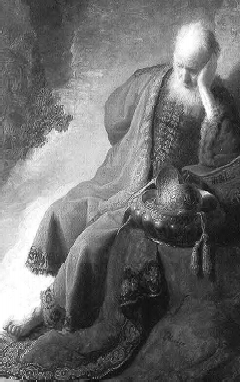
The Prophet Jeremiah
Let’s complete this reading. “Then the word of the LORD came to me, saying, O house of Israel, cannot I do with you as this potter? saith the LORD. Behold, as the clay is in the potter’s hand, so are ye in mine hand, O house of Israel. At what instant I shall speak concerning a nation, and concerning a kingdom, to pluck up, and to pull down, and to destroy it; If that nation, against whom I have pronounced, turn from their evil, I will repent of the evil that I thought to do unto them. And at what instant I shall speak concerning a nation, and concerning a kingdom, to build and to plant it; If it do evil in my sight, that it obey not my voice, then I will repent of the good, wherewith I said I would benefit them” (Jeremiah 18:5-10).
Afterward, Jeremiah was instructed to warn the people that God was framing a disaster against them. “Now therefore go to, speak to the men of Judah, and to the inhabitants of Jerusalem, saying, Thus saith the LORD; Behold, I frame evil against you, and devise a device against you: return ye now every one from his evil way, and make your ways and your doings good” (Jeremiah 18:11).
The RSV uses the word “shaping” for “framing.” This word is from the same word as “potter,” meaning to “form” or to “shape.” Jeremiah appealed to them to turn from their unrighteous ways. However, he knew what their reply would be. “And they said, There is no hope: but we will walk after our own devices, and we will every one do the imagination of his evil heart” (verse 12). “It is no use,” or “it’s hopeless,” according to the NASB translation. They would continue with their own plans and follow the stubbornness of their evil hearts, for the warnings of Jeremiah fell on deaf ears.
The message contained in Jeremiah’s symbolic visit to the potter was clear. Destruction was coming if the people did not repent. This parable teaches the sovereignty of God, like the sovereignty of the potter’s right over the lump of clay.
In this lesson of the potter we should not forget that the principle of “a free moral agency” still applies. In all this, God does not interfere with the free will of those of the Jewish nation or of mankind. He uses his knowledge of mankind and their sinful tendencies to accomplish his purposes.
God could do what he wanted to with Israel. However, the teaching of the parable shows the forgiveness of the Creator and also his long patience. The potter might have thrown away the marred piece of clay, but instead he continued to work with it and mold it into a desirable shape. God could have made a permanent break with Israel the first time they violated his commandments, but instead he continued to bless them and chastise them and work with them through many centuries in order to make of them a people who will bring honor and glory to his name.
It should be kept in mind that at one time Babylon had not fallen from divine favor, despite the mixed character within and the great mass of doctrinal error she accumulated over the centuries with her moral decadence. She manifested none of the spirit of Christ. But she was not rejected from favor until the appointed time. “Babylon hath been a golden cup in the LORD’s hand, that made all the earth drunken: the nations have drunken of her wine; therefore the nations are mad … We would have healed Babylon, but she is not healed: forsake her, and let us go every one into his own country: for her judgment reacheth unto heaven, and is lifted up even to the skies” (Jeremiah 51:7, 9).
In the parable of the wheat and the tares in Matthew 13, when the servants had discovered the tares among the wheat, they asked of the master, Matthew 13:27-29, “Sir, didst not thou sow good seed in thy field? from whence then hath it tares? He said unto them, An enemy hath done this. The servants said unto him, Wilt thou then that we go and gather them up? But he said, Nay; lest while ye gather up the tares, ye root up also the wheat with them.” We believe this event occurred during the period of the Reformation. But the Lord withheld the servants from doing anything to the system, Babylon, saying “let both grow together until the harvest” (verse 30).
BROKEN BOTTLE
Let us consider the third in this series of parables regarding the earthen vessels. Jeremiah 19:1-19 discusses the parable of the broken bottle. In the parable of the potter, there is the thought of construction. The marred clay, still soft, could be reshaped into a desirable form. In this parable, the evident theme is that of destruction.
Israel was so confirmed in sin and rebellion against the Lord that she seemed to be beyond any hope of recovery. Remolding was impossible, and being unfit for its designed use, there was no other course but to destroy it. What a solemn, striking symbol of Israel’s inflexibility, which resulted in the breaking up of her nationality, polity and religious system!
The “ancients” who were called to witness the acted out parable were the elder statesmen of the people and the priests, representatives of the civil and ecclesiastical rulers. “Thus saith the LORD, Go and get a potter’s earthen bottle, and take of the ancients of the people, and of the ancients of the priests” (Jeremiah 19:1).
Now notice where they went for the divine denunciation, into the valley of Hinnom. “And go forth unto the valley of the son of Hinnom, which is by the entry of the east gate, and proclaim there the words that I shall tell thee” (verse 2). This was the very place where their fathers had practiced the most abominable form of idolatry. Tophet was the center of the sacrifices made to the idol Molech (2 Kings 23:10). This place of degradation was witness to the retribution and destruction of Judah which was to come shortly. Listen to Jeremiah’s words that he received from the Lord to read to the people, from Jeremiah 19:3-6. “And say, Hear ye the word of the LORD, O kings of Judah, and inhabitants of Jerusalem; Thus saith the LORD of hosts, the God of Israel; Behold, I will bring evil upon this place, the which whosoever heareth, his ears shall tingle. Because they have forsaken me, and have estranged this place, and have burned incense in it unto other gods, whom neither they nor their fathers have known, nor the kings of Judah, and have filled this place with the blood of innocents; They have built also the high places of Baal, to burn their sons with fire for burnt offerings unto Baal, which I commanded not, nor spake it, neither came it into my mind: Therefore, behold, the days come, saith the LORD, that this place shall no more be called Tophet, nor The valley of the son of Hinnom, but The valley of slaughter.”
Here is an important picture and lesson that Christendom failed to acknowledge. It is a lesson they have chosen to completely ignore. This is verse 5, “Which I commanded not, nor spoke it, neither came it into my mind.” This Scripture teaches that the doctrine of everlasting torment is contrary to every element of God’s character. “Then shalt thou break the bottle in the sight of the men that go with thee, And shalt say unto them, Thus saith the LORD of hosts; Even so will I break this people and this city, as one breaketh a potter’s vessel, that cannot be made whole again: and they shall bury them in Tophet, till there be no place to bury” (Jeremiah 19:10, 11).
At the appointed time the Lord will regather the fragments of Israel and fashion them into a vessel of greater honor, according to the Apostle Paul in Romans 11:26, 27. “And so all Israel shall be saved: as it is written, There shall come out of Sion the Deliverer, and shall turn away ungodliness from Jacob: For this is my covenant unto them, when I shall take away their sins.”
REMAINING PARABLES
There are four remaining parables, listed here but not examined in detail. The seventh parable was that of the Two Baskets of Figs (Jeremiah 24:1-10). The next, The Cup of Fury (Jeremiah 25:15-38). The ninth parable was The Bonds and Yokes (Jeremiah 27-28). Then last, the tenth, was the parable of the Hidden Stones, Jeremiah 48:8-13.
— John Trzyna, 1988