
The Voice of the Lord (Psalm 29)
David in his palace in Jerusalem observes and vividly describes a severe thunderstorm as it sweeps across the entire land of Palestine from Lebanon in the north to the south of Israel. Floods from such storms cause considerable damage in the Biblical lands. Sometimes it may not rain for two or three years, but when it does, it turns into a deluge, destroying the fields, washing away the soil, drowning both man and beast unfortunate enough to be in the path of the violent storms.
Although a literal storm is described, our interest is in the symbolic meaning of this picture prophesying the great time of trouble with which this age will end. Other prophets and apostles describe the same event, each from a unique viewpoint, presenting us with a panoramic picture; some stressing how this trouble begins, still others the glorious results after the storm ends.
We first hear a low, distant murmur of an approaching thunderstorm. It breaks its full fury upon Mt. Lebanon in the northernmost part of the land, then continues over to Mt. Hermon. The famed cedars sway to and fro before the wild fury of the storm. Each stroke of lightning is accompanied by a loud clap of thunder. The storm passes southward over the heavily populated area of Galilee and Samaria. It passes over the capital city Jerusalem, then moves further south to the desert of Kadesh, finally expending itself in the rock-hewn cities of Petra. The wild beasts are stricken with terror. The forests are stripped of their leafy dress. Rain water drenches the land filling the low places and filling the usually empty creek beds to overflowing.
GIVE UNTO THE LORD GLORY
“Give unto the LORD O ye mighty, give unto the LORD glory and strength” (Psalm 29:1). “Mighty ones” would be better rendered “sons of the mighty,” or “sons of God.” Rotherham in his translation says “ye sons of the Mighty God.” As the storm forms, it is these mighty ones, these sons of God who give unto the Lord or ascribe unto the Lord the glory and the strength.
The day of Pentecost began the new creation, depicted by the Psalmist in our verse as the “sons of God.” This most distinguished day in the history of the Gospel Age church, focuses on those events that occurred in that upper room. These events were as a result of the redeemer appearing in the presence of God as the high priest offering to the father the merit of his sacrifice that had been finished at Calvary 50 days previous. This offering was accepted fully.
As a result, the apostles and disciples who were waiting were now recognized as “sons,” being sealed by the holy Spirit of adoption1 (Romans 8:15). It was appropriate that such an important matter be clearly demonstrated by an outward sign as we see in Acts 2:3, 4: “And there appeared unto them cloven tongues like as of fire, and it sat upon each of them. And they were all filled with the Holy Spirit, and began to speak with other tongues, as the Spirit gave them utterance.”
The same was true later when the gospel went to the Gentiles. We find a similar manifestation of God’s acceptance shown by an outward sign. Again, this was so that there could be no mistake that the word now had gone to the Gentiles and they likewise would be accepted in the Beloved (Acts 10:44-47).
The liberty to become sons of God did not extend to anyone who lived before the redeemer came into the world to die for them and it has extended to relatively few during this Gospel Age. Even under the enlightenment of present day conditions, the great mass of mankind know nothing about the Lord Jesus and could not believe on him whom they have not heard (Romans 10:14).
Of those that have heard, a small percentage believe in him and have the privilege of becoming sons of God, for only the consecrated are the “sons of God.” “For as many as are led by the Spirit of God, they are the sons of God” (Romans 8:14). This, then, is the class which ascribes this storm to the Lord, a class which grows smaller and smaller as the impending storm approaches.
THE COMING STORM
“Give (ascribe) unto the LORD the glory due unto his name; worship the LORD in the beauty of holiness” (Psalm 29:2).
All the consecrated need ask: Have we given God all of the glory due Him? Or, in our successes and accomplishments have we neglected this important injunction and given ourselves the credit instead? As we scrutinize our lives, we will find that perhaps here and there we have given ourselves some of the glory when we should have been giving all of it to God. We know that we have deserved none of it. In “ascribing” the glory to God, we realize that excepting those in the days of the Lord and the Apostles, we have received more than others during the age. We should be thankful for this.
The phrase, “worship the LORD in the beauty of holiness” should better be “in holy adornment” or “in holy attire.” This expression reminds us of the dress of the high priest in the Tabernacle after he had put on the garments of glory and beauty. This “beauty of holiness” is a present condition, referring to the fruits and graces of the holy Spirit that we gradually attain as they are developed in our Christian walk. Additionally, these holy garments refer to the robe of Christ’s righteousness which is given to each of the saints. Worship means to bow self down and anyone in such a prostrate position is in a humble, submissive spirit, waiting on the Lord for his leadings.
Now we have the setting. And now the storm is about to break.
SEVEN THUNDERS
Of particular note, in this Psalm the expression “voice of the LORD” is mentioned seven times. Strong’s Concordance (S.6963) defines this as “to call aloud, a voice or sound.” Other concordances carry more forceful definitions such as “tumult,” “thunder,” or “roll of thunder.” To the children of Israel it was the only descriptive force of nature that would adequately describe the utterances of the Lord and all of their experiences when he led them in the wilderness. In Job 37:1-5 we have a vivid description associating the voice of the Lord with thunder: “At this also my heart trembleth, and is moved out of his place. Hear attentively the noise of his voice, and the sound that goeth out of his mouth. He directeth it under the whole heaven, and his lightning unto the ends of the earth. After it a voice roareth: he thundereth with the voice of his excellency; and he will not stay them when his voice is heard. God thundereth marvelously with his voice; great things doeth he, which we cannot comprehend.”
Thunder, throughout the scriptures, is an expression of the wrath of God against a transgressing people. It is a voice of divine indignation about to be launched upon a guilty world.
The mention of seven thunders links us to the seven thunders of Revelation 10:1-4. The seven denotes completeness; the seven thunders are the complete and final judgment thunders. So terrible were the judgment thunders that John was commanded, “Seal up those thing which the seven thunders uttered, and write them not.” The lesson here is that the John class is to escape the full effect of the judgment thunders by being taken away before the severe phase begins. This is why it says, “write not” the effect of these thunders. It is a promise that the church will not hear them, so there would be no purpose in writing them.2
FIRST THUNDER – UPON THE WATERS
“The voice of the LORD is upon the waters, the God of glory thundereth: the LORD is upon many waters” (Psalm 29:3).
As the literal storm begins to sweep the land of Palestine, it first comes over the Mediterranean. The expression “many waters” or “great waters” has reference to the Mediterranean Sea. It provides the main ingredients for the storm, the water, the moisture. The sea is turbulent as the winds sweep over it. Here we have two symbols – water and thunder. Restless waters or turbulent waters are figurative of troubles or unstableness. Note Genesis 49:4, “Unstable as water.” Regarding thunder, our Pastor in an early Reprint article suggested thunder could represent controversy.
So putting these two ingredients together – controversy and troubles – we have a picture of what would precipitate the great time of trouble. Surely in our day we have seen the results of the restless masses and the ceaseless controversy.
At the same time, “the many waters” aptly describes the various groupings of these restless masses all combining together in the common bond of dissatisfaction.
There appears to be another picture intertwined here, a third ingredient. Waters, as we know, are also symbolic of truth, truths along every line, but especially along religious lines. When truth is added to these systems, it causes controversies. As an example, Luther bringing forth the doctrine of justification by faith caused a controversy in the Papal system which spurred on the Reformation. Now we have the combination of restlessness, of instability among the religious and social elements setting off the great time of trouble.
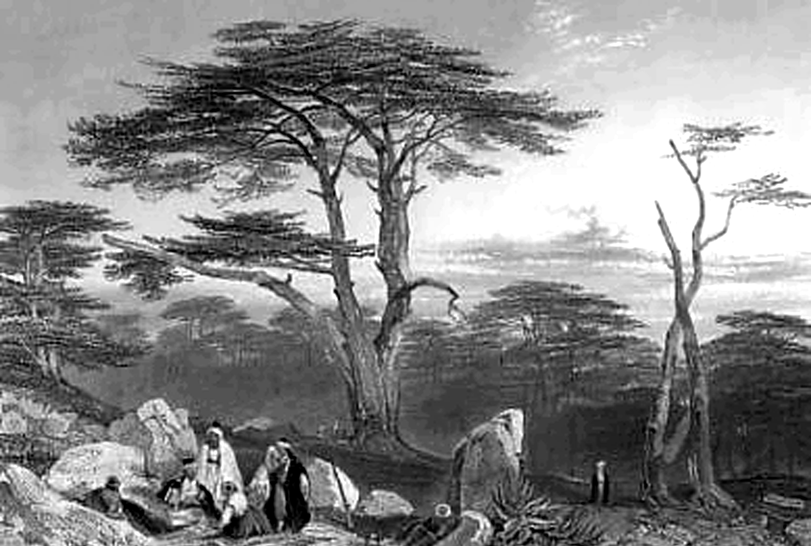
The Cedars of Lebanon
SECOND & THIRD THUNDERS – POWER & MAJESTY
“The voice of the LORD is powerful, the voice of the LORD is full of majesty” (Psalm 29:4).
A proper consideration of God’s power and majesty in the thunder and the lighting is enough to both appall, and to fill each heart with devotion and humility. For who cannot appreciate this simple expression of the greatness of God in these natural exhibitions of His forces?
FOURTH THUNDER – BREAKING THE CEDARS
“The voice of the LORD breaketh the cedars: yea, the LORD breaketh the cedars of Lebanon” (Psalm 29:5).
In David’s prayer of thanksgiving after he assembled all the materials for the building of the temple at Jerusalem, he spoke about the Lord’s power and majesty (1 Chronicles 29:11, 12). The account is an expression of David’s love for the house of God, the temple, which was left to his son, Solomon, to build. And we can see from the record that David put every fiber of his being into the assembling of the various materials that were required for the construction of the temple. At the same time, he had raised the worship of Jehovah which had reached a low ebb during the reign of Saul – he raised it to a greater level of zeal and devotion to the worship of the true God.
Our devotion and zeal likewise should be to help and to complete the antitypical temple of God. As David proceeded at an accelerated pace, we must proceed in haste in this respect to complete the antitypical temple before the trouble, the great storm of Psalm 29, overtakes the sower of seed.
Now that this moisture had driven across the land of Palestine, it begins to rise and comes over the mountain ranges on the east. The storm precipitates. “The voice of the LORD breaketh the cedars, yea, the LORD breaketh the cedars of Lebanon.” The first area to receive the fury of the storm is the cedar forest of Lebanon.
The cedars of Lebanon were huge and magnificent trees standing tall and erect. This is symbolic of the great ones of the earth, especially the great ones of ecclesiasticism, the leaders of Churchianity. They stand erect, unwilling to bend to the influx of truth that has come in to the world since the second advent of our Lord. They remain steadfast in their beliefs of the immortality of the soul, the doctrine of eternal torment, the trinity, the concept of the single salvation and so forth. And they are the first object of the Lord’s wrath. “He breaketh the cedars of Lebanon.” He will break them from their office of outward dignity and worldly esteem.
The same scenes occur on a slightly smaller mountain, Mt. Hermon. Although Mt. Hermon from the distance appears as one peak, when one reaches the top, he finds three peaks. Mt. Hermon could aptly picture Protestantism, since they also adhere to the doctrine of the trinity. Its force is similar to Mt. Lebanon being covered with magnificent cedar forests.
SKIPPING LIKE A CALF
“He maketh them also to skip like a calf; Lebanon and Sirion like a young unicorn” (Psalm 29:6).
The waiting of the mountain forest before the storm is expressed by the figures of skipping or leaping. Heavy winds sweeping across a forested area has this effect. The two mountains mentioned are Lebanon and Sirion. Sirion here is Mt. Hermon as in the previous verse – the Sidonian [Deuteronomy 3:9] name for that mountain. Geographically, it is located in the southernmost range of the Lebanon range. This skipping, or leaping of the calf is on Mt. Lebanon, while the “young unicorn” is on Mt. Hermon, or Sirion.
A unicorn is a young, wild ox. So herein is contained another picture of the same event pertaining to ecclesiasticism as described in the previous verse respecting the cedars. As the gust of winds sweep across these two forested areas, the trees sway in unison resembling a young calf leaping on Mt. Lebanon and a young wild ox on Mt. Hermon.
Why the two different animals? A calf is a domesticated animal, easy to control, and would aptly picture Catholicism and their settled, orderly ways of the past centuries. We find in the past few years, that the church has started to come apart at the seams, coming apart from within.
On the other hand, a young wild ox is free to roam as it pleases. And this pictures Protestantism with her coarser and unsettled ways constantly dividing and splitting until today we have thousands of Protestant religious groups. The calf is associated with Lebanon, the wild ox with Mt. Hermon. This picture impresses the dual nature of the destruction of the two systems in the great time of trouble, they are the Lord’s first target.
And the scriptures abound with various illustrations and pictures and symbols and types of Babylon, so-called Christianity. Perhaps the most vivid description is portrayed in Revelation 18:21: “And a mighty angel took up a stone like a great millstone, and cast it into the sea, saying, ‘Thus with violence shall that great city Babylon be thrown down, and shall be found no more at all.’ ”
Notice the decisive finality of this destruction. No more will Babylon grind out the creeds of error that have deceived the nations and people these long centuries. Babylon shall be found no more at all. There would be no vestige of the systems left. It will be complete, everlasting destruction; the millstone will never be recovered. And this destruction will come suddenly, in one hour (Revelation 18:17).
FIFTH THUNDER – DIVIDING THE LIGHTNING
“The voice of the LORD divideth the flames of fire” (Psalms 29:7).
The fifth voice of the Lord is spoken of as “dividing” the flames of fire. This is a reference to the forks of lightning as they zigzag across the sky. This language is similar to Psalm 77:18: “The voice of thy thunder was in the heaven: the lightnings lightened the world: the earth trembled and shook.” Together these two scriptures present a very convincing figure.
In the midst of the perplexity and gloom of the great time of trouble, men on occasion catch a glimpse of certain principles of truth. This truth is in marked contrast to the darkness of error about. A flash here reveals the truth along one line of human thought or endeavor. Another flash reveals the error and corruption in the various governments at all levels and the dishonesty in high places. The flashes of lightning are continually calling attention to the word of God, to the concept of equal rights and privileges among men. We see now the deepening cloud of trouble; we hear the rising tones of the judgment all about us. We see the lightning flashes of truth and righteousness as they criss-cross the skies and observe how the entire world is in the shaking process, which eventually will overthrow all the existing institutions, systems and governments.
Our task in all of this is to watch and pray, “Let us therefore fear, lest, a promise being left us of entering into his rest, any of you should seem to come short of it” (Hebrews 4:1). Our course of conduct should be so marked in contrast to the world’s conduct in this difficult period ahead as these judgments approach. How we must exercise the greatest of caution that we can make our calling and election sure, not becoming involved in any of the clamor. The lightning and thick darkness in this Psalm reminds us of the time when the Law Covenant was inaugurated. Thus in a similar way the New Covenant will be inaugurated as a result of this symbolic storm.
SIXTH THUNDER – SHAKING KADESH
“The voice of the LORD shaketh the wilderness; the LORD shaketh the wilderness of Kadesh” (Psalm 29:8).
In the Fourth Volume, Bro. Russell suggests the thought of the trouble and distress coming upon three distinct groupings. First upon Christendom, next upon the nations of the world in general, and as a final blast upon the peoples of Israel regathered in Palestine, that we generally refer to as “Jacob’s Trouble” (Jeremiah 30:7). The storm sweeps over three distinct geographical groupings. First, it sweeps over the mountainous regions of Mt. Lebanon and of Mt. Hermon, which we believe symbolizes ecclesiasticism. Second, in the central area of Palestine which contains the bulk of the country’s population, it would represent the civil and social orders of mankind. Lastly, Kadesh to the south would represent the nation of Israel. The wilderness of Kadesh was located at the south of the Promised Land; it would be identified today with the Negev [meaning, South]. It was in this land that the Israelites encamped twice with the intention of entering the promised land, but they were turned back both times by the Lord. It was in Kadesh that the spies were sent out to spy out the land.
The place-name “Kadesh” (S.6946), or “Sanctuary,” in the earliest times was called the “Fountain of Judgment,” as noted in McClintock and Strong’s Cyclopedia. Note the harmony, for the climactic phase of “Jacob’s Trouble” will be the last judgment of the “Fountain of Judgment” before the troubles are over and the kingdom proper begins.
The word “shaketh” (S.2342) in this verse means to “whirl,” or “twist.” As the gigantic storm sweeps into the hills of chalk and drifting sand on the western edge of the great Arabian desert, it sets off a whirlwind, the type of fierce storm that smote Job’s sons and daughters. Looking at this same end-time period, Jeremiah describes a whirlwind, a fitting picture of anarchy in “Jacob’s Trouble,” this way: “Thus saith the LORD of hosts, Behold, evil shall go forth from nation to nation, and a great whirlwind shall be raised up from the coasts of the earth” (Jeremiah 25:32, see also Jeremiah 30:23-24).
SEVENTH THUNDER – MAKING THE HINDS TO CALVE
“The voice of the LORD maketh the hinds to calve, and discovereth the forests: and in his temple doth every one speak of his glory” (Psalm 29:9).
Animals have a particularly rough time in severe thunderstorms. They are terrified. As a result, we see an animal born in our description here in this Psalm. Symbolically this would be the last thunder that will cause the birth of the new order and will usher in the New Covenant.
Together with the birth of an animal, the seventh voice “discovereth the forests.” This expression “discovereth the forests” means the storm’s severity strips the forest bare. Young’s translation says the storm not only strips away the leaves and the foliage from the trees but also removes the bark; this would cause the death of the tree. In symbolism, trees frequently are symbolic of nations. The Lord is telling us that near the conclusion of this symbolic storm, the destruction of the nations will occur in order to make way for the new kingdom, the new animal that is born.
The storm is over. The time of trouble has ended and now we read, “and in his temple doth every one speak of his glory.”
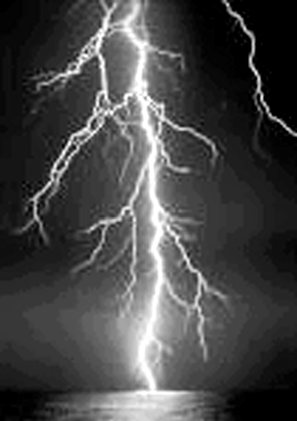
The voice of the LORD upon the waters
THE BLESSING OF PEACE
“The LORD sitteth upon the flood; yea, the Lord sitteth King for ever. The Lord will give strength unto his people; the Lord will bless his people with peace” (Psalm 29:10-11).
The passing away of the present symbolic heavens, or ecclesiastical powers, will give place to the spiritual control of the new heaven – the Church in Glory. The passing away of the present social order will give way to the “New Earth wherein dwelleth righteousness” (2 Peter 3:13), when “times of refreshing shall come from the presence [face] of the Lord” (Acts 3:19), bringing in, “the desire of all nations” (Haggai 2:7).
As the Psalm began with praises to Jehovah, of His glory, so it ends with everyone speaking of His glory. He is still in control, just as He was during the great flood when the first world passed away. As the voice of the Lord sounds at first and the thunder of the Psalm causes all things to shake, at the end it vanishes softly away in quickening drops of the words, as He blesses His people with peace.
– Bro. John Trzyna
(1) Galatians 4:2-5 uses “adoption” to mean the installation of a son into the position of family responsibility.
(2) Editor’s note: Some brethren consider the seven last plagues to harmonize with these thunders and believe that the church does indeed hear them.