
Pergamos, a “Mixed Marriage”
“To the angel of the church of Pergamos write; These things saith he which hath the sharp sword with two edges” (Revelation 2:12).
When we look at our brethren’s trials throughout the Gospel Age it truly is a cause for reflection, encouragement, and thanksgiving for their faithfulness. While the golden candlestick representing the church is beaten from one piece of solid gold, Revelation consistently speaks of seven churches, seven seals, seven trumpets. These seem to refer to subsequent periods of development in the church during the Gospel Age and within each of these periods we want to align —
(1) the message to each church directed to those who are in covenant relationship and the household of faith,
(2) the seal, or insight into the heavenly father’s plan enlightening the church in that period in some ways similar to the outside view the Israelites had outside Jericho; and
(3) the trumpet which is something that the world hears and reacts to during the historical period in some ways similar to the inside view of those who suffered the judgment of Jericho (Ezekiel 2:10, Zechariah 5:1-4). This is especially true for a particularly problematical church, the church of Pergamos, the third stage of the church. (Revelation 2:12-17)
The route followed through the seven churches in Asia Minor exhibits a distinct pattern making a clockwise circuit starting with Ephesus at the southernmost point. Pergamos is the furthest church north, a symbol of elevation, and indeed of pride when we think of Isaiah 14, where the adversary says, “I will ascend to the parts of the north, I will be like the most high.”
By nature Pergamos was fitted to be a royal city. It was planted at the foot of a magnificent, fortified rocky hill one thousand feet high, dominating the broad Valley of the Caicus River. A very impressive site with a strange name since Pergamos means “mixed marriage.” This name is fitting because there was a “mixed marriage” confronting the third church.
ROMAN POLICY AND THE CHURCH
The church was elevated by the state beginning with the startling reversal of Roman policy towards the church under Constantine in 313 AD. This was followed by the epoch-making Nicean Council (325 AD) and Arius’ futile defense of sound doctrine on the nature of Christ.
Emperor Theodosius in 380 AD published the “Edict of Thessalonica” (decree Cunctos populos, Codex Theo- dosianus xvi.1.2) in order that all Roman subjects should profess the faith of the bishops of Rome and Alexandria (i.e., the Nicene faith). Then in 381 AD, Theodosius summoned the First Council of Constantinople to repair the schism between East and West on the basis of Nicean orthodoxy. At the same time the state now worked to suppress the old pagan state religion of Rome.
The Council of Chalcedon (451 AD) was convened by Emperor Marcian, with the reluctant approval of Pope Leo the Great, it marked a significant turning point in the Christological debates. The bishop of Rome boldly asserted his claim to authority, Pope Gelatius writing (494 AD): “Two powers are there, O Emperor, by which in chief this world is ruled: the sacred authority of Pontiffs, and the royal power. And in these two the weight of the Pontiffs is in so far the heavier, in that they will have in the judgment to render an account to the Lord even for kings themselves.” Such were the inflated boasts.
THE CODE OF JUSTINIAN
Justinian, Emperor from 527 to 565 AD, one of the outstanding legalists of all time, set forth a legal code (529 AD) that organized the best Roman wisdom for how to handle civil matters in simple language. Many of elements of this code continue in both U.S. and all European-based laws today. It appears as though the first ten amendments to the US Constitution, or “Bill of Rights” (1791 AD), were directly addressing and undoing elements of the Justinian code. Since the church was an extension of the state, there were laws regulating church meetings, monasteries, the marital status of bishops, and so forth.
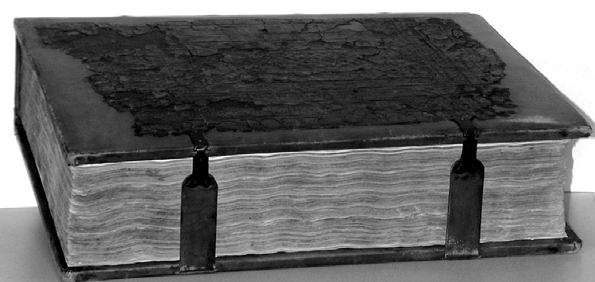
Justinian Code Codex from 1475
The church’s link to the state and further advances in this union were particularly marked in 539 AD. This unholy union is called “fornication.” The ambition to commit spiritual fornication was there earlier, but the Eastern Roman state of Byzantium could not yet formally recognize the Pope. The Pope lived in Rome, a city occupied by a hostile army. For more than a century since the fall of Rome in 410 AD Italy had been brutalized, raped, pillaged and left to decay. Rome’s liberation came from General Belisarius who reconquered the city, and then all Italy from the Ostrogoths in 539 AD. Can we imagine the joy at this liberation? And yet, this rescue made the “mixed marriage” a reality.
Legal rights under Roman law were of the highest importance and Justinian, the legalist, played a crucial role in the advancement of the “mixed marriage.” In 539 AD three very important rights were granted to the church in “Novella” added to the legal code. In March 539 Novella 79 was issued: “only bishops can judge in legal proceedings against members of the church hierarchy, civil authorities are excluded” (S.P. Scott, translator). Justinian’s finely-tuned legal mind added a refinement (Novella 83) in May 539 holding that the church would not have civil magistrates to hear about internal problems “under any kind of circumstances.”
The Roman Catholic Church today still operates as though Justinian’s Code were in force. However, today the laws have changed and today the civil authorities are interfering. These were two important legal rights that set the church above the state permitting it to operate with power and authority. One other important development (Novella 86, April) permitted the bishops to serve as a court of appeals when “the illustrious provincial governor had examined a matter and come to a conclusion that seemed unjust.”
POPE AND THE PATRIARCH
The Patriarch at Hagia Sophia in Constantinople may have hoped that he was going to be the head of the Catholic, or “universal” church. But the liberation of Italy advanced Virgilius, the bishop of ancient Rome, and de facto the Pope became the Pontifex Maximus, or “Chief Religious Ruler.” Novella 131 (545 AD), was the crowning achievement for the Papacy’s ambitions. The inflated language reads: “We order that the Most Holy Pope of ancient Rome shall hold the first rank of all the Pontiffs, but the Most Blessed Archbishop of Constantinople, or New Rome, shall occupy the second place after the Holy Apostolic See of ancient Rome, which shall take precedence over all other sees.”
ABOMINATION THAT MAKES DESOLATE
We recognize 539 AD as a setting up of both “the abomination that makes desolate,” and the historical elevation of the Papacy. “Pergamos embraces the transition period during which the Papacy had its rise” (R5992, here the authorship is likely to be Bro. Russell and Bro. Clayton Woodworth). In this article Pergamos is demarked by 313 AD and the beginning of the 1260 “days” or years. Papacy assuming civil power is an important part of “the great abomination of desolation whose foundation rests on the doctrine of the Mass” (Volume 4, page 572). During Pergamos there was the triumph of Trinitarian dogma (R5749), a dogma that negates the logic and justice of the ransom — a perfect human life for a perfect human life.
“Where Satan’s seat is,” seems to be a reference to Rome and the office of Pontiff.
“Antipas” called “my faithful martyr” is a familiar name for “Anti-Patris.” Patris is “Father.” Anti, meaning “in place of,” was used for Herod Antipas who succeeded Herod the Great. The Antipas message seems to be, “No. Setting aside the apostles and putting forward the church hierarchy, calling yourselves fathers, is not scriptural.” No single specific historical figure will be set forth as this faithful martyr although there are some visible dissenters and some positive forces such as Patrick, the bishop of Ireland, who were active during this period. Jesus says, “I have a few things against thee,” which should make us reflect on the Lord’s grace and love. Because one could think there should be a lot of things that the Lord could have against them.
The doctrine of Balaam who taught Balac to cast a stumblingblock before Israel is found in Numbers 22-25. This was when the men of Israel committed fornication, sacrificing and eating the offerings to the idols of their Moabite consorts. In antitype this is involvement in politics seeking approval from those not in covenant relationship with God. The offerings to idols may well be the Mass in antitype.
Nicolaitanes has the thought of “the people being victorious,” hence the popularity of the name. It sometimes is held to mean just the opposite, “victorious over the people” a very different thought, but if that were the meaning, it seems the name would hardly prove to be popular. During this era, the church advanced its position gaining advantage in policy with the state through the use of mob action, “the people being victorious” (see Peter Sarris, An Age of Saints? Power, Conflict and Dissent in the Early Medieval Christianity, Brill, 2011). Inciting change in government policy through religiously inspired mob action continues today throughout the Islamic word.
DAYS OF DANIEL
539 AD marks the beginning of reckoning Daniel’s abomination which makes desolate. Our Lord said it was in the future from his day (Matthew 24:15). We find that there is a formula that the scriptures use. One “day” in prophetic use means one year. And there are three periods referred to in Daniel, although 1260 (30 times 42 months) appears several times in Revelation. The 1260 links to the ministry of Elijah in proclaiming the great drought. Daniel also points to 1290 and 1335 days.
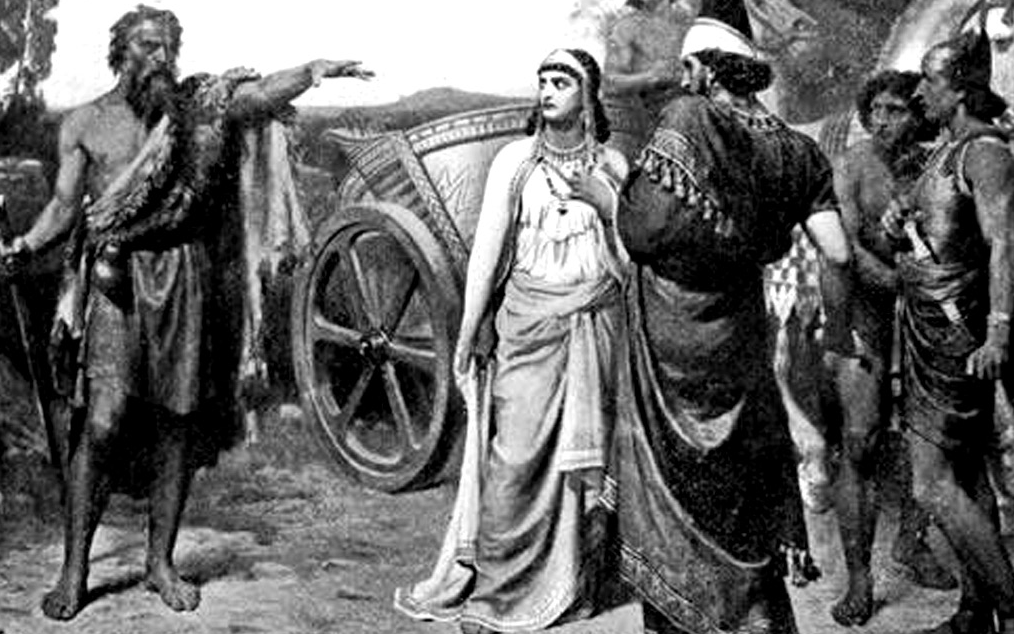
Ahab and Jezebel, rebuked by Elijah
These periods prophetically point to the dates 1799 AD, 1829 AD, and 1874 AD. The 1260 fulfillment is very clearly marked. This refers back to the condemnation of Elijah proclaiming drought and confronting Ahab and Jezebel, Ahab’s wife from Sidon. Ahab and Jezebel are a mixed marriage that brought in the worship of Baal (1 Kings 16:31). One can see how appropriate that was during this time, when the whole question of this intermixing of church and state was the question on which the church had to be faithful. Under that old order, the church crowned the kings. But what happened in 1799?
Rome had been re-occupied by Napoleon’s troops and on February 15, 1798 — on the anniversary of his elevation to the pontificate, Pius the 6th repaired to the Sistine Chapel, and was receiving the felicitations of the Sacred College of cardinals, when, in the midst of the ceremony, shouts penetrated the conclave, intermingled with the strokes of axes on the doors. Soon General Haller, a Swiss Calvinist, with a band of his soldiers, broke into the chapel, and declared that the pope’s reign was at an end. In 1799 Pius the 6th died in captivity.
To be clear, Pius the 6th was not the first pope imprisoned by a king. There is a long list of Popes who have been imprisoned. What was different about this pope going to prison was that a new way of thinking had emerged. In the past the thinking was, “This is a bad pope. We are going to throw him into prison and put in a good pope.”
That was not the thought of the French revolutionaries. They were ready to throw out every vestige of religion and thus the papacy was abased in the fall of the 10th part of the city (Revelation11:13) this is a reference to the great revolution — earthquake — in France that ushered in this new world order. Modern men like Napoleon did not embrace religion. Men of this new age were looking for civil government based only on reason and law.
The year 1829 AD is a time of importance to the true church, not to the world, because the world did not perceive what was happening in 1829 which begins the Cleansing of the Sanctuary. We link both the cleansing of doctrinal errors and the virgin class who were looking for the second coming of the Lord, trimming their lamps. The ministry of Bro. William Miller and many others both in North America and the European Continent, needs to be acknowledged here. And of course, 1874 AD, the end of 1335 days marked the parousia and Michael standing for Israel, the promise of earth under a new dominion.
THE THIRD SEAL
In the third seal (Revelation 6:5-6) appears a horse-man carrying balances. The cost of grain for a starvation diet was a “penny,” one day’s wage for a day laborer. This links back to Elijah the prophet proclaiming drought and condemning the mixed marriage of Ahab and Jezebel. The church, the antitypical Elijah, declared a drought for hearing the word of the Lord. To get the word of the Lord during this period required a lot of effort.
Barley symbolizes Jesus (Leviticus 23:10-12, 1 Corinthians 15:20); if you were supporting a family you had to suffice with this lower-priced, but earlier-harvested grain, to stay alive. This may suggest that in the place of the mature doctrines, Christian experience, understanding, and believers themselves, symbolized in the higher- priced wheat, are a crop that would take the whole Gospel Age to ripen, the joyful first-fruit doctrines of salvation through Jesus were to be meat in greater measure.
Revelation 6:6 reads, “see you hurt not the oil and the wine.” The Lord promised that the holy Spirit (the oil) and the joy of life in Christ, the Gospel, Christian experience coming out of its teachings (the wine), would not be touched. That was secure.
What kind of saints came out of this period of time? It was a time when every doctrinal authority spoke against sound doctrine, had the power of life and death, and they used it. A time when the ability to read and write were highly-skilled talents. A time when there was economic collapse and chaos. A time when there was no security against marauding bands. A time when a new invader could appear without warning. All of this was part of everyday life.
Saints very dear to the Lord came out of such trials. This appears to be why they are pictured by the black horse, which reminds us of those black horses (Zechariah 6:6) who went to the north part, the heavenly realm, and comforted the Lord.
THE THIRD TRUMPET
The trumpet linked to this third stage sounds in Revelation 8:10-11. Wormwood, as a symbol, may picture the bitterness that we bring on ourselves (Deuteronomy 29:18) which fits well with judgment on this false church system. Wormwood also pictures the judgment that the Lord forces erring ones to drink (Jeremiah 23:15).
At first it might seem that the mixed marriage and elevation of church by the state should suggest identifying Wormwood with Papacy. However, there is a problem with this. Wormwood is medicinal. It gets its name from curing intestinal worm parasites. The Egyptians and Greeks used wormwood as an antiseptic, a stimulant, a tonic, a remedy for fevers, rheumatism, anemia, and menstrual pains. Today wormwood, Artemisia Annua, is used as a low cost effective treatment for malaria, replacing costly Quinine bark.

A great star falling from heaven
“A great star from heaven” symbolizes both inspired and false teachers (Volume 4, pages 591, 593). We see this in Isaiah 34:4, “All the host of heaven shall be dissolved, and the heavens shall be rolled together as a scroll.” It seems that these stars, “host of heaven,” refer to false teachers. But the next symbol is a critical one for identifying this star, “burning as it were a lamp.” In Revelation we want to be very careful on the word details and the little nuances. A Lamp is scripture in antitype (Volume 3, pages 92-93). But, as it were a lamp suggest false scripture.
THE THIRD PART
This lamp falls upon the third part of the waters. Guidance for understanding this symbol appears in Leviticus. When a sacrifice was presented, it served for food for the first and second day only (Leviticus 19:7, 7:17,18, 19:6). The scriptures are clear. That which was not consumed in service and worship of God during this acceptable time became an abomination. Thus in Leviticus 19:7, “And if it be eaten at all on the third day, it is abominable” and then the whole sacrifice is not accepted. Hence, the third part does not mean one-third. It does not mean 33%, in fact it could be as high as 100% if it is not being used in the Lord’s service and consumed before that third day. The third part means — that which remains unconsumed in God’s service after the acceptable time.
“Falls upon the rivers and upon the fountains of water.” R499 suggests that “Running waters symbolize truth. The river channels through which water (truth) has flowed, symbolize the various sects or denominations.” Hence, these are not all truth waters. This is water that has problems. That is why the judgment of wormwood comes. Who are these false fountains and where did they issue from?
Opposition to sound doctrine began in the Apostles’ days as noted by Paul in his reference to “false brethren” (2 Corinthians 11:26, Galatians 2:4). John had Diotrephes not receiving him (3 John 1:9). Peter writes, “But there were false prophets also among the people, even as there shall be false teachers among you, who … shall bring in damnable heresies” (2 Peter 2:1). “Woe unto them! for they have gone in the way of Cain, and ran greedily after the error of Balaam for reward, and perished in the gainsaying of Core” (Jude 1:11). Jude reminds us of Cain and Korah, but again, the error of Balaam, the mixed marriage and getting mixed up with the politics of the world. Let us look at some history.
Ignatius of Antioch (~35-108 AD) overlaps the apostolic period, but how disappointing. He is the first one to write about “God existing in flesh … even Jesus Christ our Lord.” And then he writes, “It is not lawful to baptize or give communion without the consent of the bishop,” thereby elevating the hierarchy. He comes from Antioch, the very church that sent forth Paul and Barnabas, where the brethren were first called Christians. Could that happen in other organizations that the Lord has blessed? Of course, and the lesson is always to watch and pray.
Justin Martyr (~100-165 AD) lived in what today is Nabulus, Israel. He is the first one to speak of “transmutation” in the Eucharist, the offering of the bread and the wine — one can’t even call it the Memorial, because that clearly was not in his mind.
Theophilus of Antioch (death 183 AD) the earliest writer in Greek to use the word “Trinity.” The word does not appear in the Bible and one has to wait until 120 years after Jesus’ death to first read this word.
Tertullian, Carthage (165-225 AD) called “the father of Latin Christianity.” He is best known for being the oldest extent known Latin writer to use the term Trinity in Latin.
Origen, Tyre (184-253 AD). He taught against the earthly kingdom and confronted and persuaded the last recorded holdout church who believed in the earthly promises to abandon such hopes. The last holdout church was in Arabia, from which the world was soon to hear much more. Origen taught that restitution is not on earth — it is a spiritual thing. And he thought that in the Times of Restitution even Satan would be reconciled to God, which was controversial.
Athanasius of Alexandria (296-373 AD) was a problematical bishop who got exiled 17 years, in five different exiles, during the 45 years that he served. He was the chief proponent of Trinitarianism and chief opponent of Arius at the Nicene Council. This immoral man fought his pious opponent by distracting attention with “doctrine.”
Council of Nicaea (325 AD), during that watershed year under Constantine for advancing Trinitarianism, drafted the creed that is sometimes called the “Apostles” creed, although clearly it is not. As far as the record shows, of the 250-318 bishops that attended Nicaea, only five can be identified as coming from the Western Latin church in Europe, where the reality of everyday life meant dealing with barbarian invasions and economic collapse.
Augustine, bishop of Hippo (354-430 AD), the other notable Latin speaking writer from near Carthage, and author of City of God. During the Middle Ages, City of God was the next most widely read book after the Bible. He wrote to establish the faith of Christians who had had their faith shaken by the fall of Rome to the Visigoths in 410 AD. He also wrote a work called On the Trinity, embellishing this doctrinal error further. Augustine had a brilliant mind. To this day his definition of time is still the one used in Physics. A brilliant mind, but wrong!
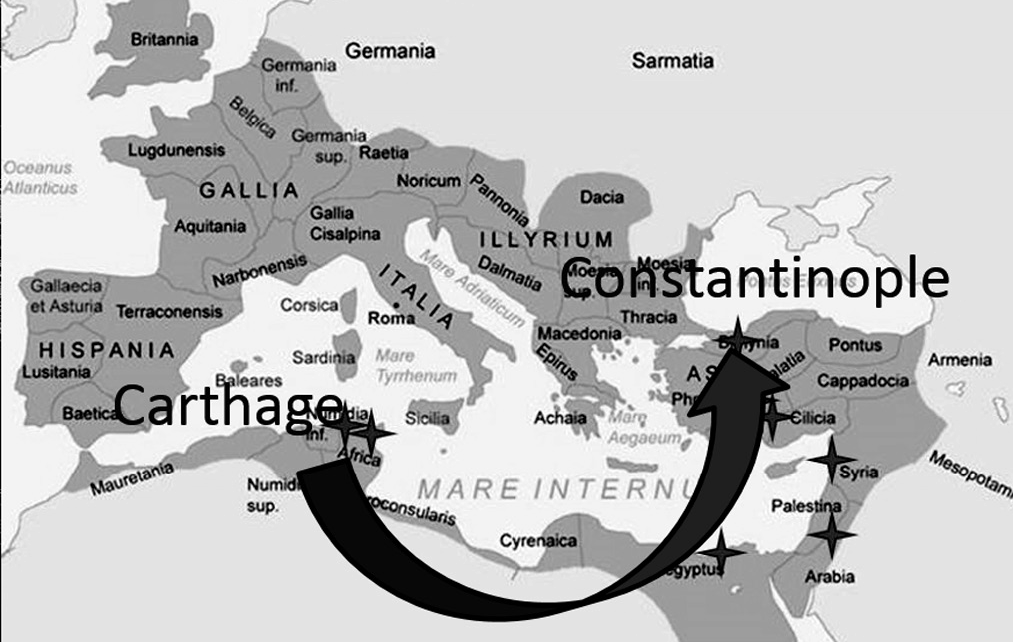
Many sources of teachings in wrong directions
The false fountains may be defined this way. Draw an arc from Asia Minor through North Africa to define the part of the Roman world that was well off. This is where nearly all the bishops attending Nicaea came from and these answer to the false fountains. The majority wrote in Greek. We have noted two who wrote in Latin. If we were to add in more “fountains” of note, we would just be filling in more of this arc. Excepting the doctrine of the primacy of the Pope from the “Old Rome,” these false fountains of doctrine come from the Eastern Church.
JUDGMENT OF WORMWOOD
Was there judgment on these false fountains of Truth? And who is this star called “Wormwood,” bringing bitter judgment to this part of the world?
Islam answers to the star called “Wormwood.” Muhammad is the spiritual leader and the star who founded Islam (622 AD). And Islam does indeed have its own set of scriptures, the Quran, “burning as a lamp.” If we look at the Ottoman Empire at its largest extent, it falls right on this arc of false doctrine. For a Christian minority living under Islam, deadly violence from the Moslem majority is always a possibility. You cannot take life for granted. The Christian community suffers unremitting misery. They are persecuted, they are heavily taxed into poverty, and they are second class citizens before the bar of justice. Five times a day the muezzin’s call from the minaret affirms, “That there is no god, but God.” This call to prayer is actually an anti-Trinitarian statement that rings in the ears of the churches that established the doctrine. It is a basic theology lesson that is sung publically.
Islam vehemently disagrees with Trinitarian doctrine. In the words of an Islamic apologist Dr. Abdal-Hakim Murad, speaking at Oxford on “The Trinity, a Muslim Perspective” (1996) says, “The doctrine of Trinity was (or is) the most notorious point at issue between Christianity and Islam, and hence was freighted with fierce passions.” The passion was on both sides. The orthodox Christians insisted at sword-point that God was a Trinity, while the Moslems insisted at sword-point, “There is one God.” When we look at what happened to the false teachers, “Wormwood” works very well as a symbol and it has indeed been a bitter, galling lesson for the nominal church that suffers so much under Islam.
DAYS OF DANIEL
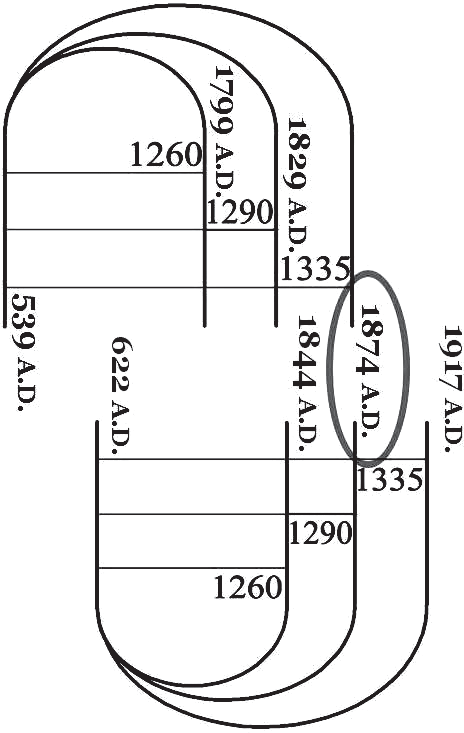
The Days of Daniel
Taking the days of Daniel that we have already laid out as they relate to Papacy, let us take a look at Islam as set forth by Bro. R.E. Streeter in Daniel the Beloved of Jehovah (this has been treated further in Beauties of the Truth, February 2007, “Days of Daniel” and “The Liberation of Jerusalem”). The Moslem calendar begins with the Hegira in 622 AD and Islamic years are slightly out of phase with our calendar because they use a 354 day lunar year rather than a 365 day solar year. Taking Moslem year 1260, Moslem year 1290, and Moslem year 1335, there is something very interesting that was first noticed in 1917 when General Allenby conquered Jerusalem. Many people noticed that Jerusalem fell in Moslem year 1335 and suggested a link back into the Days of Daniel. There was discussion on this in the Christian, Jewish and the Moslem community.
The 1260 days comes to the year 1844 AD, when the Ottomans were forced by the British to no longer execute Christian converts that the Bible societies were making from Islam. The 1335 days come to year 1917 AD when the Ottomans lost Jerusalem, and it came under a British mandate. The 1290 days take you to the year 1874 AD and Christ’s presence, that links the Western Church/Papacy, and Eastern Church/Islamic judgments together.
Thus we have two different applications of the Days of Daniel, the solar pointing to Papacy, the lunar pointing to Islam — both brought to judgment. The “Abomination which maketh desolate” was permitted by the Lord for a fixed time, overruled, and brought to judgment. The Lord knew exactly when to start it, when to end it, and He did. The “Star called Wormwood” was permitted by the Lord for a fixed time, overruled, and brought to judgment. The Lord knew exactly when to start it, when to end it, and He did. The Lord promises that all which oppresses, murders, maims, and pillages in His Name will be destroyed. He does not need our sword or the state sword of a “mixed marriage” to accomplish this.
— Br. Richard Doctor