
Psalm 47, Celebrating Victory in the Face of Enemies
“O Clap your hands, all ye peoples, shout unto God with the voice of triumph” (Psalm 47:1).1
So beloved and important is Psalm 47 that to this day it plays a special part in the annual Jewish liturgy. In traditional synagogues, Psalm 47 is recited before the sounding of the Shofar (ram’s horn) at the start of each New Year. Although the custom of reciting Psalm 47 seven times before the sounding of the Shofar may only be a relatively new one dating from the 18th century, the custom is widespread, at least in Ashkenazi communities.
The lessons of this Psalm are simple. Someday, not only the Lord’s people, but all peoples shall clap and shout unto the Lord with the voice of triumph. Some commentaries have suggested that the occasion for composing this Psalm was the bringing of the Ark of the Covenant to Jerusalem (10th century BC). Surely Psalm 47 would be an appropriate tribute of praise for any event of such magnitude. But here we will consider the special lessons of this Psalm if, as maintained by Jewish commentaries, it was first sung much later when Jerusalem was besieged by the armies of Assyria under Sennacherib (7th century BC).
To bolster the morale of the populace during the siege, the sons of Korah (Psalm 47 superscription) were directed to compose three Psalms – Psalm 46, 47, and 48. These were not to be sung in the temple, but as “Songs upon Alamoth,” that is, songs for the adolescent girls in the city to sing in the streets after the fashion in which triumphal songs would normally be sung (see “Psalm 46, A Song upon Alamoth,” Beauties of the Truth, November 2009). The reference to public participation in the singing with shouting and clapping clearly alludes to the use of the Psalm in public outside the temple compound. This singing was to take place even as the threat of destruction from the siege lay just out of bowshot beyond the city walls. The young women of Israel typically played a prominent role in leading the singing for the songs of triumph and these three Psalms celebrated the unwavering faith of the Lord’s people in the face of overwhelming odds. Up to this point Assyria had proven victorious in every siege and had overrun the 10-tribe kingdom of Israel.
Sennacherib’s Prism, which details the events of Sennacherib’s campaign against Judah, was discovered in the ruins of Nineveh in 1830, and is now stored at the Oriental Institute in Chicago, Illinois. The account is a self-serving boast from the Assyrian king. Sennacherib claims to have destroyed forty-six of Judah’s cities and trapped Hezekiah in Jerusalem “like a caged bird.” The text goes on to describe how the “terrifying splendor” of the Assyrian army caused the Arabs and mercenaries reinforcing the city to desert.
The overwhelming magnitude of the threat to Judah and Jerusalem may be estimated from the report that after the destruction of 185,000 from the Assyrian host in one night by the Angel of the Lord, the army could still sustain an orderly retreat (Isaiah 37:36). The singing and clapping that were part of this Psalm were an exhibition of trust, knowing that the Lord would indeed triumph.
“For Jehovah Most High, is awesome; He is a great king over all the earth” (verse 2).
The clapping and shouting are a joyful acknowledgement that the Lord Jehovah is God and holds universal sovereignty. Typically the heathen gods were not believed to have power beyond a limited geographical area. How different was Jehovah, the God of Israel. Though the Assyrians would boast and reproach the God of Israel, presuming to speak in His name (Isaiah 36:7, 10, 15), the blasphemy and emptiness of this attempt at psychological warfare and its attempts to undermine the confidence of the defenders would soon yield to the “awesome” nature of Jehovah’s rulership. His true power would become evident to all once His mighty angel passed through the camp of the Assyrians.
“He subdueth peoples under us, and nations under our feet” (verse 3).
Since the opening of the gospel call to the Gentiles, the invitation to the kings of the earth is to “kiss,” that is, receive instruction from, the Son (Psalm 2:12).
We wish all peoples and nations would submit themselves willingly to God as sovereign, and Jesus as the “arm” of Jehovah (Isaiah 51:5, 9, 52:10, 53:1). We know they would be blessed by recognizing the privileges and leadership of Israel in a peaceable manner. However, Psalm 2:12 tells us that their submission, under God’s elect, will be a forcible one (B101).
“He chooseth our inheritance for us, the excellency of Jacob whom he loved” (verse 4).
Why the phrase, “the excellency of Jacob?” The land of Canaan was promised to the patriarchs Abraham, Isaac, and Jacob. But though the promises of God came first to Abraham (Genesis 12:1; 22:17), then to Isaac (Genesis 26:3-4), and finally to Jacob (Genesis 28:14-15), neither all the seed of Abraham, nor all the seed of Isaac were to specially share the inheritance of the land. However, the “excellency” (Strong’s 1347) of the Holy Land would be for all the natural seed of Jacob, whom God loved (Malachi 1:2, Romans 9:13).
“Selah” (verse 4).
Advocates of excited forms of church worship find support for their excesses by pointing to expressions in the Psalms, including Psalm 47, which speaks to joyous and even loud worship – clapping, using drums and other percussive instruments, and dance. But they fail to observe that rather than abandoning worshippers to the natural human passions that can seize and control our judgment, by one word all the celebration is interrupted before it devolves into ecstatic worship. This one word brings us back to rationality – selah, or “pause and consider.” With this command all clapping and shouting would cease.
“God is gone up with a shout, Jehovah with the sound of a trumpet” (verse 5).
At first this expression might be puzzling. It is the mirror image of the expression in 1 Thessalonians 4:16 where Christ descends from heaven in a shout (Greek, en kelusmati) and the sound of a trumpet.2 The implication for this Psalm is that the nature of this military action against Jehovah’s enemies is one that employed stealth, indeed one that took place in the dead of night. Faith was needed to recognize that the heavenly host was quietly round about Jerusalem at all times, even as in an earlier day the heavenly host had defended Elisha (2 Kings 6:17). When the due time came for the angel to destroy the Assyrian host this amazing deliverance was accomplished in a single night without the men of Judah lifting their swords. This verse celebrates Jehovah’s triumphal victory which was yet to be a reality.
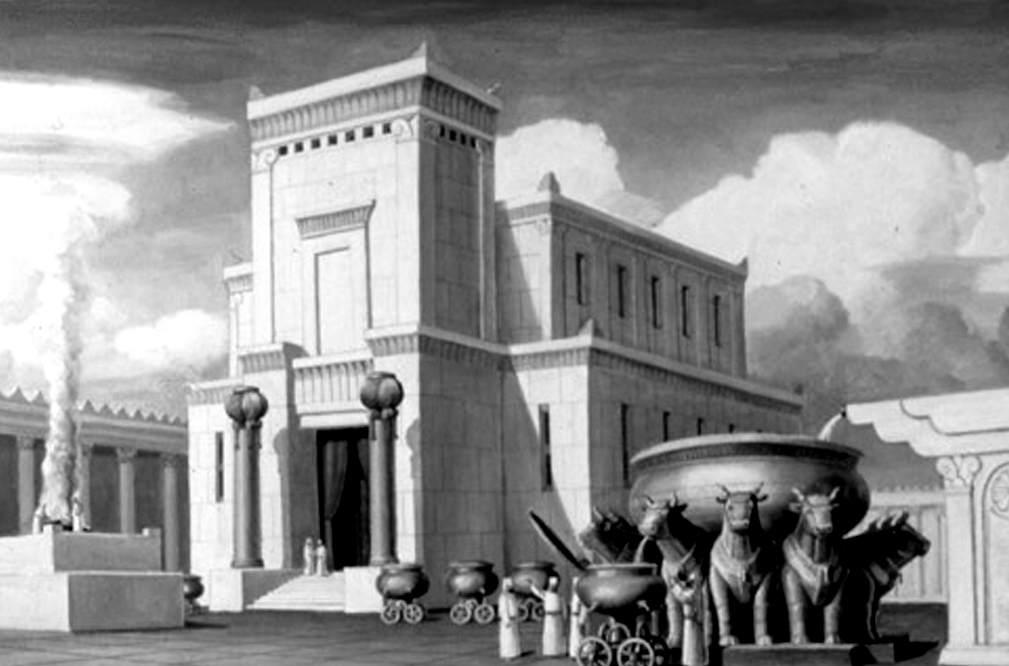
Temple of Solomon, where Psalms were sung on other occasions.
The account by the Greek historian Herodotus (Histories II.141) suggests that the agency employed by the Lord’s angel was bubonic plague. (See RVIC on 2 Kings 19:35, footnote 155).
Like the defenders of Jerusalem, the church shares in this triumph as well, for there surely is a Messianic theme here. The great doctrine of the ascension is taught in the words: “God is gone up with a shout.” The Lord while ascending back to the Father made an open shame of Satan. When we think of our Lord’s ascension and privilege to sit with him even now in heavenly places, we also are provoked to offer endless worship to Him (Ephesians 2:6).
“Sing praises with understanding” (verses 6-7).
The praises were to be sung to Jehovah both as God and King. “Zion” originally was the city or stronghold of the Jebusites and occupied the southern portion of the western ridge, the highest, most inaccessible, and easily fortified ground in what became the city of Jerusalem. When it was conquered by David it became his fortified abode or citadel. His palace was built here, and through successive reigns and dynasties, down to the Christian era, it continued to be the royal residence. Until the construction of the temple, Zion held the ark of the covenant. But its primary purpose was to serve as the civil or political center.
In these regards Jerusalem was specially favored, for it hosted both the political center of the nation and the Temple of Solomon which was its religious center. Both the citadel and the temple were within the city walls of Jerusalem. But the city boundaries fell within the territories of two different tribes – Judah and Benjamin. Thus the Temple itself was within Benjamin’s territory. (Please see “Between the Shoulders,” Beauties of the Truth, November 2009.)
The expression to “sing praises” appears four times, followed by a fifth expression that these praises should be sung with “understanding” (Strong’s 7919, maschil). Surely, the blessings of understanding in these last days come to mind, and in general maschil is taken to mean a song which teaches doctrine.
The word “praises” means a hymn of laudation, and we are enjoined to sing them unto our God and King. This is distinctly different from songs written for the people and sung to the people. This worship is always for God and directed to Him alone.
The word “understanding” tells us that if we do not understand our worship, then it accomplishes no good purpose.
One of the first reforms of Martin Luther was to restore congregational singing. A Jesuit priest observed that this was more influential than even Luther’s sermons. After centuries of silence in church from the people, they were once more given the opportunity to use their own voices to praise God in song. What a thrill it must have been to hear all the voices! May we find that true worship when we seek to fathom the depths of who God is. When we find Him, we will be overwhelmed with His presence and true feelings of worship.
Current scholarship (Soncino) now takes this understanding more specifically to mean a special kind of musical rendering for which we no longer possess any other details. This musical form must have been engaging for we find that even the enemies of Judah added to the exiles’ grief next to the rivers of Babylon by asking them to sing the glad songs of Zion (Psalm 137:3). Possibly, some special voice training was involved – highly trained professional voices may be much admired.
Possibly another maschil, or song with understanding, is sung in Revelation 14:3. There we see 144,000 singing a new song before the throne of God, and only they could learn that new song.
Like this Psalm, the song heard by John is being sung audibly. Thus it does not seem as though the words are impossible for others to hear and repeat and therefore to “learn.” So to “learn” in this context may refer to the quality and beauty of the singing, and the depth of understanding the meaning of the words. Such singing is impossible to master for any but those of this little flock standing with our Lord upon Mt. Zion.
“God reigneth over the nations, God sitteth upon his holy throne” (verse 8).
For God is the King of all the earth, he is not only our King, but the King of the universe. He has no limited power, no confined dominion. Though this is literally true in God’s universal dominion, yet more is here meant. God reigns over the heathen when, by the preaching of the Gospel, they are brought into the Church of Christ. He is a holy God; He proclaims holiness. His laws are holy, He requires holiness, and His genuine people are all holy. The throne of His holiness is the heaven of heavens; also the Temple at Jerusalem; and, lastly, the hearts of the faithful.
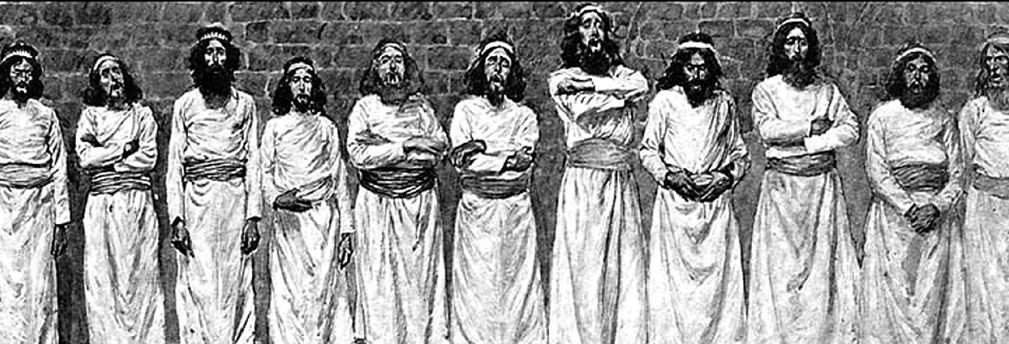
Temple Singers (for other occasions).
“The princes of the people are gathered together, to be the people of the God of Abraham: for the shields of the earth belong unto God: he is greatly exalted” (verse 9).
This Psalm can be sung at the deepest level only by those blessed with knowledge and faith in the Divine Plan of God. While under attack by the heathen Assyrians, ancient Judah was to have full faith in God. Likewise, when the New Creation is faced with its enemies, we too should respond in full assurance of faith that God will bring deliverance. During the Millennium, that deliverance will extend to the entire world, who will become “people of the God of Abraham.” Even the heathen “princes,” the mighty of this age, will gather together as people of Jehovah.
Thus, the prophecy of Jacob concerning Messiah (Shiloh) shall fully come to pass: “Unto Him shall the gathering of the people be” (Genesis 49:10, Psalm 87:4, Isaiah 60:3-8). The designation “God of Abraham” is appropriate, as it was to Abraham that the promise was made: “In thee” – “in thy seed shall all the nations of the earth be blessed” (Genesis 12:3, 22:18).
“For the shields of the earth belong unto God.” The princes are metaphorically called “shields,” as being the protectors of their people (Hosea 4:18, margin). In the Millennium the willing of mankind will gladly receive the word of life. Like the Bereans, of a noble or liberal disposition, when they hear the clear words of the Gospel, they will gladly come unto His light, and present themselves as desirous of being His people.
“He is greatly exalted.” Great as secular rulers are, God is greater and is above all – King of kings and Lord of lords. The hearts of kings and governors are in his hand. The greatest of nations and their plans are but dust in the balances. It took faith to sing this Psalm in the face of the might of Assyria and it takes faith to sing it today. Someday, faith will become sight and all shall clap and sing.
– Bro. Richard Doctor
(1) With only a few exceptions, the reading of the RVIC Bible (Bro. Jim Parkinson) is used throughout. The reader may find that version at this site – www.HeraldMag.org – under the button “RVIC.”
(2) Note that 1 Thessalonians 4:16-17 is in the reverse order of Joshua 6: “they rose early,” the trumpet, Joshua commands to shout, and the people shouted.