
Sources of Abraham’s Faith
Abraham was a wonderfully faithful man. He is referred to as the father of the faithful. “They which are of faith, the same are the children of Abraham” (Galatians 3:7). But one might ask, where did Abraham get this wonderful faith? There are at least three possible sources.
(1) FROM PROMISES TO HIS FOREFATHERS
Paul defines faith as, “the substance of things hoped for, the evidence of things not seen” (Hebrews 11:1). In other words, faith is seeing things promised tomorrow, in your hand today. But a promise is required for there to be faith. So what promises did Abraham have and know about? There were at least three:
In Eden: “I will put enmity between thee and the woman, and between thy seed and her seed; it shall bruise thy head, and thou shalt bruise his heel” (Galatians 3:15).
To Enoch: “Enoch also, the seventh from Adam, prophesied of these, saying, Behold, the Lord cometh with ten thousands of his saints, To execute judgment upon all, and to convince all that are ungodly among them of all their ungodly deeds which they have ungodly committed, and of all their hard speeches which ungodly sinners have spoken against him” (Jude 1:14, 15).
To Noah: “I establish my covenant with you, and with your seed after you; And with every living creature that is with you … neither shall all flesh be cut off any more by the waters of a flood; neither shall there any more be a flood to destroy the earth. … I do set my bow in the cloud, and it shall be for a token of a covenant between me and the earth. … The bow shall be in the cloud that I may remember the everlasting covenant between God and every living creature of all flesh that is upon the earth” (Genesis 9:9-16).
Some of these promises were vague. For instance, what is the “bruising” about in the Edenic promise? No one knew exactly. But the framing of God’s word there made clear that the culprit in the fall of man in Eden would be dealt with by someone in the line of Adam — the seed of the woman. How and when? Who knew? But for a believer in God, this promise was sufficient to trust that God was somehow going to sort it out.
The prophecy of Enoch was even more pointed in this hope. He preached clearly that evil and evil ones would be brought to justice by the Lord and his saints who come for that very purpose. Again, the prophecy raises more questions than it answers. But the promise of a coming deliverance from evil was a good basis for the faith of Abraham and others who worshipped Jehovah.
The promise to Noah was a covenant between Noah and his seed. As the seed of Noah, Abraham saw himself already in a covenant relationship with his God. Since the Creator valued faith, Abraham could conclude, by extension, that if he had faith like Noah, he also could have a close relationship with God, perhaps even a personal covenant relationship.
These are the seed thoughts of faith. Although he had only a few promises in that early time, they were sufficient to understand what God required. Consequently, Abraham, by these promises, began to develop his own faith.
(2) FROM HIS ANCESTORS
Most of us learn things by being taught by others. Abraham learned faith by seeing it in others and hearing about it from them, most notably his forbearers. Notice whom Abraham could have seen and talked to. Here is who was alive when Abraham was age 30 years:
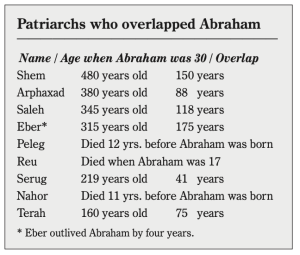
The Bible does not tell us which of these patriarchs Abraham spoke with. But who would not want to talk with Shem, the true patriarch of the family? Who would not want to hear first-hand about life before the flood and building the Ark, and being saved through the flood? Shem was surely a faithful man, having worked with his father on the ark. Probably he retold the story countless times through all of his generations. He was Abraham’s great-great-great-great-great-great-great-grandfather! It is likely that much of Abraham’s faith came from some of these fathers. Hearing first-hand accounts of God’s power and works would surely have made a lasting impression.
(3) FROM ABRAHAM’S OWN DEALINGS WITH GOD
God’s contacts with Abraham are recorded somewhat nonchalantly. “Now Jehovah said unto Abram” (Genesis 12:1, ASV). Was this the first time Abraham heard God’s voice or had there been previous communication? The scriptures are reserved here. There is no record of astonishment in this first record of interchange between God and Abram. God simply told him to move and he moved.
Brother Russell made an interesting suggestion in R5206. “The Scriptures state that Abraham believed God, and his faith was counted to him for righteousness (Genesis 15:6). God must have had some dealings with Abraham before he believed or there would have been nothing for Abraham to believe. Evidently God had had some communication with him before faith and trust could have brought him into even a tacitly justified condition.”
Conclusion: Faith is built on promises (Hebrews 11:1). Abraham learned of God’s past promises and the faith that his forefathers exercised. This provided a splendid background for Abraham’s own wonderful faith to grow.
We do not doubt that God loved Abraham from the beginning and nurtured his love and faith for God as Abraham’s life progressed. We may expect the same treatment in our lives if we are faithful to the promises that God has given us. Our faith will grow and grow and we may become lights to assist the faith of others. “Without faith it is impossible to be well-pleasing unto Him; for he that cometh to God must believe that he is, and that he is a rewarder of them that seek after him” (Hebrews 11:6).
— Br. David Stein