
Tyre and Sidon, Unrestrained Capitalism
“Tyre shall be forgotten seventy years, according to the days of one king: after the end of seventy years shall Tyre sing as an harlot” (Isaiah 23:15).
Isaiah speaks of a period not quite two centuries future to his own day when the harlot song of Tyre would follow a period of seventy years when it would be forgotten. While in their own tongue they called themselves Canaan, Tyre and Sidon were the principle cities of Phoenicia (their Greek name).
Tyre’s primacy as the economic power of the ancient world presented a continual reproach to the children of Israel.1 Tyre was settled on the Mediterranean coast about 12 miles south of present day Beirut, and it had a citadel slightly over one mile offshore with impregnable walls. For this reason, the book of Ezekiel describes Tyre as being in the midst of the seas (Ezekiel 27:25, 26).
Tyre boasted that it was the original source of both Baal worship and Venus worship. Arrian writes that the temple on the island citadel of Tyre was the most ancient of all temples within the memory of mankind (History, 2, 16). Hence the Phoenician inscription reads “To our Lord, to Melkarth, the Baal of Tyre,” and was translated by the Greek (Heraclei Archygete – “Hercules the founder”). Tyre was consecrated to this Hercules who called for the most abominable of child sacrifice and was given the appellation “the founder” because of the ancientness of the worship. To interpret this false system of worship, Tyre was consecrated to Human Power (Hercules), and Sex (Venus).2
The relationship between Tyre and Babylon shifted and even reversed course over time. Both are designated in scripture as harlots, the language is so similar that it is easy to read the texts as referring to the same system. Reality is that even for harlots there can only be one chief harlot. We must recognize this, and carefully interpret the prophecies linked to Tyre and Babylon. Their interlinked fortunes under the four dominions may be summarized:
- Babylon was Tyre’s enemy. Nebuchadnezzar sieged the portion of the city on the mainland, but he had no navy with which to attack the island. The military force under the command of Nebuchadnezzar was to leave the prize of Tyre unclaimed after a nearly unprecedented 13 years of siege. Babylon’s unsuccessful siege caused the Lord to say to Nebuchadnezzar in Ezekiel 29:18-20, “Take Egypt in payment for your ‘Great Service’ against Tyre!” Though Babylon could not conquer Tyre, the Babylonians embargoed Tyre for their entire period of supremacy. That is, for the 70 years.
- Medes and Persians. Tyre was an independent ally of the Persians, and Babylon was a subject city to the Persians. Tyre and Babylon worked together. Under the Persians, there was a second siege of Babylon – this siege is not treated in the historical record of the Bible, but history recounts that it ended in Babylon’s destruction as a fortified city.
- Greece. Tyre was destroyed in a remarkable siege by Alexander the Great. Though Babylon was inhabited, it was a non-defendable settlement without walls and gates. The battle that ended the Persian empire was fought near to Babylon and the city was captured by Alexander almost without resistance.
- Rome. A small seaport was re-established at Tyre, while the small community at Babylon was beyond the borders of Rome in the Parthian empire. Both cities were shells of their former glory. The city of Baghdad now would become the center of power in Mesopotamia.
The Biblical history of the Babylonian empire, opposed to Tyre and Sidon, shows that they were bitter enemies of Nebuchadnezzar and his successors. Antitypical Tyre and Sidon employ totally different methods than antitypical Babylon, to control and traffic in the souls of men. Revelation shows Babylon and the merchants in cooperation, so this should be clarified. In this clarification, a marvelous harmony in the scriptural antitypes will be found.
TYRE AND THE FIRST CONQUEST OF BABYLON
The city of Jerusalem was critical for the Babylonians to take as they sought world domination. But the real prize of the Levant was Tyre, the wealthy, powerful city of commerce whose lines of trade carried as far as Spain.
When seventy years (Isaiah 23:15) is discussed in scripture the initial tendency is to connect it exclusively with Judah’s misfortunes under divine judgment, as Nebuchadnezzar brought an end to that morally bankrupt monarchy that disgraced the heritage and the promise of God’s sure mercies to their father David.
However, Babylon’s rule affected every nation of the near east. Though Babylon could not conquer Tyre, the Babylonians embargoed Tyre for the entire period of their supremacy. Hence, for seventy years, during this embargo, Tyre was forgotten. Like most embargos, the targets are crippled, but rarely destroyed.
The first conquest of Babylon by the Medes and Persians is recorded in the Book of Daniel (Daniel 5:1-31). Cyrus took the city with such stealth that as the historian Herodotous records in full accord with the Biblical account, the outskirts of the city were taken by Cyrus while the festival in the center went on in its revelry, unaware of their impending doom (Histories, Book 1, 193).
The book of Daniel makes no reference to smoke or burning, nor does secular history. As the remainder of the book of Daniel shows, the Medes and Persians retained even the highest administrators, such as Daniel, who were products of Babylon’s efficient civil service apparatus. With this conquest, the Persians reversed Babylon’s policy and lifted the embargo against Tyre.
The promise of Babylon being brought to judgment after the seventy years affected not only Israel but all the nations that Babylon conquered – “And this whole land shall be a desolation, and an astonishment; and these nations shall serve the king of Babylon seventy years. And it shall come to pass, when seventy years are accomplished, that I will punish the king of Babylon, and that nation, saith the LORD, for their iniquity, and the land of the Chaldeans, and will make it perpetual desolations” (Jeremiah 25:11-12).
To consistently interpret any antitype we need to recognize that the seventy years of Babylonian domination of Tyre (Isaiah 23:15-17), and Judah’s seventy years when they would serve the king of Babylon (Jeremiah 25:11-12), are one and the same historical period. These seventy years ended when Babylon was supplanted by the Medes and Persians. Then Israel would return from captivity (Jeremiah 25:10).
BABYLON AND CYRUS IN ANTITYPE
If we are to understand the antitype of Tyre, Babylon’s enemy, we should first understand the antitype of Babylon. Pastor Russell suggests a clear identification of antitypical Babylon, nor was he alone in this Protestant interpretation:3
“The various prophecies of Isaiah, Jeremiah, Daniel and the Apocalypse concerning Babylon are all in full accord, and manifestly refer to the same great city. And since these prophecies had but a very limited fulfillment upon the ancient, literal city, and those of the Apocalypse were written centuries after the literal Babylon was laid in ruins, it is clear that the special reference of all the prophets is to something of which the ancient literal Babylon was an illustration … As already intimated, what today is known as Christendom is the antitype of ancient Babylon; and therefore the solemn warnings and predictions of the prophets against Babylon – Christendom – are matters of deepest concern to the present generation. Would that men were wise enough to consider them!”
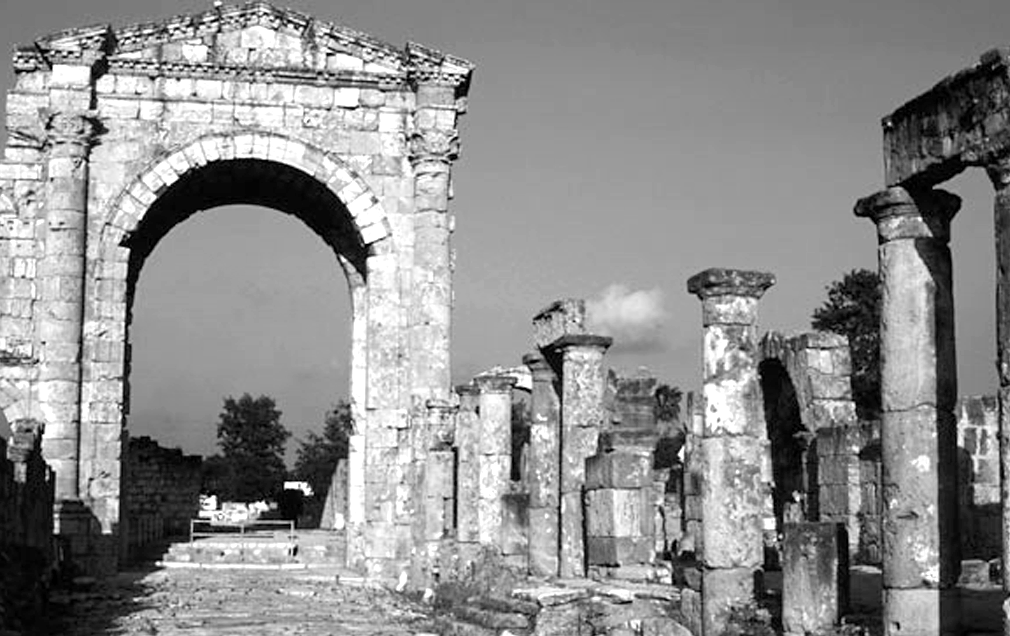
Ruins of Tyre (these are Roman ruins)
When the antitypical Babylon falls, the shackles of its dominion are broken by the antitypical Cyrus (Reprint 4892):
“Our race, groaning under the weaknesses and imperfections … mental, moral and physical – longs for the promised deliverance from the bondage of sin and death. The majority of mankind undoubtedly feel the gall of their slavery, and will be glad to be free. The great Deliverer is the antitypical Cyrus. Soon he will be victorious and will establish his kingdom under the whole heaven.”
The antitypical Cyrus is identified with our returned Lord as the great deliverer. At the same time if Christendom, that is, the Christian community of world civilization, is the antitype of Babylon, who is this intractable and unconquerable enemy – Tyre?
Here the prophecy of Isaiah frames the answer. “Who hath taken this counsel against Tyre, the crowning city, whose merchants are princes, whose traffickers are the honorable of the earth?” (Isaiah 23:8).
It is highly unusual in world culture for merchants to attain the status of princes. Indeed, this points to only one period in history where this has become possible – our own day. Who hath taken this counsel against Tyre? It is our Heavenly Father’s wisdom that has taken counsel against Tyre.
THE CHURCH, COMMERCE AND COMMUNISM
The antitypical interpretation of Isaiah 23:15 that seems to harmonize scripture and history (keeping in mind that we have no interpretation from the Pastor except that Tyre is part of Satan’s empire), is:
When the “seventy years” are ended – at our Lord’s Parousia in 1874 – and it becomes clear that the people can no longer be controlled through religion – “Babylon, or Christendom” – the next effort to maintain control of the people will be through Commerce – “Tyre.”
This is characterized as a “song” that is a passionate public expression of belief. Tyre in antitype is linked to a commerce-driven life without the restraints of divine principles. Some of the language seems to markedly parallel the leadership of Christendom:
“Son of man, say unto the prince of Tyrus [Tyre], Thus saith the Lord GOD; Because thine heart is lifted up, and thou hast said, I am a God, I sit in the seat of God, in the midst of the seas; yet thou art a man, and not God, though thou set thine heart as the heart of God” (Ezekiel 28:2).
At the time of this writing [Spring 2009] the economic leadership of the world is a much discussed topic in the G-20 summit of the major and emerging economic powers dealing with the economic crisis. Ezekiel 28:2 suggests that very strong central leadership eventually will emerge in the future. Going back in the history of the church we find that both Eastern Orthodoxy and Roman Catholicism were very strongly opposed to commerce (see inset, “John Chrysostom”).
JOHN CHRYSOSTOM
John, later surnamed “Chrysostom,” or “the golden mouth,” because of his eloquence, was born 347 AD at Antioch.4 He is especially important because his preaching against wealth was so genuine. Because of his earnest nature, Chrysostom was chosen to serve as the patriarch, or “chief father” of Constantinople. At this post he labored several years avoiding the temptation of exercising pride of office, vestments, and worldly conformity. In the midst of the splendors of Constantinople, “The New Rome,” he continued his ascetic habits and applied all his income to the sick and the poor.
He preached an intense, practical Christianity, boldly attacked the vices of his age, including the hollow, worldly, and hypocritical religion of the imperial court. His invectives against the vain young empress Eudoxia were to prove his undoing. He speaks as follows in his sermon “On Wealth and Poverty”:5
“For we are accustomed to judge poverty and affluence by the disposition of the mind, not by the measure of one’s substance. Just as we would not call a person healthy who was always thirsty, even if he enjoyed abundance, even if he lived by rivers and springs (for what is that luxuriance of water when the thirst remains unquenchable?), let us do the same in the case of wealthy people: let us never consider those people healthy who are always yearning and thirsting after other people’s property; let us not think that they enjoy any abundance. For if one cannot control his own greed, even if he has appropriated everyone’s property, how can he ever be affluent? … I beg you, remember this without fail, that not to share our own wealth with the poor is theft from the poor and deprivation of their means of life; we do not possess our own wealth but theirs. If we have this attitude, we will certainly offer our money; and by nourishing Christ in poverty here and laying up great profit here- after, we will be able to attain the good things which are to come, by the grace and kindness of our Lord Jesus Christ, with whom (be glory, honor, and might), to the Father, together with the Holy Spirit, now and ever and unto ages of ages. Amen.”
Looking at his dates, Chrysostom died over 100 years before the elevation in 539 AD of the bishop of Rome as “Pope.” There existed a calloused insincerity of other members of the hierarchy, bishops, and cardinals as the church openly linked to the state during this period. Some historians argue that during this time the bishops “established a false principle of virtue.”6 But here the historian John Lord makes an exception for Chrysostom (John Lord is cited by Pastor Russell, though not respecting Chrysostom).
At the urging of the court, Bishop Theophilus went to Chrysostom’s own diocese in Chalcedon, where he held a secret council of thirty-six bishops against Chrysostom. There he procured judgment against him upon false charges of immorality, unchurchly conduct, and high treason. Chrysostom was sent into exile where he died en route (407 AD).
The issue is not to examine his sincerity or lack of sincerity, but to note the political capital made of his ministry, for the story only begins with his death. Chrysostom was venerated by the people as a saint. Thirty years after his death, by order of Theodosius II (438 AD), his bones were brought back in triumph to Constantinople. They were deposited in the imperial tomb in the Church of the Apostles. The emperor himself met the remains at Chalcedon, his “home” and the venue for Chrysostom’s trial. Theodosius fell down before the coffin, and in the name of his guilty parents, Arcadius and Eudoxia, implored the forgiveness of the holy man.
Hence, we see that for antitypical Babylon, while a privileged elite held power and controlled the wealth, whatever they may have believed in private, they publicly espoused “false principles of virtue” that shunned wealth.
Early on, the church began an experiment in collective living we find in Acts 2:44-47. Chrysostom, taking the example of the primitive church in Acts, espoused a form of Communism and even sowed the seeds that would later lead to Communism’s emergence in a portion of Christendom (Russia) under the domination of the Orthodox Church – this is a well-established scholarly view.7,8,9 This pointed comment appears in a book entitled The Origin of Russian Communism, from the University of Michigan Press (Berdyaev)10 (emphasis added):
“St. John Chrysostom was a complete communist, though of course his was not communism of the capitalist or the industrial period. There are good grounds for asserting that communism has Christian or Judeo-Christian origins. But there soon came a time when Christianity was adapted to the contemporary kingdom of Caesar.”
Chrysostom held sway in the Orthodox Church long after his death, but he also had influence in the West. He was one of the few Eastern fathers whose translated works were read even in the Church of Rome. Within Europe under the Popes, banking, money lending, and other necessities for the emergence of a commercial sector were held in such abhorrence that no Christian was permitted to engage in them. Because they nonetheless became a necessity with time, the solution was to force the despised Jews to take up these occupations.
So, historically, commerce was opposed by antitypical Babylon, the enemy of Tyre when Babylon dominated. Along with the apparently sincere concerns for the welfare of the poor, came the bondage to church discipline and dogma for which Chrysostom deserves censure. History shows that the middle class is the breeding ground for revolutionary leaders, the merchant class, and commerce. Hence, opposing the growth of a middle class is a method of retaining power.11
– Bro. Richard Doctor (to be continued)
(1) Please see, “Tyre & Sidon,” Beauties of the Truth, 18:2 (May 2007).
(2) The city of Tyre was consecrated to Hercules (Melkarth), a “Baal” or “Lord” (Quintus Curtius, 4:2; Strabo, 16:757)
(3) Russell, Charles T., The Battle of Armageddon (originally published 1897), Study 2, “The Doom of Babylon – Christendom,” page 23.
(4) McClintock & Strong’s Cyclopedia, Chrysostom.
(5) Fitzgerald, Brian Ephrem, “St. John Chrysostom on Wealth and Poverty – A Thematic Study of St. John Chrysostom’s Sermons on Luke 16: 19-31,” at St. Philip’s Antiochian Orthodox Church, Souderton, PA (March 2002).
(6) op. cit., Studies in the Scriptures, Volume 2, page 286; citing from John Lord, The Old Roman World: The Grandeur and Failure of Its Civilization, C. Scribner and Co. (1873) page 411, page 209.
(7) Toynbee, Arnold J., Civilization on Trial: Essays, Oxford University Press (1948), page 182. These references on Chrysostom are typical and far from exhaustive.
(8) Gordon, Barry L., The Economic Problem in Biblical and Patristic Thought, Brill (1989), ISBN 9004090487, page.101.
(9) Von Mises, Ludwig, Socialism: An Economic and Sociological Analysis, Yale University Press (1951), page 424-425.
(10) Berdyaev, Nicolas, R.M. French, The Origin of Russian Communism, University of Michigan Press (1960), ISBN 0472060341, page 171.
(11) op. cit., Studies in the Scriptures, Volume 2, page 57.