
Water from the Rock at Rephidim (Exodus 17:1-7)
“And all the congregation of the children of Israel journeyed from the wilderness of Sin, by their journeys, according to the commandment of Jehovah, and en camped in Rephidim: and there was no water for the people to drink” (Exodus 17:1).
Chapter 17 opens with the nation of Israel pitching their tents in Rephidim after a journey of several stops coming from the wilderness of Sin. By this time the people have probably adjusted quite well to the daily routine of wilderness life with its weekly six mannagatherings and occasional packing and unpacking to move with the Lord. However, as we shall see, this routine had to remove all of their stubbornness to the Lord’s leadings.
The name “Rephidim” means “expanses, stretches, or rests or stays.” This was undoubtedly a very barren region, even as the meaning suggests. In fact, this area was also called “Horeb” which means “drought, desert, dried up.” So this barren, void land would naturally be most foreboding to strangers. And it would definitely be no surprise to discover that water was a very scarce item. Please notice that verse one distinctly says that the encampment at Rephidim was brought about at the “commandment of Jehovah.” Sadly, this fact was once again overlooked by Israel. We find them yet another time complaining against Moses.
Verses two and three: “Wherefore the people strove with Moses, and said, Give us water that we may drink. And Moses said unto them, Why strive ye with me? Wherefore do ye tempt Jehovah? And the people thirsted there for water; and the people murmured against Moses, and said, Wherefore hast thou brought us up out of Egypt, to kill us and our children and our cattle with thirst?”
LACK OF FAITH PROFOUND
Their lack of faith was profound. They demanded that he produce water for them! Where was their recognition of God? Every morning Israel could plainly see that that God, not Moses, was providing their necessities. So their faithless request was quite upsetting to Moses. He immediately and correctly reproved his people telling them, again, that it was Jehovah they were tempting.
However, God allowed the test to continue. This provoked them even further. They accused Moses of bringing the congregation into the wilderness to kill them with thirst! They so quickly forgot the miraculous deliverance that God’s hand had given earlier. A faithless heart clouds the memory and eclipses the thankful appreciation one should have. So boisterous do they become that Moses begins to fear for his own life. “And Moses cried unto Jehovah, saying, ‘What shall I do unto this people? They are almost ready to stone me’ ” (verse 4).
So often servants of God have been threatened by the very ones God sought to help. Jeremiah, Elijah, David, and Daniel are among many examples. Even Jesus was threatened with stoning, similar to Moses’ situation (John 10:31). Jesus was the bringer of special blessings to the nation. Had they merely listened, these blessings would have been theirs. But the reverse happened.
So with Moses. The people should have held Moses in high esteem for his part in connection with their deliverance. Indeed, the Lord had their welfare in mind by choosing a man of such noble character as Moses. It is true that Moses was under the Lord’s training from his birth onward for this very difficult assignment. But his willingness to be used despite the distrust and scorn of the people is certainly to his credit. Of course, the Lord would not permit Moses to be killed in a rebellion against him. But he understood the people’s need for water.
SMITTING THE ROCK WITH THE ROD
Verse 5: “And Jehovah said unto Moses, Pass on before the people, and take with thee of the elders of Israel; and thy rod, wherewith thou smotest the river, take in thy hand, and go.”
What river is God referring to here? Reflecting back to Moses’ earlier meetings with Pharaoh, we recall that it was with his rod that he struck the Nile River in order to turn the water into blood (Exodus 7:20). In fact, several translations identify the river as the Nile. Take for an example Moffatt’s translation of Exodus 17:5: “Move ahead of the people, said the Eternal, along with some of the sheikhs of Israel; take the stick with which you struck the Nile, and advance.”1
Moses was then instructed what to do with his rod. Exodus 17:6: “Behold, I will stand before thee there upon the rock in Horeb; and thou shalt smite the rock, and there shall come water out of it, that the people may drink. And Moses did so in the sight of the elders of Israel.”
Horeb and Sinai are apparently interchangeable terms. If there is any distinction at all between the two it would be that Sinai refers to the mountain itself whereas Horeb designates the mountainous region in front of Sinai. But this is at most a very fine distinction.2 Here in Exodus 17:6 the reference seems to be the mountainous region around Sinai inasmuch as Horeb is not prefaced by the word “Mount.”
The Lord showed Moses a particular rock in this Horeb region and told him to smite it with his rod and thus furnish the people with drinking water. This entire process was done with the elders as witnesses. This was to establish beyond doubt that it was a miracle from Jehovah.
Exodus 17:7 concludes: “And he called the name of the place Massah, and Meribah, because of the striving of the children of Israel, and because they tempted Jehovah, saying, Is Jehovah among us, or not?”
Some have wondered whether the name Massah refers to the testing of the Israelites by Jehovah or the tempting of Jehovah by the Israelites. The latter is supported by Deuteronomy 6:16 and Deuteronomy 9:22. “Ye shall not tempt Jehovah your God, as ye tempted him in Massah,” and “At Taberah, and at Massah, and at Kibrothhattaavah, ye provoked Jehovah to wrath.” On the other hand, the former would seem to be true if we read Deuteronomy 33:8: “And of Levi he said, ‘Thy Thummim and thy Urim are with thy godly one, Whom thou didst prove at Massah, With whom thou didst strive at the waters of Meribah.’ ” 3
We have a very interesting veiled reference to this particular section of scripture in two other places in the Bible. These are Psalm 95:8,9 and Hebrews 3:8,9. We quote verse 8 of Hebrews 3: “Harden not your hearts, as in the provocation, in the day of temptation in the wilderness.” When we recall the literal meaning of Massah and Meribah, we see this verse contains both these meanings — Meribah = “provocation” and Massah = “temptation.”
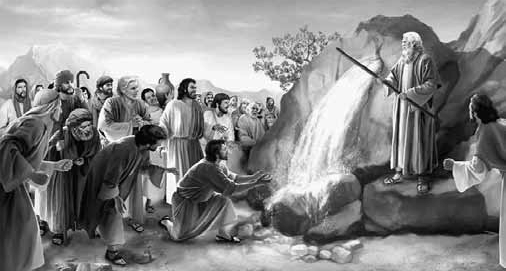 Moses at the rock
The Lord thus calls attention not only to this incident, but also to the fact that the entire forty years of wandering was filled with provocation and temptation. This is truly a sad account of history, but one full of important, necessary lessons of faith for the true saints of this Gospel Age. God has once again caused good to come out of misfortune.
ANTITYPICAL LESSONS
There are also spiritual and antitypical lessons for Spiritual Israel from these experiences of Natural Israel.
There are several separate pictures or antitypes in this account. The first one pertains to smiting the rock. The Apostle Paul identified Christ as the Rock from Exodus 17. “And did all drink the same spiritual drink: for they drank of a spiritual rock that followed them: and the rock was Christ” (1 Corinthians 10:4). So Paul indicates that the Rock in Horeb typified Christ. So, the smiting of the rock must signify the smiting of Jesus in death. Further, since Moses smote the rock, he may be a type of God and His Law, at whose direction Jesus died. Finally, as smiting the rock refreshed the Israelites, so also will come refreshment to the whole world in the Kingdom.
Another picture lesson from this can be applied more personally. As each individual member of the body of Christ needs spiritual refreshment during his daily earthly journey, he always has ample access to our Rock, our source of grace from God. If we need purification from some misstep we may have made, we may come to the cleansing stream through the Word of him who died for us. Indeed, this spiritual water is ever available, but only at this divinely appointed source.
The rock needed to be smitten but one time, no more. A single smiting indicates considerable importance not only in the type during a later experience of Israel, but also in the antitype. The crucial point is that Jesus needed to die only once for mankind, just as the rock was intended to be smitten only once. Paul appreciated this foundation truth. He writes in Hebrews 9:25-28 (ASV): “Nor yet that he should offer himself often, as the High Priest entereth into the holy place year by year with blood not his own; else must he often have suffered since the foundation of the world: but now once at the end of the ages hath he been manifested to put away sin by the sacrifice of himself. And inasmuch as it is appointed unto men once to die, and after this cometh judgment; so Christ also, having been once offered to bear the sins of many, shall appear a second time, apart from sin [or, sin offering, RVIC], to them that wait for him, unto salvation.”
Our final lesson is devoted to an examination of the question asked by the Israelites who so tempted Jehovah. “Is Jehovah among us or not?”
In our daily journey on this side of the veil, our Father puts in our path experiences of all kinds. Sometimes they seem good to our limited perception, other times bad. But no matter what our initial estimation of them may be, we must always remember that they are specially designed by God to help or develop us to fit His purposes and for our eternal wellbeing. To be lacking this conviction of faith is to ask, “Is Jehovah among us [with me] or not?”
CURBING FAITHLESSNESS
Israel had an overabundance of evidence that God was with them. With all this proof it was truly inexcusable that they should have so little faith and truth. Yet Jehovah continued patient and merciful. But there would be a point where it would no longer be loving for God to excuse their faithlessness. At that point, if He continued to overlook Israel’s bad attitudes, it would become a reinforcement to such a course. So, God must eventually take measures to curb or eliminate faithlessness or, sadly, the faithless ones themselves. This, in fact, is what He needed to do.
This same principle operates in God’s dealings with Spiritual Israel, as a class and as individuals. Once we make a full consecration to God’s will and are begotten of the holy Spirit, the evidence of His dealings with us should accumulate as proof of our divine sonship. These evidences will be primarily manifest to the individual, though others will, with time, see the Christlike development of character. Thus, with proof of God’s dealings, faith should grow strong. With stronger faith may come more intense trials. The suffering that accompanies testing should not engender doubt. Rather, it should be counted as further proof of the great privileges we have. Notice this very thought in Romans 8:16,17, “The Spirit himself beareth witness with our spirit, that we are children of God: and if children, then heirs; heirs of God, and jointheirs with Christ; if so be that we suffer with him, that we may be also glorified with him.” If our testing makes us ask, “Is Jehovah with me or not,” we stand in a dangerous position.
So rather than doubt, let us press on in our journey, trusting, full of faith that Jesus is our unfailing leader. He is fully able, competent, and willing to lead us in paths of righteousness. With this outlook, how can we not be pleasing to our heavenly Father? With all this, we should have a thankful heart for the marvelous guide given us in His Word, the Bible. There is still much in it to learn. Let us continue through our studies of ancient Israel to be learning pupils in the school of Christ.
— Br. David Stein
(1) See also The Bible in Living English, Byington.
(2) John Calvin wrote, “It is well known that Horeb is the same mountain which is also called Sinai, except that a different name is given to its opposite sides, and, properly speaking, its eastern side is called Sinai, its western, Horeb” (www.sacredtexts.com/chr/calvin/ cc03/cc03006.htm).
(3) We might briefly note here that although the “Massah” in the verse quoted above does refer to the verses under our consideration, the “waters of Meribah” evidently do not. The “waters of Meribah” seem to be the KadeshMeribah incident described in Number 20 rather than this Rephidim Meribah experience.