
Psalm 46, A Song Upon Alamoth
“God is our refuge and strength, a very present help in trouble. Therefore will not we fear, though the earth be removed, and though the mountains be carried into the midst of the sea” (Psalm 46:1).
The situation was dire. The Armies of mighty Sennacherib, king of Assyria stood outside the very gates of Jerusalem. Recognizing the high cost of a direct assault on the city, the Assyrians waged a psychological war to demoralize the soldiers defending Jerusalem. “Let not Hezekiah deceive you, for he will not be able to deliver you” (see Isaiah chapters 36, 37, specially 36:13-16).
King Hezekiah laid before the Lord the arrogant letter of Sennacherib that reproached the living God. In response, God sent Isaiah to bolster the king’s courage. “Thus saith Jehovah, the God of Israel, Whereas thou hast prayed to me against Sennacherib king of Assyria, this is the word which Jehovah hath spoken concerning him: ‘The virgin daughter of Zion hath despised thee and laughed thee to scorn; the daughter of Jerusalem hath shaken her head at thee. Whom hast thou defied and blasphemed? and against whom hast thou exalted thy voice and lifted up thine eyes on high? [even] against the Holy One of Israel’ ” (Isaiah 37:21-25).
In one night the angel of the Lord of Hosts smote the enemy encampment. The Assyrian army retreated to Nineveh in tatters and King Sennacherib later perished at the hands of his own sons. Thus were the Assyrians defeated (Isaiah 37:33-36). But before the Lord’s angel brought this deliverance, a psychological victory had already been achieved. That battle was for courage in the hearts of the defenders.
A TRILOGY OF PSALMS
In response to this national emergency, a trilogy of Psalms was composed, identified in the Soncino Jewish Commentary as Psalms 46, 47, and 48. These Psalms were to provide courage, refreshment and “comforting and sustaining power to the Lord’s faithful … in full harmony with the words of the Apostle in the New Testament, who declares that ‘all things are working together for good to them who love God, who are the called according to His purpose’ ” (R3232).
The superscription of Psalm 46 in many Bibles reads “a psalm of the sons of Korah,” suggesting that the authorship of the lyrics and melody are attributed to them. There is another more confusing portion that reads “a song upon Alamoth.” Alamoth is the Hebrew word (Strong’s number 5961) for “girls,” or “maidens.” On this the scholars are unanimous, but they are befuddled respecting how to interpret it. Since girls would never be part of psalm-singing service in the temple, some thoughts have sought for musical accompaniment by instruments in the soprano range.
The key is found in Isaiah 37:22. To be consistent with the promise, it seems reasonable that “Alamoth” refers to “the virgin daughters of Zion” who were to sing; and apparently with a divinely commanded insolent little shake of the head as well as a laugh of scorn. It was the special privilege of the “Alamoth” or maidens to sing victory songs. We find this custom creating grief for Jephthah (Judges 11:34), and creating a breach between Saul and David where Saul killed his “thousands” and David his “tens of thousands” (1 Samuel 18:7).
There is no inconsistency with the appointed singing in the temple. The maidens were not to sing these Psalms in the temple but as a victory song in the streets even while the Assyrian army in its strength camped outside the wall. These Psalms were to provide courage both to those defending the walls and to the population, who might otherwise expect months of demoralizing misery of famine, thirst and disease during the siege.
As we shall see, this is a Psalm for all seasons of life. But we need first to hear it through the voice of these virgins, the future mothers of Israel. Imagine that you are a soldier on the wall looking out at the massive encampment of Assyrians – your heart grows faint. Then, furtively, you cast a glance toward your home in the city. The tents of the refugees who have fled to the safety of the walls dot the streets and open areas, making the normally narrow, crowded street even more so. As you look towards the familiar but chaotic streets, from between the houses you catch the strains of a song of praise.
Soon you see your own daughters, your little sisters, your nieces, the neighbor girls. You can see the sun and shadows playing on their long flowing hair, for they are not yet required to cover their hair. They are dancing, they are singing, they are shaking their heads and they are laughing as God commanded through Isaiah. They look up to the defenders on the wall with confident smiles. This is “a song upon Alamoth.” The defenders would be renewed in their courage and cast behind them the clever, demoralizing words of Rabshakeh.
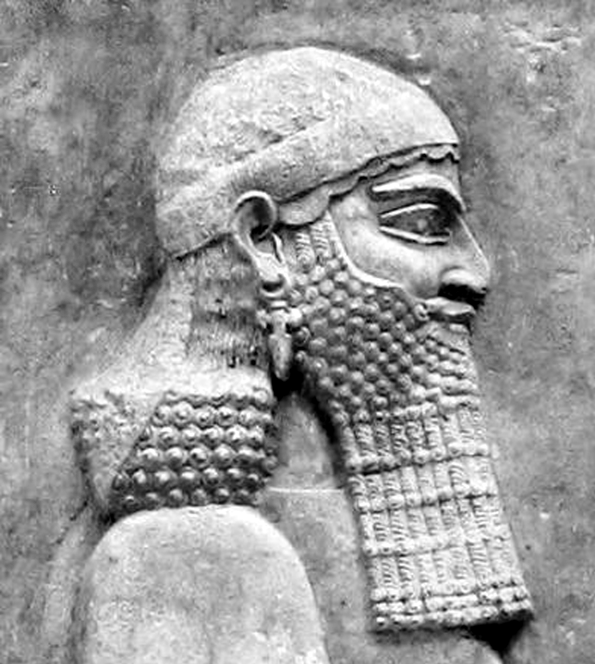
Sennacherib, King of Assyria
IMMEDIATE AND LONG RANGE APPLICATION
The Psalm had an immediate application to the Assyrian siege as well as an antitypical application in our day. Psalms 46:1, “God is our refuge and strength, A very present help in trouble.” The Lord is never far away or unmoved by the danger that threatens his people. Though Israel – the ten-tribe kingdom – had fallen to Assyria and gone into captivity, the two-tribe kingdom of Judah under king Hezekiah would not join them in exile.
When the Psalm was first sung, the people understood “mountains” to refer to the great kingdoms that threatened their national existence. Psalms 46:2-3, “Therefore will we not fear, though the earth do change, And though the mountains be shaken into the heart of the seas; Though the waters thereof roar and be troubled, Though the mountains tremble with the swelling thereof. Selah”
Syria had fallen to its enemy Assyria. That fall was welcome, for Judah and Syria had been enemies. But very unwelcome was the threat upon Judah and their ally Egypt, whose political fortunes were now in eclipse. For more than a millennium, Egypt had been a leading world power. Now the Egyptian alliances with Israel were of no help against Assyria. So the earth did change, yet for God’s people, trusting in their fortress, the change brought by the rise of Assyria was just another event. Precautions for defense were to be taken, but the situation was not to be feared.
Once a mountain is “shaken” to pieces by God’s judgment, what remains is a big pile of rubble, and there are a few methods the Bible uses to get rid of rubble piles. One is to melt it so that it flows away in a great puddle (Psalms 46:6). Another is to grind up the rubble and have the wind carry it away (Daniel 2:35). But the fastest way is to cast the mountain into the sea. Then it disappears forever as the waves close over its loftiest height. “Seas” often picture peoples and masses, troubled peoples, and in extreme cases, anarchistic peoples. To the defenders on the walls of Jerusalem, “seas” would have meant the anticipated disappearance of their enemies, and this indeed happened.
A coalition between Rezin of Damascus (Syria), and King Pekah of Israel, whom the scriptures disparaging call “Remaliah’s son,” comprised a seemingly invincible alliance that was a cause of grave concern to Judah. Pekah had reached the throne by assassination to become the penultimate monarch of the 1O-tribe kingdom of Israel in the north. Syria had recently revolutionized warfare with a secretly manufactured super weapon – Syrian swords were now formed from fine steel. Yet, the ten tribes disappeared, Syria disappeared, and Assyria disappeared.
Psalms 46:4, “There is a river, the streams whereof make glad the city of God, The holy place of the tabernacles of the Most High.” Rabshakeh hurled a less than delicate warning to the men on the wall about waiting until the water supply and food was exhausted (Isaiah 36:12). Sennacherib’s military strategists thought Jerusalem’s limited water supply was a fatal weakness. But as history shows, military intelligence is not always accurate.
The Assyrians were unaware that in Jerusalem a skillful tunneling effort to build an aqueduct had been executed with the highest urgency when Hezekiah was certain that the threat was real. Working continuously day and night, two teams of miners had carved through the solid bed rock that supports the holy city. Starting at two opposite ends the tunneling crews met only a few feet apart far beneath the city streets. This aqueduct of Hezekiah carrying fresh water to the Pool of Siloam, along with the ever flowing natural water source, the “waters of Shiloh,” now provided an ample water supply during the longest siege.
Jerusalem’s river – essential to life during a siege – was to make glad the City of God. The language of Isaiah draws a contrast between Jerusalem’s river, this tunnel of Hezekiah, and the nation of Assyria, also described as a river. The Assyrian river had punished Judah’s enemy Syria, and their ally the ten-tribe kingdom to the north (Isaiah 8:5-1O).
Isaiah had prophesied that Assyria would also sweep on- ward into Judah, “it shall overflow and pass through.” Lachish and the rest of the land was conquered. Also, “it shall reach even to the neck.” The Assyrian flood would threaten Jerusalem, the “head” of the nation – but it would not overcome. Can we see how this promise of the Assyrian invasion was both predicted and under Jehovah’s control?
Nevertheless, the Bible is honest about the defenders’ doubts (Mark 9:24). Thus Psalms 46:5 says the deliverance would come early. “God is in the midst of her; she shall not be moved: God will help her, and that right early.” Indeed, when the Israelites rose early in the morning they saw the host of Assyrians slain by the angel of death during the night.
Psalms 46:6. “The nations raged, the kingdoms were moved: He uttered his voice, the earth melted.” He who formed the mountains by his word, again utters his voice and they melt back into the elements.
Psalms 46:7. “Jehovah of hosts is with us; The God of Jacob is our refuge. Selah” Though Syria had been eliminated as a threat, Egypt and Assyria raged at each other. Lesser kingdoms such as Israel, Judah, and others were caught in the clash between the two superpowers. Yet all of this was to melt away when Jehovah but spoke the word. Whatever military strength the battle hosts of the kingdoms of man can boast, “Jehovah of hosts” is more than a match.
Though these spiritual battles are invisible to us, we get a sense of the power of the Lord of hosts in 2 Kings 6:17, where the eyes of Elisha’s servant were opened. Jehovah is surely a refuge. He watches over the special interests of Israel, for he is “The God of Jacob.”
Psalms 46:8. “Come, behold the works of Jehovah, What desolations he hath made in the earth.” All of Judah’s enemies were made desolate, and Egypt was put on notice that it was on the wane. Though Jehovah’s power was not yet exercised against Assyria, by faith through the victory song of the maidens, the deliverance is already counted to have taken place. Is that not a wonderful thought?
Psalms 46:9-11. “He maketh wars to cease unto the end of the earth; He breaketh the bow, and cutteth the spear in sunder; He burneth the chariots [a better translation is “supply wagons”] in the fire. Be still, and know that I am God: I will be exalted among the nations, I will be exalted in the earth. Jehovah of hosts is with us; The God of Jacob is our refuge. Selah.”
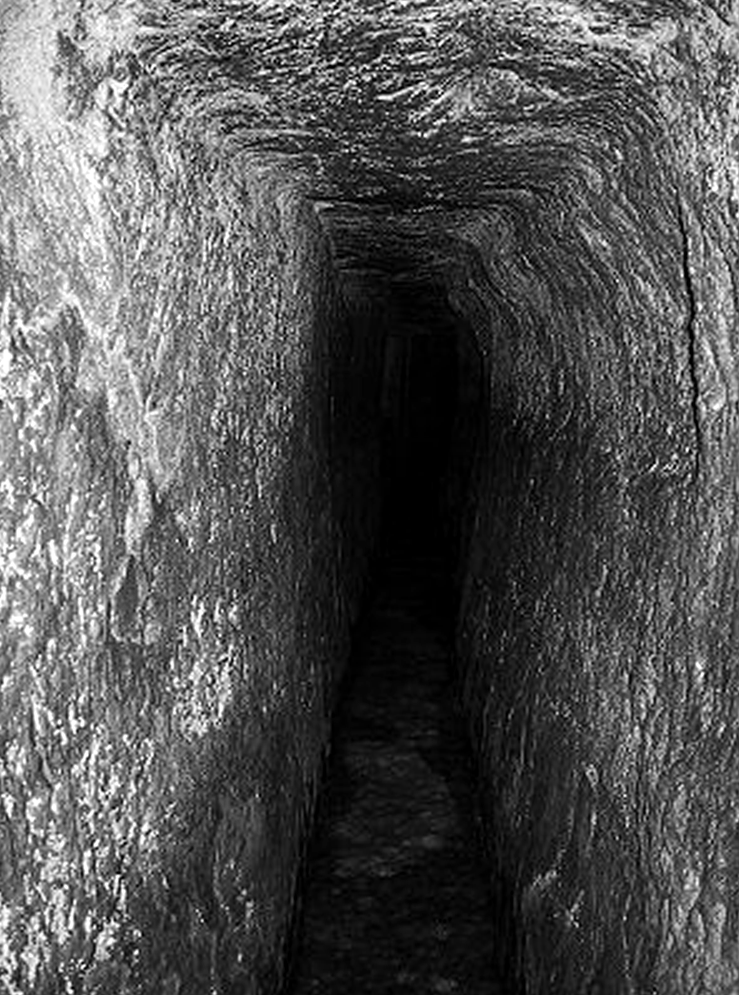
Deep inside Hezekiah’s Tunnel
MARTIN LUTHER
Luther found Psalm 46 to be a great encouragement for himself and the Reformers. Surely, God would be a strong refuge and strength for them in their current time of trouble, a battle against not merely fleshly armies but in the realm of spiritual warfare as they defended the Gospel.
One writer put it this way, “Almost everyone associates Martin Luther with the Book of Romans, particularly Romans 1:17, ‘The just shall live by faith.’ We tend to forget that Luther was converted not only by his study of Romans, but also by his study of the Psalms. Luther taught the Psalms for years and loved them very much, even late in life. His favorite was Psalm 46. It is said of Luther that there were times during the dark and dangerous periods of the Reformation when he was terribly discouraged and depressed. But at such times he would turn to his friend and co-worker Philip Melanchthon and say, ‘Come, Philip, let’s sing the forty-sixth Psalm.’ Then they would sing it in Luther’s own strong version … We know it as A Mighty Fortress Is Our God.”
PROPHETIC PROMISE
This Psalm has long-served as an inspiration. But what of the anti-type for us?
Psalms 46:1, The Assyrians were there outside the walls of Jerusalem. They were there because the Lord had brought them to execute judgment against Judah’s enemies. The sinful ten-tribe kingdom of Israel with its capital of Samaria had filled up the measure of its iniquities. All these enemies went off to captivity. The root cause of the trouble in this “Present Evil World” is the condemnation of our race. By nature we are “Children of wrath” as Paul declares in Ephesians 2:3. And though the sins of Judah were great, good king Hezekiah had sincerely turned his heart towards Jehovah and he harkened to the voice of the prophet Isaiah.
Because of this trust in Jehovah, in the floods of trouble that will close out this old order, God will be both our “refuge” and “strength.” For “In the LORD JEHOVAH is everlasting strength” (Isaiah 26:4). But these words, “in trouble,” have a special application to the trouble closing this age. This is a time of trouble which entirely changes the present construction of society.
The Assyrians were not wonderful people. They were cruel, bitter, impetuous, and rapacious. That God uses such instruments as his tools consistently surprises God’s people. For example, Habakkuk could not understand the judgment against Judah brought by Babylon. “Look ye among the nations, and behold, and wonder marvelously; for, behold, a work shall be wrought in your days, which ye will not believe though it be told you. For, lo, I raise up the Chaldeans, that bitter and impetuous nation, that march through the breadth of the earth, to possess dwelling-places that are not theirs” (Habakkuk 1:5,6, JPS). “Thou that art of purer eyes than to behold evil, and that canst not look on perverseness, wherefore lookest thou upon them that deal treacherously, and holdest thy peace when the wicked swalloweth up the man that is more righteous than he?” (Habakkuk 1:13).
This is not just a question, this is actually a challenge, as we learn from Habakkuk 2:1-2, “I will stand upon my watch and set me upon the tower, and will look forth to see what he will speak by me, and what I shall answer concerning my complaint. And Jehovah answered me, and said, Write the vision, and make it plain upon the tablets, that he may run that readeth it.”
Let us bring this down to our day. There are frequent communications, some from well-meaning brethren, with essentially the same “complaint.” Those who make trouble in the world are not nice people. Throughout the age there has been the query: Why, Lord, do you, “hold thy peace when the wicked swallows up the man that is more righteous than he?” What is the answer?
The only answer is to take refuge in Jehovah. By “refuge” we mean a rest of both faith and knowledge in God and our confidence in the “Divine Plan of the Ages.” God’s answer to Habakkuk’s question was not a rebuke of this perplexing question. “And Jehovah answered me, and said, Write the vision, and make it plain upon the tablets, that he may run that readeth it.”
Psalm 46:2. Because we have made the Lord our refuge and habitation, because we are anticipating Messiah’s Kingdom, because we know our redemption draws near – we do not fear. Rather, the saints rejoice and are restful of heart while others lament and weep. The trouble upon society will reach its intensity when the shaking of the heavens, ecclesiasticism and all its God-dishonoring errors, shall be removed.
A very early reprint, R511, suggests that Psalm 46 sets forth a complete picture of the seventh plague of Revelation. Governments, and every form of civil power that dominates society, are pictured by “the mountains” (A323). These are carried into “the midst of the sea,” that is, the lawless, ungovernable masses in an anarchy which will swallow up the false systems.
So important is it for us to understand this image that Psalm 46:3 explores it further. The image of troubled waters conveys the passions of the “infuriated” mass of mankind. This is indeed an uncontrollable sea, the faceless “masses” of mankind who individually are “drops in a bucket,” but collectively can swallow up mountains.
The response of mankind will not be to turn to the son, “to kiss the son” (Psalm 2:12), for healing. Neither new and stronger leaders or new and stronger extra-legal measures will succeed – though we expect these in the future, judging by prophecy and history.
Nicholas Murray Butler, President of Columbia University, won the Nobel Peace Price in 1928. In 1931, speaking to students, he said totalitarian regimes ascending in Russia, Germany, and Italy, were outpacing the plodding democratic response to the troubled financial and political issues of the day, bringing forth, “Men of far greater intelligence, far stronger character, and far more courage.” Mankind consistently makes the same mistakes. We study history because it also casts a light forward.
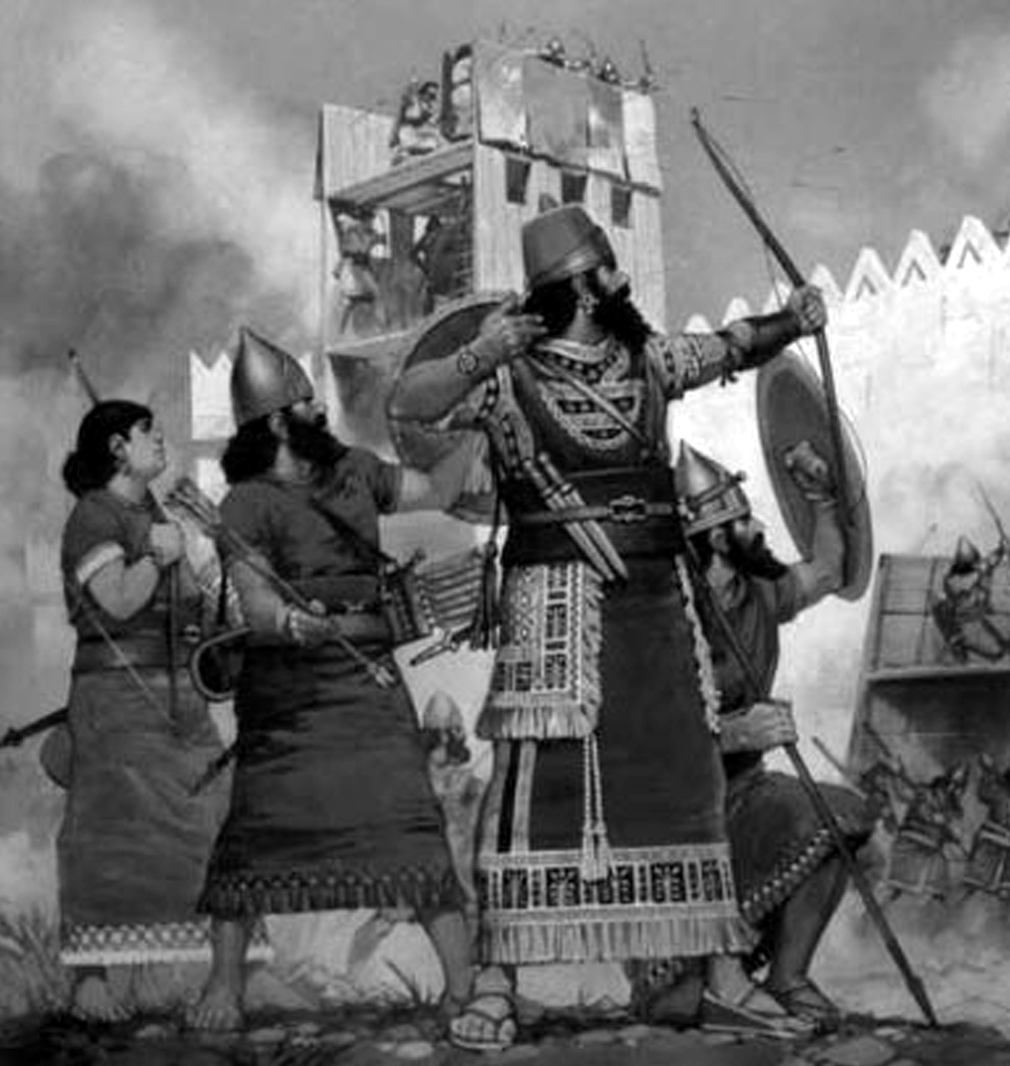
The Siege of Jerusalem
The ungovernable passions of society do not answer to any leader. Hence the image of the sea is meaningful in many ways. We as the Lord’s people recognize that these are retributive and purgatorial troubles that will make the settled parts of earth “Tremble for fear and insecurity” (R147O-89). As always in the trouble, there is a special test for the Lord’s people to see whether we are making God our refuge.
But as Psalm 46:4 notes, “There is a river.” This river of salvation and truth, hidden to others, sustains us through the siege of life. We are privileged to drink now. Some day these waters will flow forth from Jerusalem as the water of life during the Millennial age from the glorified New Jerusalem. Nor is it that we rejoice in our own security, regardless of the woes of others (R686).
The prophetic nature of this Psalm goes far beyond the Assyrian invasion during Hezekiah’s reign, for we are assured those made glad include, “the city of God, The holy place of the tabernacles of the Most High.” The reference is to tabernacles in the plural. Yet the promise of Revelation 21:3, “I heard a great voice out of the throne saying, Behold, the tabernacle (singular) of God is with men.”
“The holy place” is the Church, the Sanctuary. It is not the Kingdom set up and glorified, else it would be represented as in the Most Holy. This veiled reference to the Church’s present condition, combined with the reference to tabernacles in the plural, refers to the present condition of the saints.
Psalm 46:5-7 from the Leeser translation reads, “God is in her midst; she shall not be moved: God will ever help her, at the dawning of her morning. Nations rage, kingdoms are moved: he letteth his voice be heard, the earth melteth away. The Lord of hosts is with us; a defense unto us is the God of Jacob. Selah.”
“Her” and “she” refer to the Church, the Bride of Christ. When it says we “shall not be moved” (Psalm 46:5), this does not mean we are exempt from the shaking. Rather, it means that we are not moved by it. Earthquakes cannot dissolve the relationship that holds the Lord and his faithful through such upheavals. They are preserved by the peace of God ruling in their hearts. The outward turmoil does not endanger their spiritual interests.
The rubble from the shaken mountains (kingdoms) that is not tossed into the sea will “melt” away (Psalm 46:6) in the fervent heat of the day. Possibly it was this Psalm that the Apostle Peter had in mind when writing 2 Peter 3:9-13. But “there is no saint of God so weak as not to be able abundantly to stand, even in this evil day, if he is only loyal and faithful to God” (R1318).
THE MORNING
Psalm 46:5. “And that right early.” The morning brings with it deliverance from danger, victory over enemies, peace to the nations, and the renewal of earth, by the establishment of Messiah’s glorious throne. It was not until the morning that the work of the angel of death became apparent to the defenders in Jerusalem.
Ultimately this means restoration for Israel, thus the special reference to “the God of Jacob” (Psalm 46:7). Thereafter, the blessings of the kingdom will flow to all the earth. But in a special way, the dawning of her morning is to precede the Millennial morning.
CLOSING
The closing stanza of this Psalm, 46:8-11 (Leeser), says, “Come, look at the deeds of the Lord, who hath made desolations on the earth. He causeth wars to cease unto the end of the earth; he breaketh the bow, and cutteth the spear in pieces; he burneth wagons in the fire. Be still, and know that I am God: I will be exalted among the nations, I will be exalted on the earth. The Lord of hosts is with us; a defense unto us is the God of Jacob. Selah.”
The “desolations” of divine wrath are the necessary work of the physician who wounds only to heal, but the closing promise is, that wars will cease. Also, the word “chariots” is rendered by Leeser as “wagons,” supply wagons for the armies, to be burned in fire – perhaps judgment on mega-billionaire defense contractors when the “fire” of anarchy consumes these elements of the old order.
After all the human pride and boasting, the Lord says “Be still” (Psalms 46:1O). Desist from your former ways, O people. This is God’s message to babbling, clamorous, self-assertive humanity in the time of trouble. Out of the wild commotion of that stormy sea, God will bring order and peace. “Know that I am God, I will be exalted.”
– Bro. Richard Doctor