
The Sacred Elements of the Bread and the Wine
“Whoso eateth my flesh, and drinketh my blood, hath eternal life” (John 6:54).
Every year, consecrated followers of Jesus Christ gather to obey Jesus’ command, “This do in remembrance of me” (Luke 22:19). In this service, we share the sacred elements of bread and wine, symbolic of Jesus’ body and blood. We use the word “sacred” to describe them, but this is not understood to mean “sacraments” as the Catholic church defines them. Rather they are sacred in the sense of holy, set apart for specific use and meaning.
It is probable that Jesus selected bread and wine as emblems to be used in the Memorial celebration because of their frequent use in the Hebrew scriptures. This study will survey where these sacred elements are found and how they connect prophetically with our Memorial specifically — and with other parts of the Divine Plan.
BREAD AND WINE
The first occurrence in the Hebrew Scriptures where we have both emblems together is respecting King-Priest Melchizedek. Bread is mentioned earlier by itself. When Adam was expelled from the Garden of Eden, God said that by the sweat of your brow you will eat bread — but there is no wine mentioned there. Our interest is in the association of the two items, which are first mentioned together in Genesis 14:18.
“And Melchizedek, King of Salem, brought forth bread and wine, and he was priest of the Most High God.” Melchizedek is mentioned only one more time in the Hebrew Scriptures. “Jehovah hath sworn and will not repent. Thou art a priest forever after the order of Melchizedek” (Psalm 110:4).
These are the only two occurrences of this name, Melchizedek, in the Old Testament. Of course, in the book of Hebrews, the Apostle Paul refers to Melchizedek several times. That Melchizedek should be mentioned in Psalm 110 suggests that there is something special about this man. The Psalm addresses someone else and says of that person “thou art a priest.” Of whom is the psalmist speaking? Who is the priest? Clearly this is Jesus. This is a prophetic note, and it describes what kind of priest Jesus will be — a Priest after the order of Melchizedek!
When the Psalms were written, there was an Aaronic priesthood. But that is not the order of priesthood of which Jesus would be, for he was of the tribe of Judah, which is not the priestly tribe. Levi was the priestly tribe. So, there is something about the priesthood of Melchizedek that is particularly interesting.
On page 2 is a picture of Melchizedek meeting Abraham. Abraham is kneeling before Melchizedek and receiving the bread and wine from him. He and the King of Sodom had just come from a military rout of his enemies. These enemies had plundered the cities of Sodom and Gomorrah and taken “all the goods.” In addition, they had kidnapped Lot from Sodom. Abraham (Abram at the time) was a savior here, delivering Lot, and also taking back “all the goods” from the enemy’s possession. It was a grand victory (Genesis 14:13-16). The account also mentions that Abraham gave a tenth of the spoils to Melchizedek.
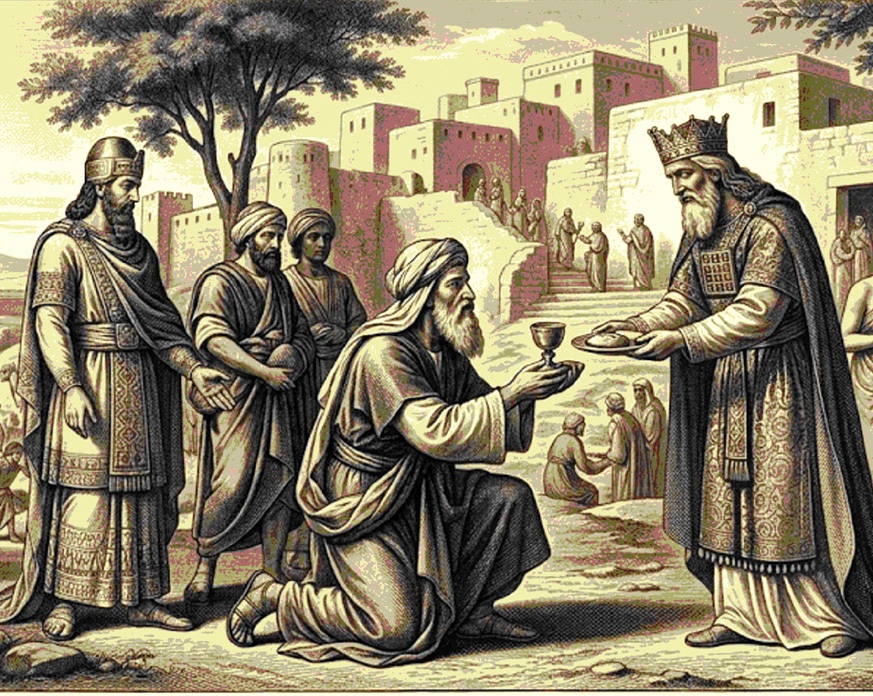
Abraham meeting Melchizedek in the Valley of Shaveh
MELCHIZEDEK KING OF RIGHTEOUSNESS
The Apostle Paul writes about Melchizedek at length in Hebrews 5, 6, and 7:15-17. Paul makes the identification of Melchizedek with Jesus very clear. The prophecy of Psalm 110 definitively shows that Melchizedek is a type of Jesus.
“What we say is yet more abundantly evident, if after the likeness of Melchizedek there ariseth another priest, who hath been made, not after the law of a carnal commandment, but after the power of an endless life: for it is witnessed of him, Thou art a priest for ever After the order of Melchizedek” (Hebrews 7:15-17).
The name, Melchizedek, itself is instructive. It is formed from two root words — “Melchi,” which means king, and “zedek,” which means righteousness. Thus, Melchizedek means “king of righteousness.” This is beautifully prophetic because it well describes our Lord Jesus. A righteous, perfect man in everything.
But there is more. Melchizedek was the king of Salem. “Salem” means peace. In fact, this city of Salem was the same city that later came to be called Jeru-salem, “city of peace.”
This word may be familiar if you have heard the Jewish greeting, “shalom.” This is a greeting of peace, and it is basically the same word as Salem. We are all acquainted with King Solomon. His name is another variation of the same word meaning peace.
These are wonderful connections, but so is the location of this meeting. “The king of Sodom went out to meet him, after his return from the slaughter of Chedorlaomer and the kings that were with him, at the vale of Shaveh (the same is the King’s Vale)” (Genesis 14:17 ASV).
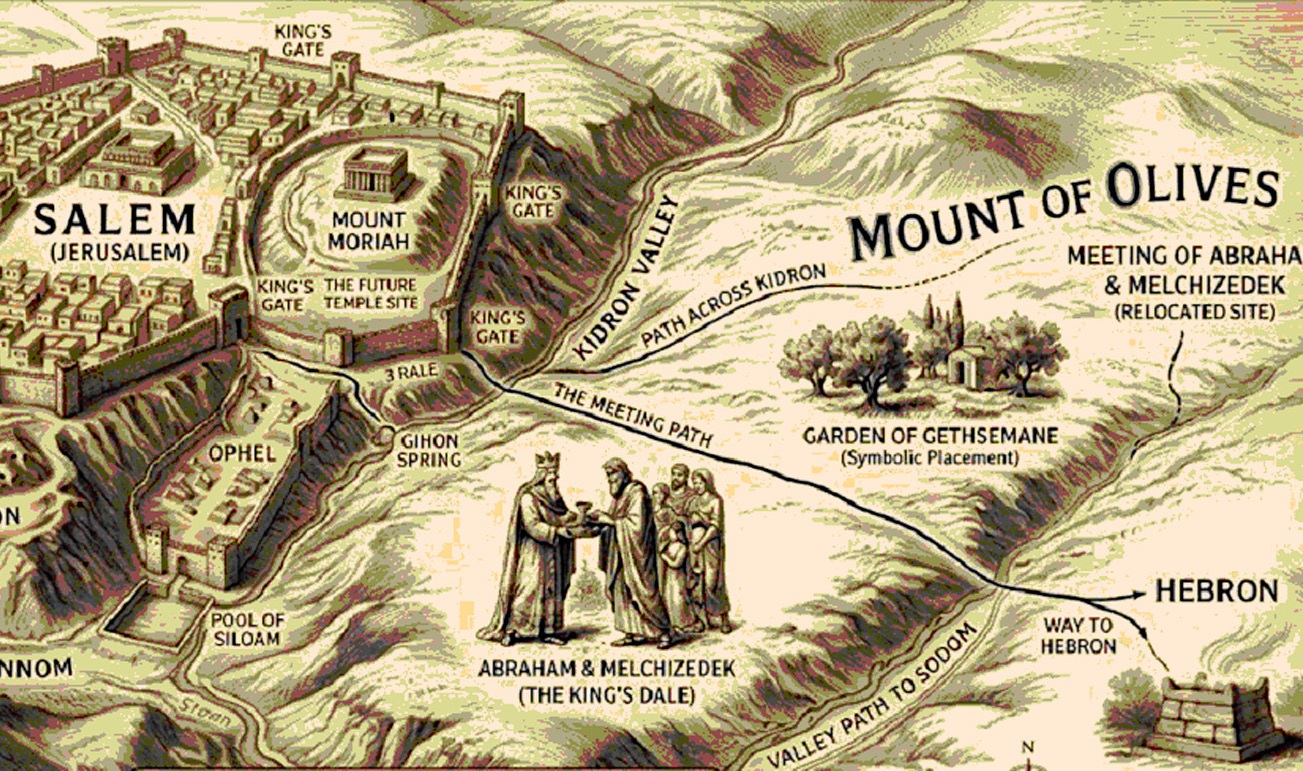
Ancient Salem and Vale of Shaveh
Where is this vale of Shaveh? The map illustrates the location. This valley of Shaveh is between the Mount of Olives and Jerusalem. Several references identify Shaveh with the Kidron Valley, east of Jerusalem. This is interesting and leads us to some other discoveries.
Who else, at a later time, traveled directly through this area? Jesus! Jesus crossed that same valley after the Last Supper, to travel to the garden of Gethsemane, which is on the Mount of Olives. Thus both Jesus and Melchizedek traveled the same path. “When Jesus had spoken these words, he went forth with his disciples over the brook Kidron, where was a garden, into which he entered, himself and his disciples” (John 18:1).
ABSALOM
Another who traveled across that same location, interesting from a prophetic standpoint, is King David. It was late in his reign when his son Absalom sought to take the Kingship.
Incidentally, Absalom means “father of peace.” Notice that “salom” at the end of his name, “peace.” Ab, like Abba, means “father.” Thus the meaning of the name is “father of peace.” Sadly, Absalom was far from a peaceful person.
Absalom determined to become king in place of his father (2 Samuel 15:10-12), and marched from Hebron to Jerusalem to usurp the throne. But there is another interesting detail here. Part of the strategy Absalom used to usurp David’s throne was to turn one of his father’s closest confidants against him. This was Ahithophel, a trusted counselor of King David who then betrayed him.
“David said unto all his servants that were with him at Jerusalem, Arise, and let us flee; for else none of us shall escape from Absalom: make speed to depart, lest he overtake us quickly, and bring down evil upon us, and smite the city with the edge of the sword” (2 Samuel 15:14).
Notice where David went. “All the country wept with a loud voice, and all the people passed over: the king also himself passed over the brook Kidron, and all the people passed over, toward the way of the wilderness” (2 Samuel 15:23).
John 18:1 notes that Jesus took the same path! Both Jesus and David, at the end of their lives, were betrayed by a close confidant and traveled out of Jerusalem and over the Kidron river!
These parallels are interesting because they reinforce the idea that God exercises oversight over all that happens through history since the sin of Adam. At no time had anything been out of control. The Heavenly Father puts these little parallelisms in to remind us of that.
Here are a few connections:
- Melchizedek is type of Jesus in his Kingdom.
- Melchizedek is a King-Priest which Jesus and the church will be in the Kingdom.
- Jesus will be a King of Righteousness and a King of Peace.
- “Bread” and “wine” are associated with both Melchizedek and Jesus.
- Jesus and Melchizedek were in or near the same city when the bread and wine were offered.
- The bread and wine from Melchizedek represented hospitality and refreshment coming after Abraham’s military victory. For Jesus, the bread and wine were emblematic of his upcoming death and resurrection victory which followed.
WHO IS THIS MAN MELCHIZEDEK?
He appears in the Genesis narrative one time. He is mentioned one other time in the Psalms. The Apostle Paul wrote about him rather mysteriously: “Without father, without mother, without genealogy, neither beginning of days nor end of life having been recorded, but having been made like unto the Son of God), abideth a priest continually” (Hebrews 7:3 RVIC).
What does this mean? Brother Russell was asked this question in the question book, page 485. “We do not understand him to mean that Melchisedek never was born or that he never died, but rather that as a priest he was typical, and that his priesthood did not come to him from his parents, as did the priesthood of Aaron which descended from one son to another, but that his priesthood was an original priesthood; he had no parents in this Melchisedek priesthood, and he had no children in this Melchisedek priesthood; his priesthood was without any beginning of time and without any ending of time; and thus he typified Christ whose priestly office as a priest of the new order of the Millennial kingdom is not a limited one, and does not come to him by heredity, nor pass from him to another. Thus Melchisedek was a type” (see also Photo-Drama of Creation, page 25).
THE FIRSTBORN BLESSING OF GRAIN AND NEW WINE
The next place where bread and wine are found is with Jacob. “God give thee of the dew of heaven, And of the fatness of the earth, And plenty of grain and new wine” (Genesis 27:28).
Here we understand “grain” to mean bread. Admittedly, grain is not bread, at least not yet. But what will grain be? It will become bread. Bread was a staple of life. Grain was overwhelmingly used to make bread. Consequently, we have the association here between grain and bread.
The context of Genesis 27:28 is Isaac giving the firstborn a formal blessing, evidently a patriarchal tradition. Isaac dispensed this blessing on the son he believed was Esau. Jacob had purchased the firstborn blessing from his brother Esau. It was a legitimate transaction, but Esau evidently forgot about it. Now came the time when Jacob wants to get this blessing. Rebekah his mother helped him, so he pretended to be Esau. But he is getting the firstborn blessing that was rightfully his.
Consequently, the promise of plenty of grain / bread and new wine, included in the firstborn blessing, suggests the blessing that Jehovah will give to his firstborn, Jesus, as well. “Whom he foreknew, he also foreordained to be conformed to the image of his Son, that he might be the firstborn among many brethren” (Romans 8:29). Thus, this firstborn blessing from Isaac, given to Jacob, was a picture of the blessing that Jesus would get and share with his brethren, the church.
JOSEPH — BREAD AND WINE
Our next example of bread and wine is in the life of Joseph. This one also is interesting because it is packed with lessons. The narrative begins at Genesis 40:1. “It came to pass after these things, that the butler of the king of Egypt and his baker offended their lord the king of Egypt.”
We have two ministers working for Pharaoh who in some unspecified way, offended him. It is never good to offend a king![1] “Pharaoh was wroth against his two officers, against the chief of the butlers, and against the chief of the bakers. And he put them in ward in the house of the captain of the guard, into the prison, the place where Joseph was bound” (Genesis 40:2, 3).
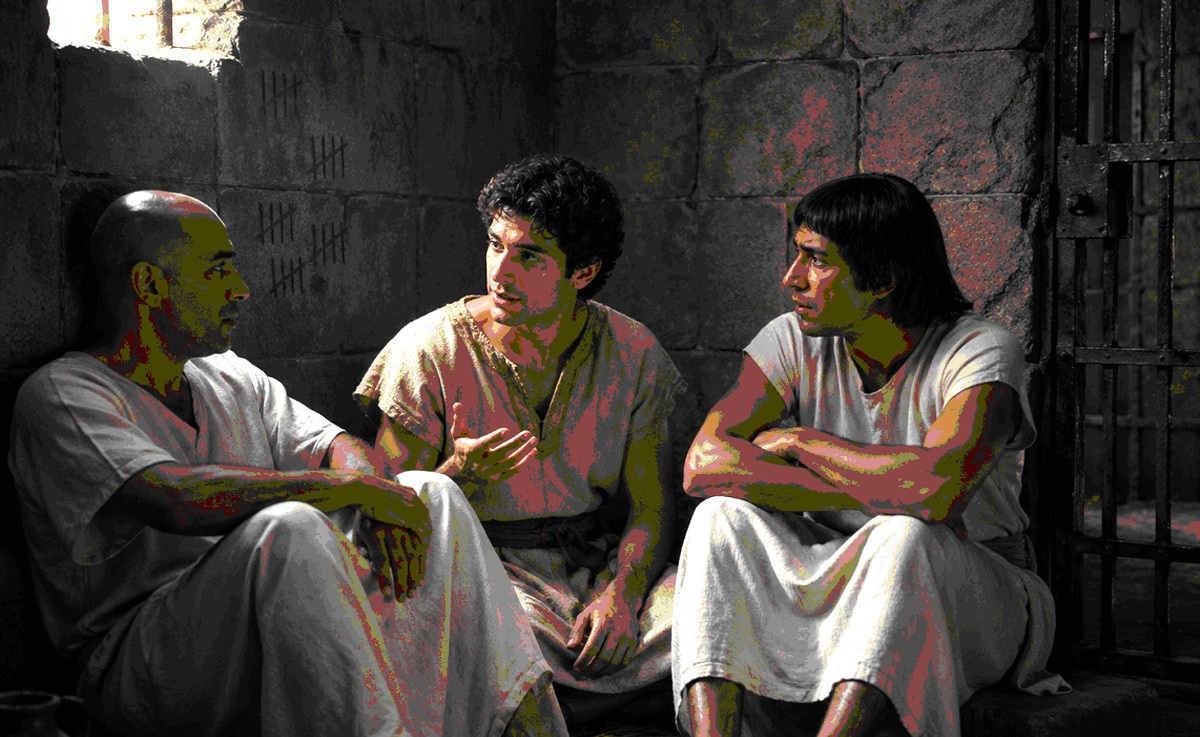
Joseph, the Baker, and the Wine bearer
What does a butler do for Pharaoh? Several translations render the word, “cup bearer.” Of course, it is a cup of wine. Consequently, the butler associates with wine. What does a baker do? He bakes Pharoah’s bread. Putting the two together, we have bread and wine! The Bible in Basic English translation characterizes it nicely. “After these things the chief servant who had the care of the wine, and the chief bread-maker in Pharaoh’s house, did something against Pharaoh’s orders.”
Thus, these two individuals are associated with bread and wine. These beautiful emblems, though hidden, reveal themselves with a little meditation. Joseph interpreted the dreams and told his prison mates what would happen to each of them.
Not long afterward, it transpired as Joseph prophesied. “He restored the chief butler unto his butlership again; and he gave the cup into Pharaoh’s hand: but he hanged the chief baker: as Joseph had interpreted to them” (Genesis 40:21). The butler, the wine bearer, was restored to his position. He lived. But the baker died. In this picture, bread is associated with death and wine with life.
Joseph is another type of Jesus Christ. Here are some more parallels that make it unquestionable.
- Joseph was falsely accused — Jesus was falsely accused.
- Joseph was put in prison — Jesus was put in prison and executed
- Joseph brought out of prison — Jesus was resurrected out of the prison house of death
- Joseph was given all power and authority in Egypt by Pharaoh — Jesus was given all power and authority by Jehovah God
Pharaoh still retained supreme authority. Joseph was number two. God always retains supreme authority. Again, a divine parallel to be seen.
What are the connections that we can make with the Memorial, since that is our focus, how bread and wine comes back to us? Jesus said, “I am the living bread which came down out of heaven. If any man eat of this bread, he shall live forever. Yea, and the bread which I give is my flesh for the life of the world” (John 6:51).
Relating Jesus’ words with the picture of Joseph, we understand the bread represents Jesus’ flesh, his human body. As this was given in death as a ransom for the world, it seems appropriate that the baker died. How did the baker die? “Within yet three days shall Pharaoh lift up the head off thee and shall hang thee on a tree” (Genesis 40:19). The baker was crucified. In fact, he is the first occurrence of a crucifixion in scripture. Isn’t that significant? Paul wrote in Galatians 3:13, “Christ redeemed us from the curse of the law, having become a curse for us. For it is written, cursed is everyone that hangeth on a tree.” So the parallel is striking. The baker is crucified and dies. Jesus, the bread from heaven, dies on a cross.
Contrastingly, the cup-bearer of Pharaoh’s wine lives. “Jesus, therefore, said unto them, verily, verily, I say unto you, except ye eat the flesh of the Son of man and drink his blood, ye shall not have life in yourselves. He that eateth my flesh and drinketh my blood hath eternal life, and I will raise him up at the last day” (John 6:53, 54).
LIFE IS IN THE BLOOD
Symbolically, blood is associated with life. “The life of the flesh is in the blood” (Levitucus 17:11). Blood is associated with life. Obviously, the spilling of blood is associated with death. But when Jesus died, he retained the value of his life because he died unjustly. He did not die for his own sin. He was put to death unjustly. But he retained ownership of the value of his life, he retained his human life-rights. Therefore, he could apply those life rights for the ransom of Adam and the whole human race. Jesus’ blood is life-giving! The cupbearer Lived.
Summing up this lesson, we can think of the cupbearer in connection with the wine and the blood of Christ, which gives life, and we can think of the baker in connection with the bread and the necessity of Jesus dying.
MORNING AND EVENING SACRIFICES – A SHADOW OF THE CRUCIFIXION
Another example of bread and wine is in connection with the Morning and Evening sacrifices. “This is that which thou shalt offer upon the altar: two lambs a year old day by day continually. The one lamb thou shalt offer in the morning; and the other lamb thou shalt offer at even” (Exodus 29:38-39).
The daily sacrifice under the law required that a lamb be sacrificed twice a day, in the morning and in the evening. When we see a lamb, we think about Jesus. “Behold, the Lamb of God.” But it is interesting to see what must accompany that daily sacrifice of a lamb. “Wth the one lamb a tenth part of an ephah of fine flour mingled with the fourth part of a hin of beaten oil, and the fourth part of a hin of wine for a drink-offering” (Exodus 29:40).
An ephah was about a bushel of dry measure and a hin of liquid measure was about a gallon, though some references make it up to a gallon and a half.[2] Along with the twice-daily sacrifice of a lamb, there is this additional meal offering. It consists of these three items:
- 1/10 of a ephah of fine flour
- 1/4 of a hin of beaten oil
- 1/4 of a hin of wine.
Bread can be made with flour and water, or with flour and oil, or with flour and oil and water. The specification here was flour and oil to make bread. However it was done, we have bread and wine, and that is the important part of the lesson here. Jesus, the Lamb of God, was slain, and in the evening before, he instituted the Memorial with bread and wine. All these items are part of the daily sacrifice. Some features of the daily sacrifice are astonishing in their parallels.
(1) The sacrifice was the lamb, representing Jesus. “Behold, the lamb of God,” John the Baptist said in John 1:29. (2) The morning sacrifice was made about 9 AM. Jesus was crucified on the third hour of the day = 9 AM (Mark 15:25). (3) The evening sacrifice was made about 3 PM. Jesus died at the ninth hour = 3 PM (Matthew 26:46-50).
Thus the morning and evening sacrifice prophetically describe the crucifixion of Jesus, the time he spent on the cross. The meal offering of the flour, oil, and wine connects us back to the memorial supper the previous evening.
ELIJAH AND THE PROPHETS OF BAAL
The lovely narrative in 1 Kings 18, about the contest between Jehovah and Baal, shows another interesting connection to our Lord’s crucifixion. At that contest there were 450 prophets of Baal. Elijah challenged them: “If Baal is God, have him call down fire out of heaven and consume the sacrifice.”
The Baal priests went first. They worked, and they worked, and they worked, and Baal did not respond. No fire from Baal came to consume the sacrifice.
By contrast, Elijah said a simple prayer to God, and not only did it consume the sacrifice, it consumed the altar and the stones and everything else. But notice the time when the sacrifice was consumed by Jehovah. “It came to pass at the time of the offering of the evening oblation, that Elijah the prophet came near, and said, O Jehovah, the God of Abraham, of Isaac, and of Israel, let it be known this day that thou art God in Israel, and that I am thy servant, and that I have done all these things at thy word. Hear me, O Jehovah, hear me, that this people may know that thou, Jehovah, art God, and that thou hast turned their heart back again. Then the fire of Jehovah fell, and consumed the burnt-offering, and the wood, and the stones, and the dust, and licked up the water that was in the trench” (1 Kings 18:36-38).
Elijah’s sacrifice was totally accepted by Jehovah God at 3:00 PM. This is the time of the evening offering, and the time of the slaying of the Passover lamb, and the exact same time that Jesus finished his course. Is it remarkable that we look at Scripture, and we see one parallel after another, after another? These things mesh together beautifully, reinforcing one another to build up our faith.
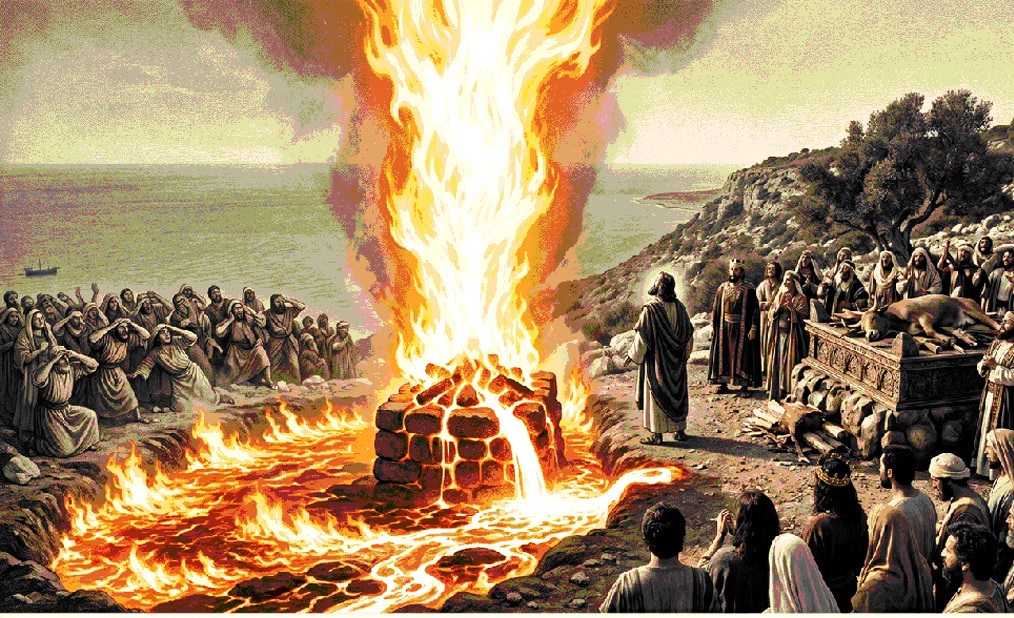
God responded to Elijah with fire from above.
OFFERING THE FIRST FRUITS OF THE BARLEY
The Law regarding the first fruits of the barley offering is in Leviticus 23. This chapter lists all the various festivals or gatherings required under the law. Leviticus 23:9-11 describes the offering of firstfruits of the barley harvest. “When ye are come into the land which I give unto you, and shall reap the harvest thereof, then ye shall bring the sheaf of the first-fruits of your harvest unto the priest: and he shall wave the sheaf before Jehovah, to be accepted for you: on the morrow after the sabbath the priest shall wave it.”
Note the day when this sheaf of barley was waved: the morrow after the Sabbath. After what Sabbath?
The previous verse describes the slaying of the Passover Lamb on the 14th. This is followed by the Feast of Unleavened Bread on day 15, which we are told was to be a Sabbath. So we conclude that the wave offering of barley must be on the 16th, the day after the Sabbath.
Now let us reflect upon the timing of Jesus’ death and resurrection. Jesus died on the 14th of Nisan at the same time the Passover Lambs were slain. We understand that to be Friday, April 3rd, 33 AD. The next day, Saturday, was the Sabbath. The morrow after the Sabbath was the 16th. What happened on the 16th of Nisan? Jesus was raised from the dead. This waving of the barley harvest represents the resurrection of Jesus, demonstrating the full acceptance by Jehovah, of his sacrifice.
This was a barley sheaf because Jesus was perfect, he was acceptable as is. There was another wave offering sometime later, representing the church. But it is not a sheaf of wheat. It is loaves baked with leaven. The church, when called from the world, is not acceptable as is. They are still part of the sinful, fallen race of mankind. So, they need to be prepared and cleaned. The blood of Christ, our justification, does this. Coupling this with the heat of trial, we have a group acceptable. The wave offering of the loaves represents this beautifully.
Looking at the elements of bread and wine, we find another meal offering made along with this waving of the barley harvest.[3] “In the day when ye wave the sheaf, ye shall offer a he-lamb without blemish a year old for a burnt-offering unto Jehovah. And the meal-offering thereof shall be two tenth parts of an ephah of fine flour mingled with oil, an offering made by fire unto Jehovah for a sweet savor; and the drink-offering thereof shall be of wine, the fourth part of a hin” (Leviticus 23:12, 13).
Again, accompanying the wave offering is a lamb, and flour and wine — bread and wine. How perfectly this describes the association between the waving of the barley and Jesus and fine flour and wine. The lesson is the same — bread and wine associated with redemption, in this case including the resurrection of our Lord as well, on Nisan 16.
FREEWILL OFFERINGS
The law of the meal offerings is a little more complicated. The details are numerous and important. This is found in Numbers 15:1-11.
“Jehovah spake unto Moses, saying, Speak unto the children of Israel, and say unto them, When ye are come into the land of your habitations, which I give unto you, and will make an offering by fire unto Jehovah, a burnt-offering, or a sacrifice, to accomplish a vow, or as a freewill-offering, or in your set feasts, to make a sweet savor unto Jehovah, of the herd, or of the flock; then shall he that offereth his oblation offer unto Jehovah a meal-offering of a tenth part of an ephah of fine flour mingled with the fourth part of a hin of oil: and wine for the drink-offering, the fourth part of a hin, shalt thou prepare with the burnt-offering, or for the sacrifice, for each lamb. Or for a ram, thou shalt prepare for a meal-offering two tenth parts of an ephah of fine flour mingled with the third part of a hin of oil: and for the drink-offering thou shalt offer the third part of a hin of wine, of a sweet savor unto Jehovah.”
“And when thou preparest a bullock for a burnt-offering, or for a sacrifice, to accomplish a vow, or for peace offerings unto Jehovah; then shall he offer with the bullock a meal-offering of three tenth parts of an ephah of fine flour mingled with half a hin of oil: and thou shalt offer for the drink-offering half a hin of wine, for an offering made by fire, of a sweet savor unto Jehovah. Thus shall it be done for each bullock, or for each ram, or for each of the he-lambs, or of the kids.”
Let us lay this out in a table for clarity.
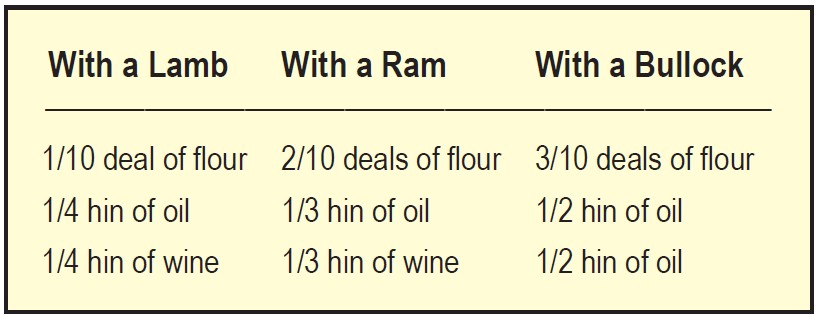
Here again are bread and wine. But what do the changes in the amounts of flour, oil, and wine represent?
We note first that this describes the offerings that the people bring of their own volition. These are free will offerings, different than the specified rituals of Leviticus 16 or the consecration of the priesthood. They are voluntary. As these are offering subsequent to the Day of Atonement, they typify offerings that the world makes during the Millennium.
We quote Brother Russell here and his application of these types of offerings. “Perfection will come gradually, and it will require the cooperation of the sinner’s will ever to reach it. He must do what he can to climb up again to perfection, and will have all the assistance necessary. This is shown by these sacrifices in general: they were to be according to every man’s ability. However degraded by sin and imperfect, each must, when he comes to a knowledge of the truth, present himself to God, the offering indicating his condition. The dove or pigeon brought by the poorest in the type represented the justified all of the morally poor and degraded; the goat offered by others more able, represented the all of some less degraded; while the bullock represented the all of those who had attained perfection of human nature.
“As a bullock was used to typify the perfect humanity (much fat) of Jesus’ sacrifice, and a goat (wayward and lean) was used to represent the imperfect human nature of the saints, in the sacrifices of this Atonement Day, so those animals similarly represented the offerers (Israel — typical of the believing world in the Millennium) in their consecrations. But it should be remembered that these burnt-offerings and peace-offerings of the future represent the people as consecrating — giving themselves to the Lord. They do not represent sin-offerings to secure atonement, as do the sacrifices of the Day of Atonement. There were indeed trespass-offerings which were in a sense sin-offerings for individuals; but these, as we shall see presently, were wholly different from the national sin offerings of the Atonement Day” (Tabernacle Shadows, pages 95, 96).
Brother Russell is saying that these general offerings represent the offerings of mankind in their various conditions of advancement toward human perfection.
OIL IN THE OFFERING
Reviewing the oil offering specified with each of the animal sacrifices:
With a Lamb: 1/4 hin of oil
With a Ram: 1/3 hin of oil
With a Bullock: 1/2 hin of oil
One hin of oil was used in the anointing of the high priest. Exodus 30:23-25. “Take thou also unto thee the chief spices: of flowing myrrh five hundred shekels, and of sweet cinnamon half so much, even two hundred and fifty, and of sweet calamus two hundred and fifty, and of cassia five hundred, after the shekel of the sanctuary, and of olive oil a hin. And thou shalt make it a holy anointing oil, a perfume compounded after the art of the perfumer: it shall be a holy anointing oil.”
Psalm 133 is a scripture we often use to describe this, both symbolically and actually. “Behold, how good and how pleasant it is for brethren together in unity. It is like the precious oil upon the head that ran down upon the beard, even Aaron’s beard that came down upon the skirts [or collar, ASV margin] of his garments.”
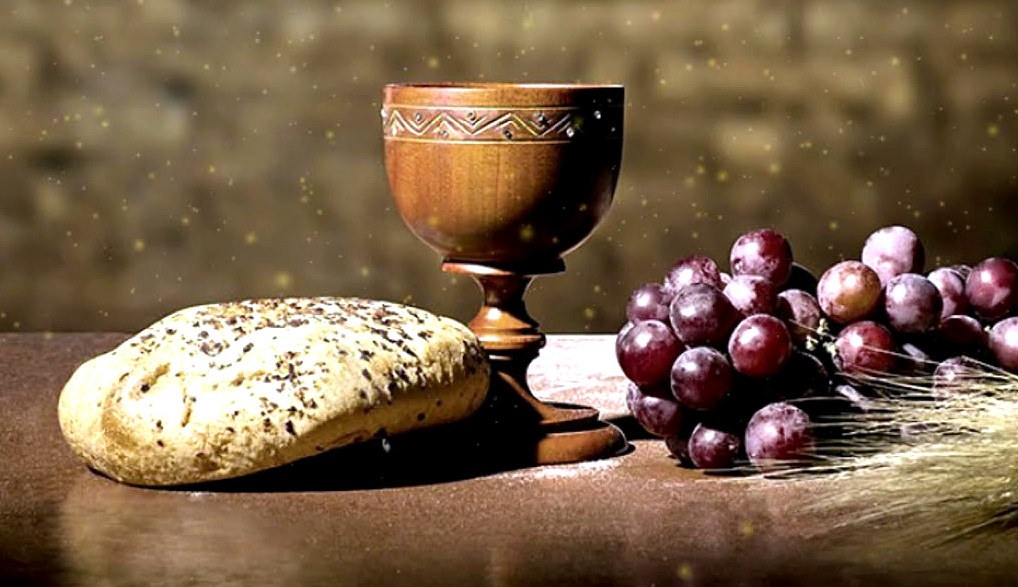
Jesus sacrifice is represented by the bread and cup.
In this type, the whole amount of oil, one hin, is poured upon Aaron’s head. The head received it all. The oil would flow down over his body, each part having less than was poured on his head. This is an exact and beautiful picture of our holy Spirit anointing. Jesus the head receives the full anointing, and we receive the anointing that comes from him.
But in the world to come, there will be another outpouring of holy Spirit also. “It shall come to pass afterward, that I will pour out my Spirit upon all flesh” (Joel 2:28).
Perhaps the amount of oil used on mankind is indicative of their progress toward human perfection, with the bul lock representing the final and perfect achievement. Remember Psalm 51:19, that we apply in the kingdom. Mankind will offer “bullocks,” plural, on the altar. A bullock is a type of perfect humanity. When mankind achieves perfection, they will be perfect humans as Jesus was.
One-half a hin of oil to accompany the offering of the bullock is 1/2 of the full hin, the amount of the high priest. Could this suggest the difference between the spiritual and earthly reward? One full hin upon Jesus spiritually, but one half a hin upon a bullock, a two-to-one ratio.
We see this spiritual /earthly ratio in a couple of other places. In the tabernacle, the Spiritual part is 10 cubits high. But the Court, representing the earthly condition, has a curtain 5 cubits high, one half the height of the Tabernacle walls.
We see this also in the Great Pyramid. The king’s chamber is at the 50th level. Where is the Queen’s chamber? At the 25th level.
Consequently, we suggest that the 1/2 hin of oil represents the achievement the holy Spirit brings every member of the human race that achieves earthy, human perfection.
FLOUR IN THE OFFERING
How about the amount of flour in the offering? The increments with lamb, ram, and bullock are 1/10 of deal, 2/10, and 3/10 respectively. Perhaps this suggests the progress toward perfection of each individual in the kingdom.
What is the minimum amount of time that anyone in the kingdom will be allotted to show progress? We get a number from Isaiah 65:20. “There shall be no more thence an infant of days, nor an old man that hath not filled his days; for the child shall die a hundred years old, and the sinner being a hundred years old shall be accursed.” Notice that 100 years is exactly 1/10 of the millennium of 1000 years. Could 2/10 also represent the amount of time to make intermediate, and 3/10 the time necessary to make perfection?
Brother Anton Frey in his Notes on the Tabernacle makes a very insightful suggestion. “If we are correct in this conjecture [i.e. 100 years is exactly 1/10 of the millennium is correct] then the “2/10” and “3/10” deals of flour may well represent 200 and 300 year periods of grace in which the “offerers” of the Millennial Age ought to be able to “offer” themselves as “rams” and “bullocks” respectively. It will not, yea, it ought not, require more than 300 years under conditions then prevailing, for one to attain unto a perfect humanity. But a perfect humanity does not necessarily imply the right to everlasting life; for not even the Ancient Worthies, though possessing perfect humanity, will have this right until after the trial at the end of the Millennial Age” (Anton Frey, Notes on the Tabernacle, page 478).
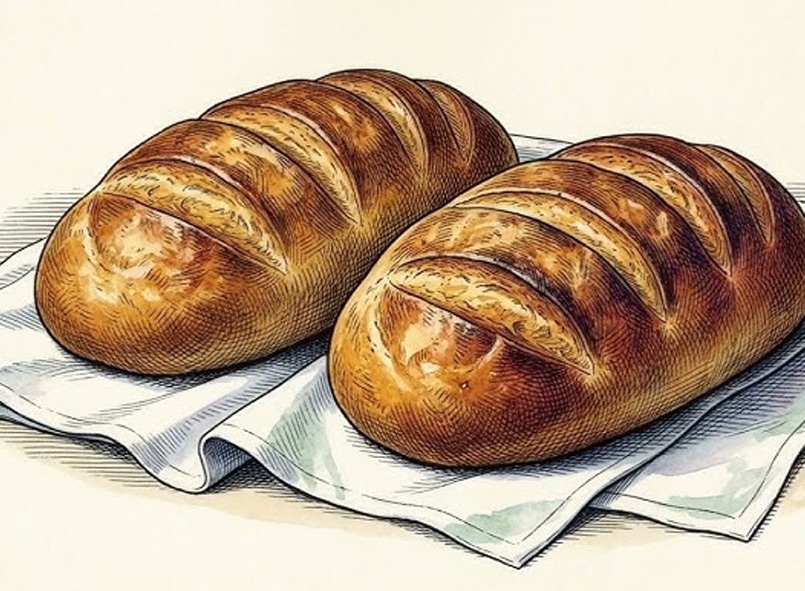
Two loaves of wheat bread, with leaven, offered at Pentecost
This is an interesting suggestion, that the 1/10, 2/10, 3/10, represent the amount of time necessary to achieve the perfection represented by a bullock.
ECCLESIASTES — BREAD AND WINE
One more beautiful text is found in Ecclesiastes. Here again we have the elements of bread and wine. “Go thy way, eat thy bread with joy, and drink thy wine with a merry heart; for God hath already accepted thy works. Let thy garments be always white; and let not thy head lack oil” (Ecclesiastes 9:7).
SUMMARY
With the Gospel Age church in mind, we can see the beautiful application of bread and wine.
- God accepts our works because of our Justification
- Our garments are White. We have the robe of Christ!
- We have the begettal of the holy Spirit. Our heads do not lack Oil.
- We have the wine of the kingdom, the blood of Christ, and the bread of truth which sanctifies us.
In summary, we have seen the following points and admonitions:
- Jesus, with a knowledge of how bread and wine appeared in the Hebrew scriptures, utilized these emblems to emphasize to us the power of these symbols.
- The bread and wine representing the body and blood of Jesus reminds us that every blessing that we have is due to his selfless sacrifice.
- We have been invited to follow his footsteps and lay our lives down every day for the Lord, the truth and the brethren.
- The truth should cost us something every day. Examine yourselves to make sure that you are rendering what has been promised.
- Never, never, never forget what Jehovah’s beloved son Jesus has done for us.
At the same time, there are applications for humanity in the kingdom. Our concluding text is found 1 Corinthians 11:22, 23. “I received of the Lord that which also I delivered unto you, that the Lord Jesus in the night in which he was betrayed took bread; and when he had given thanks, he brake it, and said, This is my body, which is for you: this do in remembrance of me. In like manner also the cup, after supper, saying, This cup is the new covenant in my blood: this do, as often as ye drink it, in remembrance of me.”
— Br. David Stein
[1] Editor note: Evidently, Pharaoh got a king-size bellyache. Who could be guilty?
[2] How much is a hin in the bible? – The holy script
[3] Editor’s note: Gideon also was associated with barley, Judges 7:13-14.