
The Return of Judah and Ephraim
The following is from Charles Burton (minister of All- Saints, Manchester), “Lectures on the Millennium, the New Heavens and New Earth,” London: Hamilton, Adams & Co., 1841, pages 61-62.
As to the historic fact of the return of some of the Ten Tribes, along with some of Judah and Benjamin, there is very scanty information. It was unnecessary that any particular mention should be made of the genealogies of the other tribes, as they were not concerned in the great thread of the Scripture history, which is handed down as a record of the lineal descent of Jesus Christ; enabling St. Matthew and St. Luke to make out the genealogy of our Lord and Saviour. But enough may be found to prove that representatives of the tribe of Ephraim, and of others of the Ten Tribes, returned with Zerubbabel, and Ezra, and Nehemiah.
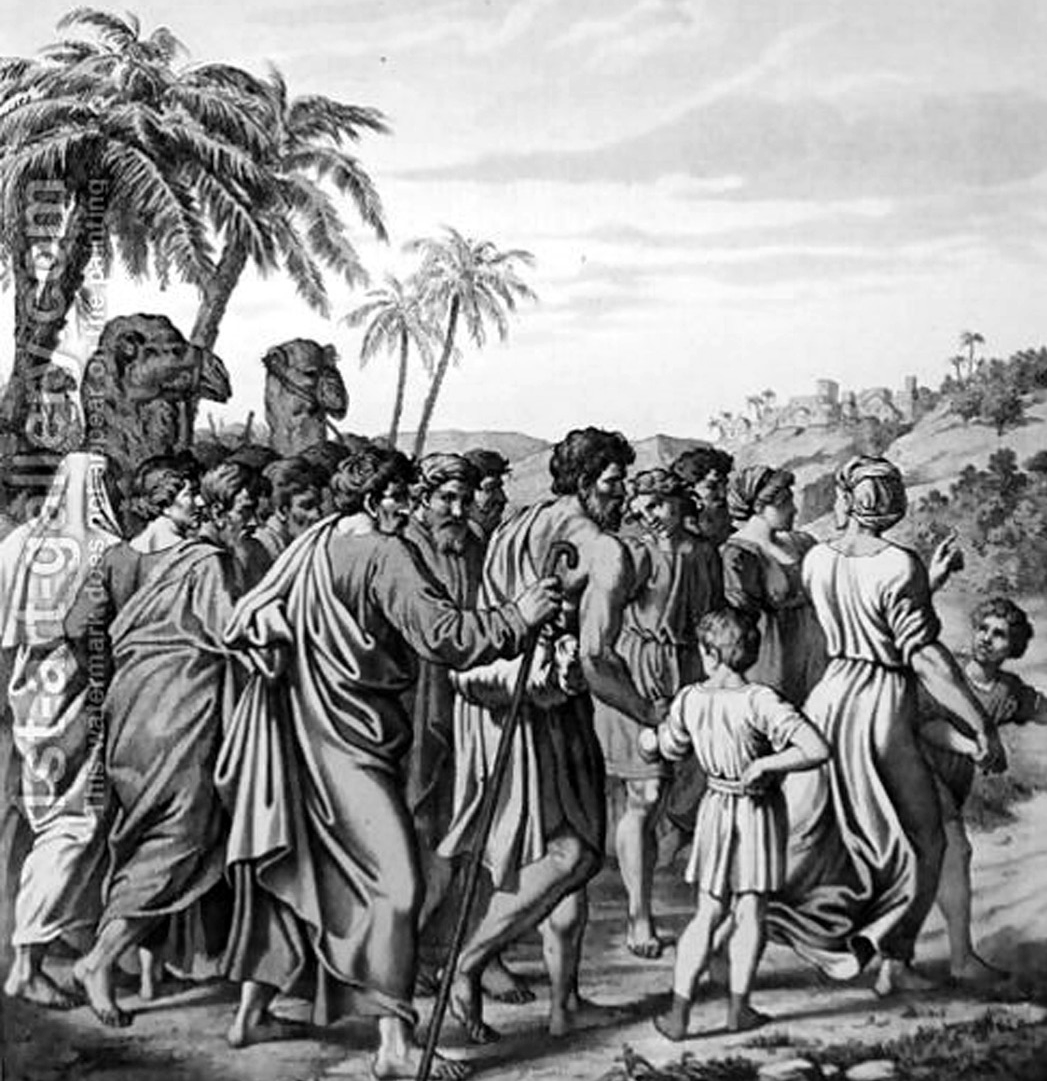
Israelites returning from Babylon in the days of Zerubbabel
I have carefully compared the lists of names and families given in the Chronicles and by Ezra, and discover that many companies, who returned at that time, belonged neither to the tribe of Judah nor of Benjamin. For example: the children of Parosh (in number 2172) belonged to the tribe of Manasseh; the children of Arah (775) belonged to the tribe of Asher; the children of Jorah (112) belonged to the tribe of Gad; the children of Nebo (52) belonged to the tribe of Reuben; the men of Michmash1 (122) belonged to the tribe of Ephraim, and to the same tribe the men of Bethel and Ai (223) (see 1 Chronicles 7:28). There appeared to be 33 companies.
The 33 belonged to the two tribes of Judah and Benjamin; and have shown that six companies did, really, belong to the other tribes of Israel; and of the remaining sixteen companies, classed by Ezra (chapter 2) as returning with Zerubbabel, no certain proof can be found, as far as I have been able to search the record, whether they belonged to Israel or to Judah.
The return of some from the tribe of Asher receives confirmation in Luke 2:36, “And there was one Anna, a prophetess, the daughter of Phanuel, of the tribe of Asher.” Arah’s descent from Asher is given in 1 Chronicles 7:30, 39-40, “And the sons of Ulla: Arah, and Hanniel, and Rizia. All these were the children of Asher, heads of the fathers’ houses, choice and mighty men of valor, chief of the princes.”
Ezra 2:1-5 records, “Now these are the children of the province, that went up out of the captivity of those that had been carried away, whom Nebuchadnezzar the king of Babylon had carried away unto Babylon, and that returned unto Jerusalem and Judah, every one unto his city; who came with Zerubbabel, Jeshua, Nehemiah. … The number of the men of the men of the people of Israel: … The children of Arah, seven hundred seventy and five” (Nehemiah 7:10 gives only 652 for the children of Arah).
(1) “Bethel and Michmash” are said in 1 Chronicles 7:28 to belong to the tribe of Ephraim; and in Nehemiah 11:31 they appear to have become the residence of such of the tribe of Benjamin as had returned from captivity. This discrepancy vanishes when you consider that, in the former instance, we have a proper statistical survey, taken before the captivity; and that Bethel and Michmash were situated just at the division of the territory of these tribes, and lay contiguous to Jerusalem. The residences of the different tribes, after the captivity, were not so particularly confined to their original possessions, appointed by Joshua, at the first division of the land. Many of Ephraim, and Manasseh, and others, dwelt at Jerusalem. Benjamin possessed Gilead. (Obadiah 19). Bishop Newcombe observes, “They who returned from Babylon were to extend ‘themselves everywhere.’ ”